1998 ISS rules
Looping Games · 2022
- Players
- 1–4
- Minutes
- 60–90
- Age
- 12+
Ask your question: I answer about this game’s rules.
The game in 30 seconds
Each player runs a space agency helping the International Space Station grow. You load shuttles with astronauts and materials, prepare modules, install compartments and carry out experiments to score points. Once the last Russian or US shuttle reaches its launch pad, the round is finished, everyone plays one more turn and points are counted.
A turn, in short
- If both shuttles are empty, put one of your material tokens in one of them.
- Optionally use an extra action you earned during an earlier launch.
- Place a cube on one of the 8 action cards and carry out that Earth or ISS action.
- Slide that cube onto the neighbouring module, then lower a loaded shuttle's countdown by 1 or 2.
- Any shuttle whose countdown hits zero launches right away.
How to win
- Most pointsScore installation tokens, external materials, your long-stay level, goals, different shuttles and completed experiments, minus unplayed experiments; the highest total wins. (p. 10)
Printable play aids
3 free A5 play aids for 1998 ISS, from the rulebook: step-by-step setup, a player aid for everyone, and the turn sequence.
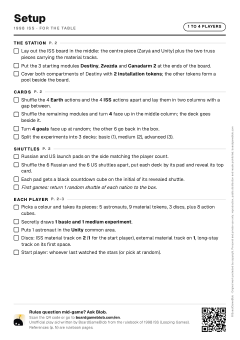 Setup
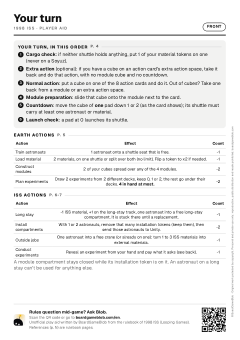 Player aid
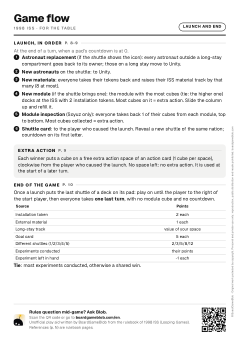 Game flow
The rules in questions
From the official rulebook by Looping Games. In parentheses: the rulebook’s page. How Blob answers
How does a game of 1998 ISS end?
When a launch leaves a Russian or US shuttle deck empty because its last card went to the pad, you finish the round up to the player right of the starting player, then everyone takes one final turn without placing cubes on modules or moving countdowns. (p. 10)
How are ties broken in 1998 ISS?
The tied player who completed more experiments wins. If they are still level, they share the victory. (p. 10)
Can you lower the countdown of an empty shuttle?
No. A shuttle needs at least one astronaut or material from some player aboard before its countdown can drop, which is why you must load a material token if both shuttles start your turn empty. (p. 4)
What happens to astronauts when a shuttle launches?
If the shuttle shows the replacement icon, every astronaut outside a long-stay compartment goes back to its owner, while long-stay astronauts return to the Unity common area. Any astronauts carried by the shuttle then arrive in Unity. (p. 8)
What is the maximum on the ISS material track?
Eight. If a launch would take you past that, you still get all your tokens back, but your disc stops at the limit. (p. 8)
How many experiment cards can I hold?
Four at most. Every experiment still unperformed at the end of the game costs you 1 point. (p. 5, 10)
Which module goes into orbit when a shuttle carrying a module launches, and who gets an extra action?
The module card with the most action cubes goes up; on a tie, take the highest one in the column. Players with the most cubes on that module earn an extra action, placing a cube on a free extra action space. (p. 8-9)
How do extra actions work, and do they move the countdown?
At step 2 of a later turn you may take back your cube from a card's extra action space and perform that card's action. You neither place a cube on a module nor lower any countdown with it. (p. 4, 9)
What is the difference between a long-term and a short-term task on an experiment?
For a long-term task your astronaut stays in the required free compartment. For a short-term task the astronaut only passes through the free compartment and goes straight to Unity; a question mark means any available compartment works. (p. 7)
How does the 1998 ISS solo mode work?
You play against FEDOR, a robot set up as a second player with only 4 astronauts and no goal cards. Each FEDOR turn, a flipped FEDOR card tells it which ISS action to take. (p. 11-12)
Common mistakes
- Lowering an empty shuttle's countdownNot allowed: the shuttle must carry at least one astronaut or material before its countdown cube can move. (p. 4)
- Placing a module cube with an extra actionAn extra action only gives the card's effect: no cube goes to the adjacent module and no countdown is lowered. (p. 4)
- Using an astronaut stuck in long stayA long-stay astronaut cannot move or take part in actions until a shuttle with the replacement icon launches. (p. 6, 8)
- Forgetting the inspection after a SoyuzEach Soyuz launch makes every player remove one of their cubes from each module; whoever removes the most gains an extra action. (p. 8)
What’s in the rulebook
See the 3 other parts
Tap a part and Blob explains it.
The game
- Players
- 1–4
- Length
- 60–90 min
- Age
- 12+
- Released
- 2022
- Designer
- Gerard Ascensi
- Publisher
- Looping Games
- Rules
- Official rulebook