7 Wonders rules
Repos Production · 2010
- Players
- 3–7
- Minutes
- 30
- Age
- 10+
Ask your question: I answer about this game’s rules.
The game in 30 seconds
You lead an ancient city through three Ages. Each turn, everyone picks one card from their hand at the same time, then passes the rest along. You use those cards to raise structures and the stages of your Wonder, buying missing resources from your two neighbors. Armies are compared after every Age, and after the third the highest score wins.
A turn, in short
- Secretly pick one card from your hand and set it face down in front of you.
- Everyone reveals at once: build that structure, tuck it under your board as a Wonder stage, or discard it for 3 coins.
- Pass the remaining cards on: to the left in Ages I and III, to the right in Age II.
- After six turns, compare your shields with each neighbor and collect Conflict tokens.
How to win
- Most pointsAfter Age III, add up conflicts, coins, Wonder, blue, green, yellow and purple cards. The best total wins. (p. 6)
- TieThe richer tied player in coins takes the win; an equal coin count leaves the tie unbroken. (p. 6)
Printable play aids
4 free A5 play aids for 7 Wonders, from the rulebook: step-by-step setup, a player aid for everyone, the turn sequence, and a quick reference.
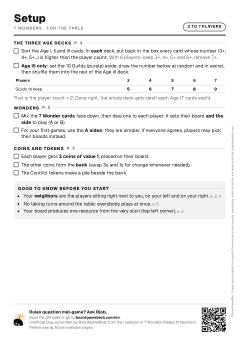 Setup
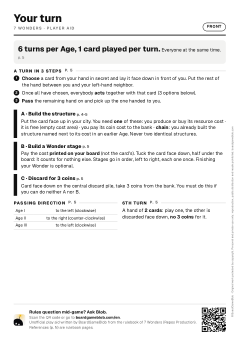 Player aid
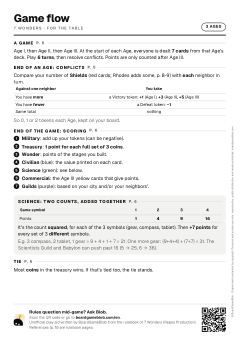 Game flow
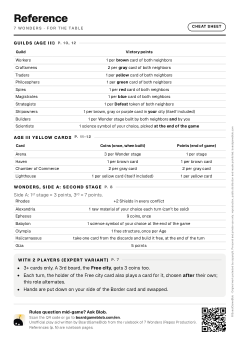 Reference
The rules in questions
From the official rulebook by Repos Production. In parentheses: the rulebook’s page. How Blob answers
How many coins do you start with in 7 Wonders?
Each player starts with 3 coins of value 1, placed on their board. All other coins form the bank, where you can swap 1s and 3s whenever needed. (p. 3)
How are ties broken in 7 Wonders?
The tied player holding the most coins wins. If they also have the same number of coins, the tie stands and is not broken any further. (p. 6)
How much does it cost to buy a resource from a neighbor?
You pay 2 coins per resource to the neighbor who produces it, or 1 coin with a discount card such as a trading post or the Marketplace. Neighbors cannot refuse, and they keep using that resource themselves. (p. 4, 12)
Can I buy any resource my neighbor produces?
No. Only the starting resource printed on their board and what their brown and gray cards produce can be bought. Resources from some yellow cards and some Wonder stages are kept for the owner alone. (p. 4)
Can I spend coins earned from trade on the same turn?
No. You must already hold the coins when the turn begins; money a neighbor pays you during a turn only becomes usable for buying from the next turn on. (p. 4)
Can you build two copies of the same card in your city?
Never. A city may not contain two structures sharing the same name and illustration. (p. 5)
What happens to the last card in each Age of 7 Wonders?
On the sixth turn you get two cards: play one and discard the other face down, with no coins for it. Side B of Babylon's second stage lets you play that seventh card instead. (p. 5, 9)
How does military conflict scoring work at the end of each Age?
Compare your shield total with each neighbor separately. Higher earns a Victory token worth +1, +3 or +5 depending on the Age; lower gives a -1 Defeat token; a tie gives nothing. (p. 5)
How do you score the green science cards, for example with 3 compasses, 2 tablets and 1 gear?
Each symbol family scores its count squared, and every set of three different symbols adds 7 points, both methods added together. That example gives 9 + 4 + 1 + 7 = 21 points. (p. 6)
How do you play 7 Wonders with only 2 players?
Use the 3+ cards and a neutral third board called the Free city. Each turn, the player holding the Free city card draws an extra card and plays one for the Free city after choosing their own; this role alternates. (p. 7)
Common mistakes
- Thinking resources get used up when you buildYour production is never spent: the same resources are available again every turn for the whole game. (p. 4)
- Building Wonder stages out of orderStages go strictly left to right, each only once, and they are not tied to the Ages at all. (p. 5)
- Paying for a card you could chain for freeIf you built the structure named on the card during an earlier Age, you place it without paying its resource cost. (p. 4)
- Earning coins for the unplayed sixth-turn cardThe card you do not keep on the last turn of an Age is simply discarded, with no 3 coins. (p. 5)
What’s in the rulebook
See the 3 other parts
Tap a part and Blob explains it.
Expansions
The game
- Players
- 3–7
- Length
- 30 min
- Age
- 10+
- Released
- 2010
- Designer
- Antoine Bauza
- Publisher
- Repos Production
- Expansions
- 4
- Rules
- Official rulebook