Brian Boru: High King of Ireland rules
Osprey Games · 2021
- Players
- 3–5
- Minutes
- 60–90
- Age
- 14+
Ask your question: I answer about this game’s rules.
The game in 30 seconds
A trick-taking and area-majority game set in Ireland around the year 1000. Each card you play either takes a town if you win the trick or grants a consolation action if you lose: coins, fighting Vikings, church support or progress towards a marriage. After three or four rounds, the highest score wins.
A turn, in short
- Preparation: reveal a Viking card to fill the battle area, then the round's marriage card.
- Draft: keep two cards from your hand and pass the rest left, until every card is chosen.
- Action: play tricks on the active town; the winner takes it, losers use a bottom action.
- Upkeep: resolve the marriage, the battle against the Vikings, the church, then region claims.
How to win
- Most pointsAfter the final marriage card, add coins, the active town marker, renown, claim tokens and regions occupied; the top total wins. (p. 10)
- TiebreakersMore claim tokens first, then more marriage cards; otherwise the victory is shared. (p. 10)
Printable play aids
3 free A5 play aids for Brian Boru: High King of Ireland, from the rulebook: step-by-step setup, a player aid for everyone, and the turn sequence.
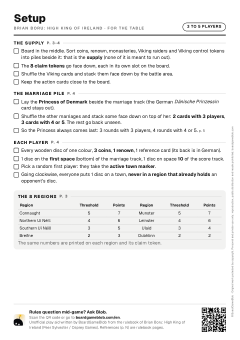 Setup
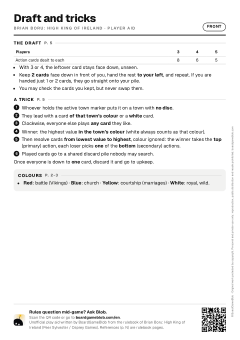 Player aid
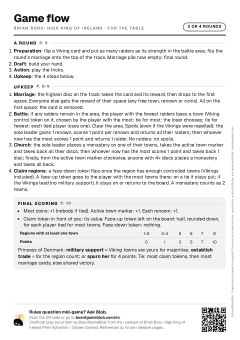 Game flow
The rules in questions
From the official rulebook by Osprey Games. In parentheses: the rulebook’s page. How Blob answers
How many rounds does Brian Boru last?
Three rounds with three players and four rounds with four or five. The marriage deck sets this: two or three cards sit on top of the Princess of Denmark, and the round where the last one is revealed is the final round. (p. 4, 5)
Who wins a trick in Brian Boru?
The highest card in the active town's colour wins; white royal cards are wild and count as that colour. A card of another colour can never win, however high its value. (p. 5)
Do I have to follow suit in Brian Boru?
Only the player who placed the active town marker must lead a card matching the town's colour or a white card. Everyone else may play anything, with no need to match colour or value. (p. 5)
In what order are card actions resolved after a trick?
From the lowest card value to the highest, whatever the colour. The winner uses the top (primary) action; each loser picks one bottom (secondary) action. (p. 5, 7)
What happens if I land on a space of the marriage track that someone else occupies?
Once your action is fully resolved, you slide down until you reach an empty space or the first space. Spending two more coins to climb one extra space can avoid this. (p. 6, 7)
If several players tie for fewest Viking raider tokens in the battle step, who loses a town?
Every tied player has a town taken by the Vikings. Normally the player with the most raiders picks the town, but if that top spot is also tied, the losers choose their own town. (p. 9)
Does a monastery count as two towns when claiming regions?
Yes. A town with a monastery counts double both for reaching a region's threshold and for deciding who has the most towns there. A town can hold only one monastery. (p. 9)
If two players tie for most towns in a region, who keeps the claim token?
Nobody takes it: the token stays where it is, on the board or with its current owner. At game end, a face-up token left on the board gives tied leaders half its value, rounded down. (p. 9, 10)
Should I choose military support or establish trade with the Princess of Denmark?
Military support makes Viking towns count as yours for claiming regions and for face-up tokens left on the board. Establish trade only counts them for the number of regions you are in. You may instead discard her for 4 points. (p. 8, 10)
How are ties broken at the end of Brian Boru?
The tied player holding more claim tokens wins. If still tied, compare marriage cards; if that is also equal, the victory is shared. (p. 10)
Common mistakes
- Thinking the highest card always winsOnly cards in the active town's colour, or white royal cards, can win. A yellow 17 loses on a red town. (p. 5, 7)
- Resolving actions starting with the winnerActions go from the lowest value played upwards, winner included, which affects the coins each player has when acting. (p. 5)
- Staying on an occupied marriage spaceAfter your action, if you share a space, you move down to a free space or to the first space. (p. 6)
- Taking a claim token on a tieWhen players tie for most towns, the token does not move: it stays with its holder or on the board. (p. 9)
What’s in the rulebook
Tap a part and Blob explains it.
The game
- Players
- 3–5
- Length
- 60–90 min
- Age
- 14+
- Released
- 2021
- Designer
- Peer Sylvester
- Publisher
- Osprey Games
- Rules
- Official rulebook