Carpe Diem rules
alea · 2018
- Players
- 2–4
- Minutes
- 45–75
- Age
- 10+
Ask your question: I answer about this game’s rules.
The game in 30 seconds
In ancient Rome you develop your own city district by laying tiles: villas, landscapes, dwellings, markets, bakeries and fountains. Every edge must match its neighbors, and finishing a building or landscape usually earns an instant bonus. The game runs over four phases of seven rounds, each followed by a scoring period, then a final scoring decides the winner.
A turn, in short
- Move your meeple along a black line to either of the two facing semi-circular spaces.
- Take one building tile from the blueprint space next to it.
- Add it to your district with every edge matching, or store it face down on your overview board.
- Collect the bonus for any landscape, dwelling, market, bakery or fountain you just finished.
How to win
- Most victory pointsAfter the fourth scoring, a final count adds completed villas, stored items, banderole position, fountain cards and frame goals. The highest total wins. (p. 11-12)
- TiebreakerAmong tied players, whoever is furthest behind on the banderole bar wins. (p. 12)
Printable play aids
3 free A5 play aids for Carpe Diem, from the rulebook: step-by-step setup, a player aid for everyone, and the turn sequence.
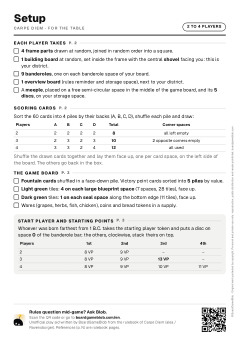 Setup
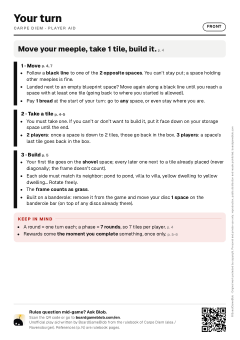 Player aid
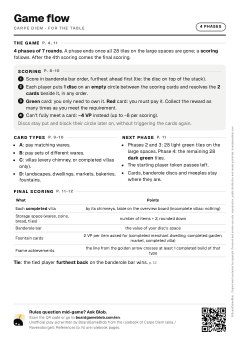 Game flow
The rules in questions
From the official rulebook by alea. In parentheses: the rulebook’s page. How Blob answers
How many scoring cards are used in Carpe Diem for 2, 3 or 4 players?
Two players use 8 cards (two of each letter), three players use 10 (2 A, 3 B, 2 C, 3 D) and four players use 12 (3 A, 3 B, 2 C, 4 D). With two, the corner spaces stay empty; with three, two opposing corners do. (p. 2)
How many victory points does each player start with?
The starting player begins with 8 points, the next player with 9, and in a four-player game the others get 10 and 11. Three players are the exception: the third player starts with 13. (p. 3)
Where can my meeple move on my turn?
It must travel along a black line to either opposite semi-circular space, even if another meeple is there. Paying one bread at the start of your turn lets you go anywhere, or stay put. (p. 4, p. 7)
What happens to a tile I take but can't or don't want to place in my district?
You still have to take a tile; if you don't build it, it goes face down on your overview board's storage space until the end. Each two stored items are worth one point at the final scoring. (p. 4, p. 11)
Do tiles left on the board get removed in 2- and 3-player games?
Yes. With two players, once a space's second tile is taken, its two remaining tiles go back to the box. With three, the last tile on a space is removed as soon as the one before it is picked. (p. 5)
How many wares does a completed landscape give?
You receive one ware fewer than the number of tiles in the landscape, once, when it is completed. A finished three-tile pond therefore gives you two fish. (p. 6)
What happens in Carpe Diem if I can't meet a scoring card's requirement during a scoring period?
You earn nothing from that card and lose 4 victory points instead, keeping whatever you could not fully pay. Since your disc triggers two cards, a single scoring can cost you up to 8 points. Coins and three bread can help fill a gap. (p. 10)
Who scores first after each phase, and how are ties on the banderole bar broken?
The player furthest along the banderole bar places a disc first; if several share a space, the disc on top goes first. Each player places one disc on an empty circle, triggering both neighboring cards. (p. 8)
How do frame achievements work at the end of the game?
Each golden arrow on your frame shows a building or landscape type. Trace an imaginary line from it across your district: if it crosses at least one completed item of that type, you score that goal once. (p. 12)
Who wins a tie in Carpe Diem?
Among the tied players, the one furthest behind on the banderole bar wins. (p. 12)
Common mistakes
- Placing a tile with a mismatched edgeEvery side must show the same thing as the tile it touches. The frame counts as grass, so only grass edges may sit against it. (p. 5)
- Starting the district anywhereYour very first tile goes on the shovel space in the center. Later tiles must touch an existing tile orthogonally. (p. 5)
- Forgetting the scoring card penaltyEach triggered card you cannot fully satisfy costs you 4 victory points instead of paying out. (p. 10)
- Leaving your meeple where it isYour meeple must move every turn. Only spending a bread at the start of your turn lets you go anywhere or stay. (p. 4, p. 7)
What’s in the rulebook
See the other part
Tap a part and Blob explains it.
Expansions
The game
- Players
- 2–4
- Length
- 45–75 min
- Age
- 10+
- Released
- 2018
- Designer
- Stefan Feld
- Publisher
- alea
- Expansions
- 1
- Rules
- Official rulebook