Cascadia rules
AEG · 2021
- Players
- 1–4
- Minutes
- 30–45
- Age
- 10+
Ask your question: I answer about this game’s rules.
The game in 30 seconds
You build your own corner of the Pacific Northwest by laying hexagonal habitat tiles and placing animals on them. Five scoring cards, one per species, tell you how to arrange bears, elk, salmon, hawks and foxes for points. Large connected areas of each habitat score too. After 20 turns each, the highest total wins.
A turn, in short
- Check the four wildlife tokens on offer: four alike are redrawn automatically, three alike may be redrawn once.
- Take one of the four tile and token pairs, or spend a nature token to mix any tile with any token.
- Add the tile next to your existing tiles, then put the animal on any empty tile showing that species, or return it to the bag.
- Refill the empty spots with a tile from the stacks and a token drawn from the bag.
How to win
- Most pointsAdd up the five wildlife cards, your biggest corridor in each habitat, majority bonuses and unused nature tokens. (p. 8-9)
- TiebreakThe tied player holding more nature tokens wins; if still level, the victory is shared. (p. 9)
Printable play aids
4 free A5 play aids for Cascadia, from the rulebook: step-by-step setup, a player aid for everyone, the turn sequence, and a quick reference.
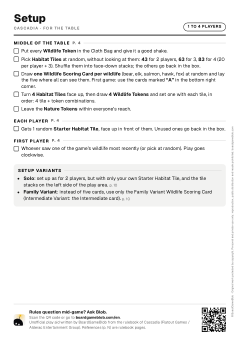 Setup
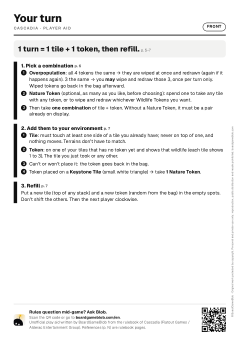 Player aid
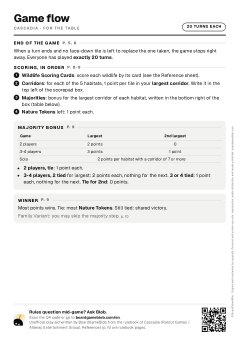 Game flow
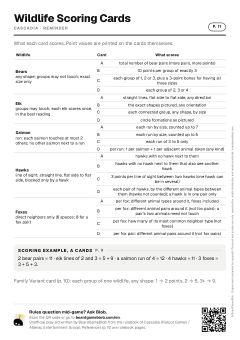 Reference
The rules in questions
From the official rulebook by AEG. In parentheses: the rulebook’s page. How Blob answers
How many habitat tiles do you use with 2, 3 or 4 players?
Randomly pick 43 tiles for 2 players, 63 for 3 and 83 for 4, without looking at them; that is twenty per player plus three. The rest go back in the box. (p. 4)
When does a game of Cascadia end?
It ends as soon as a turn finishes and no face-down habitat tile remains to refill the display. By then everyone has taken exactly 20 turns, and you move on to scoring. (p. 8)
What happens when 3 or 4 of the wildlife tokens on offer are the same animal?
Four identical tokens are always swept away and redrawn, which can repeat in a single turn. With three alike, the active player may choose to redraw just those three, once per turn. Wiped tokens return to the bag afterwards. (p. 6)
What can you do with nature tokens?
Before choosing, spend one to take any tile with any token, or to replace as many wildlife tokens as you like. You can spend several per turn, and each one left at the end is worth 1 point. (p. 6, p. 8)
How do you earn a nature token?
Place a wildlife token on a keystone tile showing that animal. Spend it on a later turn or keep it for 1 point at the end. (p. 7, p. 8)
Do you have to put the wildlife token on the tile you just took?
No. It can go on any of your tiles that has no token yet and shows that animal. If none fits, or you would rather not place it, the token goes back into the bag. (p. 7)
Do habitat edges have to match when you place a tile?
No. A new tile only needs to touch at least one tile already in your environment, and placed tiles never move or stack. Matching terrain simply helps you build bigger corridors for scoring. (p. 7)
How are the habitat majority bonuses scored in a 3 or 4 player game, including ties?
The largest corridor of each habitat earns 3 bonus points and the second largest 1. Two tied for largest get 2 each; three or four tied get 1 each, and then nobody scores second place. A tie for second gives nothing. (p. 9)
In the solo game, what happens to the display after each turn?
Before refilling, remove from the game the tile and token farthest from the draw stacks, slide the remaining two pairs away from the stacks, then draw two new tiles and two new tokens. (p. 10)
Can two groups of bears touch each other?
No. Bear groups can take any shape, but separate groups must never be adjacent, and each group needs exactly the number of bears the card asks for to score. (p. 11)
Common mistakes
- Placing the animal only on this turn's tileThe token can go on any of your empty tiles that shows its species, not just the one you picked up this turn. (p. 7)
- Letting two bear groups touchSeparate bear groups must never be adjacent, and each needs exactly the size printed on the card to count. (p. 11)
- Sliding the market after a pickIn multiplayer you just fill the empty spaces and leave the other tiles and tokens where they are. Only solo mode shifts the display. (p. 7, p. 10)
- Counting one elk in two formationsElk groups may sit next to each other, but every elk scores only once. Split connected elk in whatever way earns the most. (p. 11)
What’s in the rulebook
See the 7 other parts
Tap a part and Blob explains it.
Expansions
The game
- Players
- 1–4
- Length
- 30–45 min
- Age
- 10+
- Released
- 2021
- Designer
- Randy Flynn
- Publisher
- AEG
- Expansions
- 1
- Rules
- Official rulebook