Catan rules
Kosmos · 1995
- Players
- 3–4
- Minutes
- 60–120
- Age
- 10+
Ask your question: I answer about this game’s rules.
The game in 30 seconds
You settle an island of hexes that produce brick, lumber, wool, grain and ore. Each turn the dice decide which hexes pay out to the settlements and cities touching them. You trade, build roads, settlements and cities, and buy development cards. The first player to have 10 victory points on their own turn wins.
A turn, in short
- Roll both dice: every hex showing that total gives its resource to each adjacent settlement and city.
- Trade with the other players or with the bank, using a harbor if you control one.
- Build roads, settlements or cities and buy development cards, then pass the dice to your left.
- You may play one development card at any moment of your turn, even before rolling.
How to win
- 10 victory pointsReach 10 points on your turn from settlements, cities, victory point cards, Longest Road and Largest Army. (p. 5, 14)
Printable play aids
4 free A5 play aids for Catan, from the rulebook: step-by-step setup, a player aid for everyone, the turn sequence, and a quick reference.
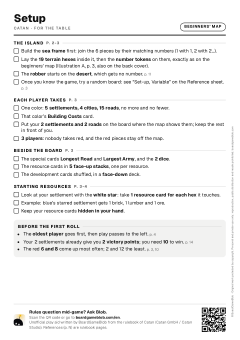 Setup
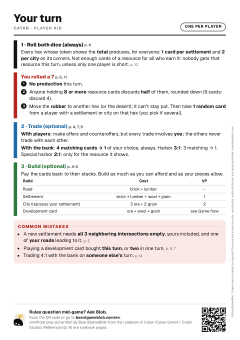 Player aid
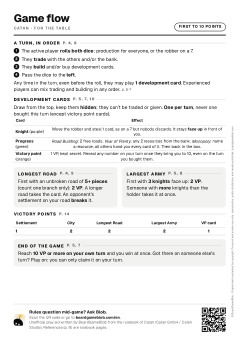 Game flow
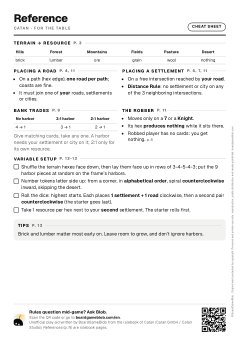 Reference
The rules in questions
From the official rulebook by Kosmos. In parentheses: the rulebook’s page. How Blob answers
How many victory points do you need to win Catan?
You need 10 victory points, and you can only claim the win during your own turn. If you hit 10 on someone else's turn, play goes on until a player has 10 on their turn. (p. 5, 7)
What happens when someone rolls a 7?
Nobody collects resources. Anyone holding 8 or more resource cards discards half, rounding down, then the roller must move the robber to another hex and takes one random card from an owner of an adjacent settlement or city. (p. 11)
Can other players trade with each other when it is not their turn?
No. Every trade must involve the player whose turn it is, so two opponents can never swap cards between themselves during your turn. (p. 4, 7)
How does trading with the bank work if I have no harbor?
You can always give 4 matching resource cards to the supply for 1 card of your choice. A generic harbor improves this to 3:1, and a special harbor gives 2:1 but only for its own resource. (p. 9)
Can I play a development card on the same turn I buy it?
Not as a rule: a knight or progress card has to wait for a later turn, and only one may be played per turn. Victory point cards are the exception, so a freshly bought one can be revealed if it gives you 10 points. (p. 5, 7)
How many resources does a city produce compared to a settlement?
A city collects 2 resource cards from each adjacent hex whose number is rolled, while a settlement collects 1. A city is also worth 2 victory points instead of 1. (p. 5, 6)
If my longest road gets cut by an opponent's settlement and two players end up tied, who keeps the Longest Road card?
If you are still tied for the longest, you keep it. If you are no longer longest and two or more others tie, the card is put aside until only one player holds the longest road, of 5 or more pieces. (p. 9)
What happens if the bank runs out of a resource during production?
If there is not enough of a resource for everyone, nobody gets that resource that turn. When only one player is affected, they take whatever is left in the supply. Other resource types are produced normally. (p. 10)
In the set-up phase, in what order do players place their second settlement, and which one gives starting resources?
Round two runs counterclockwise, starting with the player who placed last in round one, so the starting player places last. Each player takes one resource for every hex bordering their second settlement. (p. 12)
Common mistakes
- Building a settlement next to another oneAll three neighboring intersections must be empty, whoever owns the nearby building, and the new settlement must touch one of your roads. (p. 5, 7)
- Leaving the robber where it isAfter a 7 or a knight, the robber has to go to a different hex; keeping it in place is not allowed. (p. 11)
- Counting road branches for Longest RoadOnly the single longest unbroken line counts, and an opponent's settlement built on it splits it. (p. 9)
- Trading the same resource for itselfSwaps of like resources, gifts, and trades of development cards are all forbidden. (p. 14)
What’s in the rulebook
Tap a part and Blob explains it.
Expansions
The game
- Players
- 3–4
- Length
- 60–120 min
- Age
- 10+
- Released
- 1995
- Designer
- Klaus Teuber
- Publisher
- Kosmos
- Expansions
- 5
- Rules
- Official rulebook