Caylus rules
Ystari Games · 2005
- Players
- 2–5
- Minutes
- 60–150
- Age
- 12+
Ask your question: I answer about this game’s rules.
The game in 30 seconds
You are a master builder helping raise the King's castle and the town growing at its feet. Each turn you send workers into buildings along the road to gather resources, put up new buildings and deliver batches to the castle. The provost decides which buildings actually work. The game ends once the castle's Towers have been counted.
A turn, in short
- Collect income: 2 deniers, plus your residential buildings, the Library and the Hotel if you own them.
- In turn order, pay to place one worker or pass, until everyone has passed.
- Special buildings take effect, then each player, in passing order, may pay to shift the provost forward or back.
- Buildings up to the provost work in road order, then workers in the castle deliver batches.
- The bailiff advances one or two spaces depending on the provost, and a castle section may be counted.
How to win
- Most prestigeAfter the Towers count, add points for leftover gold, cubes and deniers. Highest prestige wins, and tied leaders share the victory. (p. 6)
Printable play aids
3 free A5 play aids for Caylus, from the rulebook: step-by-step setup, a player aid for everyone, and the turn sequence.
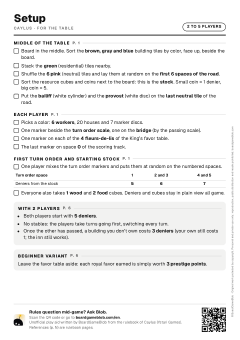 Setup
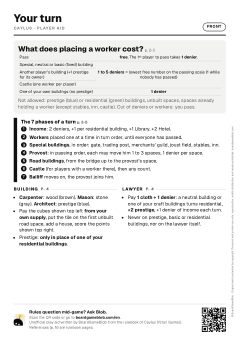 Player aid
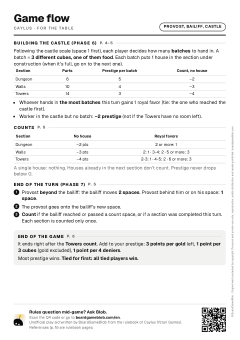 Game flow
The rules in questions
From the official rulebook by Ystari Games. In parentheses: the rulebook’s page. How Blob answers
How does a game of Caylus end?
It ends immediately after the Towers section is counted, which happens when the bailiff reaches the Towers count space or all 14 Towers parts are filled. (p. 6)
How do you break a tie in Caylus?
There is no tiebreaker: every player tied for the most prestige points shares the win. (p. 6)
What are leftover resources and money worth at the end?
Each gold cube is worth 3 points, every 3 other cubes are worth 1 point, and every 4 deniers are worth 1 point. (p. 6)
How much does it cost to place a worker?
Placing in one of your own buildings costs 1 denier. Anywhere else, including the castle, you pay the lowest free number on the passing scale, so it gets dearer as players pass. (p. 2-3)
What makes up a batch for the castle?
A batch is three cubes that are all different, and one of them has to be food. (p. 4)
Can two workers go on the same building?
No, one worker per space, except at the stables (up to 3, one per player), the inn and the castle (several workers, one per player). (p. 2-3)
If I put a worker in the castle but can't deliver a batch, what happens?
You lose 2 prestige points, without dropping below 0. The penalty does not apply when you can't deliver during the Towers only because no space is left. (p. 5)
How far does the bailiff move at the end of a turn, and when are sections counted?
He advances 2 spaces if the provost is ahead of him on the road, otherwise 1. The provost then joins him. A count happens when he reaches or passes a count space, or when a section was filled. (p. 5)
Can I gain several royal favors in one phase and put them all on the same line?
No. Favors earned in the same phase must each go to a different line of the table, so four is the maximum per phase. (p. 6)
My worker is past the provost after phase 4. Does the owner of that building keep the prestige point?
Yes. Buildings beyond the provost are not activated and you just take your worker back, but prestige already scored for placing there is not removed. (p. 3)
Common mistakes
- Assuming every placed worker gets to workOnly buildings between the bridge and the provost activate. Workers beyond him simply return with nothing. (p. 3)
- Stacking workers on an occupied buildingEach space holds one worker, apart from the stables, the inn and the castle. Blue and green tiles never take workers. (p. 2)
- Counting on a cube produced later on the roadBuildings resolve in road order, so a cube gained further along arrives too late for an earlier building such as the joust field. (p. 6)
- Putting several favors on one lineWhen you earn more than one favor in the same phase, each must be placed on a different line of the table. (p. 6)
What’s in the rulebook
See the 7 other parts
Tap a part and Blob explains it.
The game
- Players
- 2–5
- Length
- 60–150 min
- Age
- 12+
- Released
- 2005
- Designer
- William Attia
- Publisher
- Ystari Games
- Rules
- Official rulebook