Chinatown rules
alea · 1999
- Players
- 3–5
- Minutes
- 60
- Age
- 12+
Ask your question: I answer about this game’s rules.
The game in 30 seconds
In 1960s New York Chinatown, you collect buildings and Shop tiles, then haggle freely with everyone to line up shops of the same kind side by side. Each round your businesses pay income, more as they near their full size. After six rounds, the richest player wins.
A turn, in short
- Get new Building cards, keep the number shown in Table 1, and mark those buildings with your color on the board.
- Draw your Shop tiles in secret; everyone reveals them at the same moment.
- Negotiate with anyone at once: buildings, tiles and money can all change hands.
- In clockwise order, place as many Shop tiles as you like on your own empty buildings.
- Collect income for each business you own, then advance the Year marker.
How to win
- Most moneyAfter the sixth round's income, the richest player wins. On a tie, whoever has more Shop tiles on the board takes it. (p. 7)
Printable play aids
3 free A5 play aids for Chinatown, from the rulebook: step-by-step setup, a player aid for everyone, and the turn sequence.
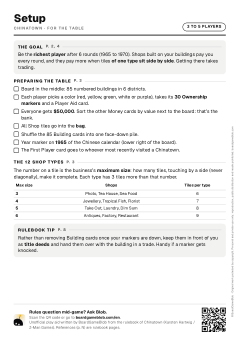 Setup
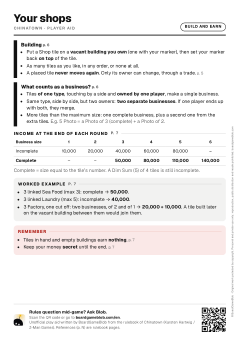 Player aid
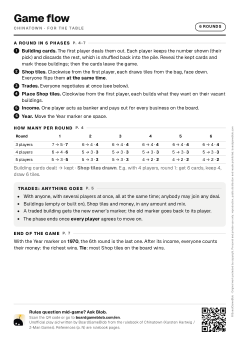 Game flow
The rules in questions
From the official rulebook by alea. In parentheses: the rulebook’s page. How Blob answers
How many rounds are there in Chinatown?
Six rounds, each standing for one year from 1965 to 1970. After income is paid in the sixth round, when the Year marker reaches 1970, the game is over. (p. 4, 7)
How much money does each player start with?
Everyone begins with $50,000; the rest of the Money cards are sorted and kept beside the board as the bank. (p. 3)
How many Building cards and Shop tiles do you get each round in a 4-player game?
In round 1 you get 6 Building cards, keep 4, and draw 6 Shop tiles. From round 2 on you get 5 cards, keep 3, and draw 3 tiles. The red number in Table 1 tells you how many tiles to draw. (p. 4, 5)
What can be traded during the trading phase?
Almost anything: buildings, with or without a shop on them, Shop tiles and cash, in any mix or amount. Everyone negotiates at once, with anyone, until all players agree to move on. (p. 5)
Can a Shop tile be moved once it is on the board?
No, a placed Shop tile stays where it is until the game ends. Only its owner can change, through a trade, with the Ownership marker swapped to show the new owner. (p. 5)
Do diagonal Shop tiles of the same type count as one business?
No, tiles only join a business when they touch along a side, never at a corner. They must also be the same type and belong to the same player. (p. 3, 6)
What happens if I build more tiles of one type than the number printed on them?
The group splits into two businesses: one complete business at the printed maximum size, and a second one made of the leftover tiles. Five adjacent Photo tiles, for example, make a business of 3 and another of 2. (p. 6)
How much income does a business earn at the end of a round?
It depends on its size and whether it is complete. An incomplete business pays from $10,000 for one tile up to $80,000 for five; a complete one pays $50,000 at size 3 up to $140,000 at size 6. Unplaced tiles and empty buildings earn nothing. (p. 7)
Who wins Chinatown if two players have the same amount of money?
The tied player with more Shop tiles on the board wins. Otherwise the richest player after the final income wins. (p. 7)
Do players have to show how much money they have?
No, every player keeps their money hidden from the others for the whole game. (p. 7)
Common mistakes
- Moving a Shop tile that is already builtOnce on the board, a tile stays put for the rest of the game. Only its ownership can change through a trade. (p. 5)
- Joining tiles that touch only at a cornerA business grows only through tiles sharing a side. Same-type tiles owned by different players are also separate businesses. (p. 6)
- Counting an oversized group as one businessExtra tiles beyond the printed maximum form a second, separate business, which earns its own smaller income. (p. 6)
- Revealing your cashEach player's money stays hidden from the others throughout the game. (p. 7)
What’s in the rulebook
See the 2 other parts
Tap a part and Blob explains it.
The game
- Players
- 3–5
- Length
- 60 min
- Age
- 12+
- Released
- 1999
- Designer
- Karsten Hartwig
- Publisher
- alea
- Rules
- Official rulebook