Chronicles of Crime: 1900 rules
Lucky Duck Games · 2021
- Players
- 1–4
- Minutes
- 60–90
- Age
- 12+
Ask your question: I answer about this game’s rules.
The game in 30 seconds
A cooperative investigation set in Paris in 1900, where the whole team plays one young journalist. A required app guides the game: you scan locations, characters and clues to question people, search scenes and crack puzzles. When you think you know the truth, you return to the Newspaper Office and answer the final questions that decide your score.
How to win
- On scoreEveryone plays together: your score comes from your answers to the final questions, and it drops the longer you take to close the case. (p. 3, 7)
Printable play aids
3 free A5 play aids for Chronicles of Crime: 1900, from the rulebook: step-by-step setup, a player aid for everyone, and the turn sequence.
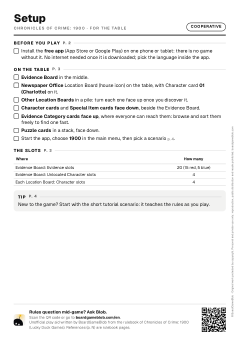 Setup
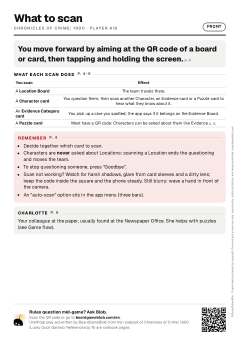 Player aid
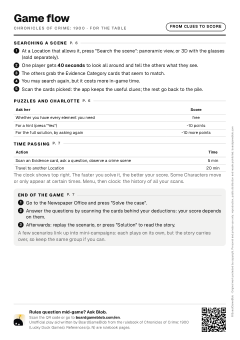 Game flow
The rules in questions
From the official rulebook by Lucky Duck Games. In parentheses: the rulebook’s page. How Blob answers
Do you need an app to play Chronicles of Crime: 1900?
Yes, the free app for a phone or tablet is required, and the game cannot be played without it. One device is enough, and no internet connection is needed once it is installed. (p. 2)
How does a game of Chronicles of Crime: 1900 end?
When the team thinks it has cracked the case, it goes to the Newspaper Office and presses "Solve the case". You then answer questions by scanning the cards that back up your deductions, and those answers set your score. (p. 7)
How much in-game time does each action take?
Scanning an Evidence Category card, questioning a Character or observing a crime scene costs 5 minutes. Moving between Locations costs 20 minutes. Taking less time gives a better final score. (p. 7)
Can you ask a Character about a Location?
No, Characters are never questioned about locations. If you scan a Location during an interrogation, the interrogation ends and the team moves there instead. (p. 4)
What is the difference between the red and blue areas of the Evidence Board?
Red holds evidence you actually have, found at a scene or handed over by a Character. Blue holds evidence you have only heard about; if you obtain it later, the app tells you to move it to red. (p. 5)
How does searching a crime scene work?
One player gets 40 seconds to look around the scene, in panoramic view or in 3D with glasses sold separately, and describes it. The others pick matching Evidence Category cards, which are then scanned so the app keeps only the useful ones. (p. 6)
How much does Charlotte's help with a puzzle cost?
Asking whether you have every element you need is free. Each hint she gives removes 10 points from your final score, and the full solution removes another 10. (p. 6)
Where do I put a Character when we don't know where they are?
Put the card on one of the 4 Unlocated Character slots of the Evidence Board, then move it to the right Location Board once you learn where that Character is. (p. 5)
When can we turn over Character, Special Item or Puzzle cards?
Only when the app names a specific card. Locations, Characters, Special Items and Puzzle cards stay face down until then; Evidence Category cards are the exception and stay face up for everyone. (p. 3, 4)
What should we check if a QR code will not scan?
Look for sharp shadows, reflections from card sleeves or a dirty camera. Keep the code inside the square and hold still; if focusing still fails, wave a hand in front of the camera. (p. 4)
Common mistakes
- Turning cards over before the app names themLocations, Characters, Special Items and Puzzle cards stay face down until the app calls for a specific card. (p. 4)
- Putting every searched card on the Evidence BoardAfter a search, scan the cards you picked: only those the app confirms go on the board, and the rest return to the pile. (p. 6)
- Scanning without watching the clockEvery scan, question or scene observation moves the clock forward, and each trip even more. Talk it over before scanning. (p. 4, 7)
What’s in the rulebook
See the 3 other parts
Tap a part and Blob explains it.
The game
- Players
- 1–4
- Length
- 60–90 min
- Age
- 12+
- Released
- 2021
- Designer
- David Cicurel
- Publisher
- Lucky Duck Games
- Rules
- Official rulebook