Concept rules
Repos Production · 2013
- Players
- 4–12
- Minutes
- 40
- Age
- 10+
Ask your question: I answer about this game’s rules.
The game in 30 seconds
A word-guessing game where nobody speaks the answer. Two neighbors pick a secret word or phrase from a card and point the rest of the table toward it by placing pawns and cubes on a board of universal icons. The first to guess scores, the team scores too, and play stops once all 12 Double tokens are gone.
A turn, in short
- Your team of two draws a card and secretly picks one of its nine words, Easy, Hard or Challenging.
- Put the green question mark pawn on an icon to show the main idea of the word.
- Add green cubes to refine it, then optionally open sub-concepts with the other colored pawns and their cubes.
- Everyone else calls out guesses freely. The first correct guesser gets 2 VP, each teammate 1 VP, then the next two players clockwise take a new card.
How to win
- Most pointsWhen the 12 Double VP tokens have all been claimed, whoever holds the most victory points wins; ties share the win. (p. 2)
Printable play aids
3 free A5 play aids for Concept, from the rulebook: step-by-step setup, a player aid for everyone, and the turn sequence.
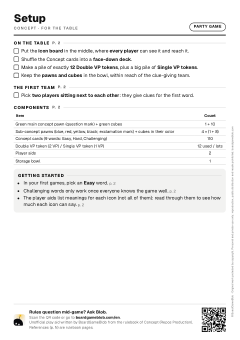 Setup
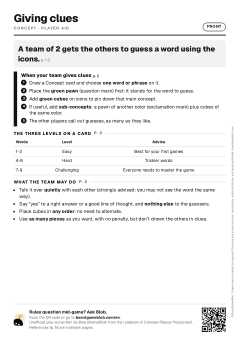 Player aid
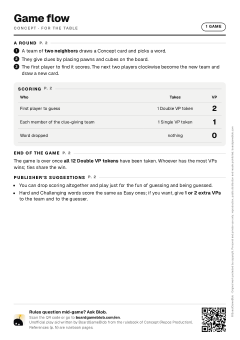 Game flow
The rules in questions
From the official rulebook by Repos Production. In parentheses: the rulebook’s page. How Blob answers
How do you play Concept?
A team of two neighboring players picks a word or phrase from a card, then places pawns and cubes on the board's icons so the others can guess it. (p. 1-2)
How does scoring work in Concept?
Whoever guesses first takes a Double token worth 2 VP, and each of the two clue-givers takes a Single token worth 1 VP. (p. 2)
When does a game of Concept end?
It ends as soon as all 12 Double VP tokens have been claimed; the player or players with the most VPs win. (p. 2)
What do the different colored pawns mean?
The green question mark pawn marks the main concept, the word itself. Blue, red, yellow and black exclamation mark pawns add sub-concepts that help clarify the main one. (p. 1-2)
Can the clue-givers talk to the guessers?
Only to say yes when someone gives a good answer or is on the right track. Between themselves, the two teammates may confer quietly. (p. 2)
What happens if nobody can guess the word?
After a while the team brings in a third player to help. If that still fails, the word is dropped and nobody scores that round. The team may also clear the board and start over another way. (p. 2)
Is there a limit on how many cubes and pawns the team can use, and do teammates have to alternate placing them?
No limit and no penalty on pieces, though too many clues can confuse people. Teammates place cubes freely without taking turns, and the order of placement can matter. (p. 2)
Do Hard or Challenging words score more points than Easy ones in Concept?
Not by default: every word scores the same. The editor suggests an optional house rule giving 1 or 2 extra VPs to both the team and the guesser for harder words. (p. 2)
Which difficulty should beginners choose?
Start with Easy words for your first few games; Challenging words only work well once everyone at the table knows the game well. (p. 2)
Common mistakes
- Giving spoken hintsClue-givers may only say yes to a good answer or a good line of thought. Anything else must come through the pieces on the board. (p. 2)
- Mixing up main concept and sub-conceptsGreen always marks the word being guessed. The other colors only add side ideas that narrow it down. (p. 1-2)
- Getting stuck on an impossible wordCall in a third player to help, or wipe the board and try a new angle. If nothing works, abandon the word with no points. (p. 2)
What’s in the rulebook
Tap a part and Blob explains it.
Expansions
The game
- Players
- 4–12
- Length
- 40 min
- Age
- 10+
- Released
- 2013
- Designer
- Gaëtan Beaujannot
- Publisher
- Repos Production
- Expansions
- 1
- Rules
- Official rulebook