Concordia rules
PD-Verlag · 2013
- Players
- 2–5
- Minutes
- 100
- Age
- 13+
Ask your question: I answer about this game’s rules.
The game in 30 seconds
In ancient Rome, you send colonists along land and sea routes, build houses in cities and trade goods. Each turn you play one personality card from your hand. The game stops once the last card on the board is bought or someone builds a 15th house. Points come from the gods printed on your cards.
A turn, in short
- Play a single personality card from your hand and carry out its action.
- The card goes onto your personal discard pile, where only the latest one stays visible.
- When you want your cards back, play the Tribune to return the whole pile to your hand. (p. 1)
How to win
- On pointsAt the end, each god rewards the cards tied to it based on your houses, provinces, colonists and wealth. Highest total wins. (p. 4)
- Concordia cardWhoever triggers the end takes the Concordia card for 7 extra points; the others then play one last turn. (p. 4)
Printable play aids
3 free A5 play aids for Concordia, from the rulebook: step-by-step setup, a player aid for everyone, and the turn sequence.
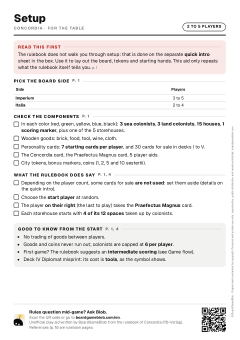 Setup
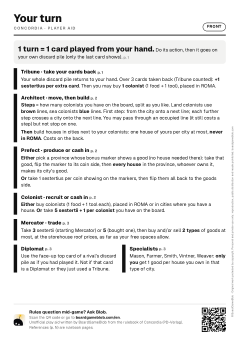 Player aid
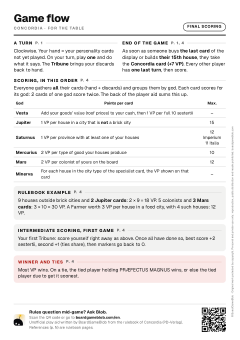 Game flow
The rules in questions
From the official rulebook by PD-Verlag. In parentheses: the rulebook’s page. How Blob answers
When does a game of Concordia end?
It ends when someone buys the final card from the board display or places their 15th house. That player takes the Concordia card, worth 7 points, and everyone else gets one last turn before scoring. (p. 4)
How do you break a tie in Concordia?
The tied player holding the Praefectus Magnus wins; if none of them has it, the win goes to whichever tied player would get it soonest. (p. 4)
How much does it cost to build a house?
A brick city costs 1 food and 1 coin; any other city costs 1 brick plus that city's good, and 2 to 5 coins depending on its type. The coin price is multiplied by the number of houses the city will then contain. (p. 2)
How much money does the Tribune give?
You get 1 sestertius for every card you pick up beyond the third, counting the Tribune itself. You may also pay 1 food and 1 tool to put a new colonist in Roma. (p. 1)
Can my colonist stop on a road where another colonist already is?
No, a colonist may not end its move on an occupied line, but it may pass through one; each occupied section crossed still costs a movement step. (p. 2)
How does the Praefectus Magnus work, and can I save it for later?
No, you cannot save it: when its holder uses a Prefect to make a province produce, the province bonus is doubled, then it passes to the right. Taking the cash bonus does not trigger it, so the card stays with you. (p. 4)
What can the Diplomat copy?
It copies the action of the face-up card on top of another player's discard pile, as if you had played it. A Diplomat or a Tribune on top of a pile cannot be copied. (p. 3)
If my storehouse is full, can I throw away goods to make space for new ones?
No, discarding goods to free room is forbidden. If you receive more goods than you have empty spaces, you pick which ones to keep, but you must fill every free space. (p. 4)
What is the difference between the Senator and the Consul?
The Senator buys up to two cards, paying the card cost plus the goods shown under its board position. The Consul buys only one card and ignores the board cost. (p. 3)
Should beginners use the intermediate scoring?
Yes, it is recommended the first time you play: each player scores when first playing the Tribune, and the top two scores earn 2 and 1 sestertii. Experienced groups can skip it. (p. 1, p. 4)
Common mistakes
- Paying the board cost with the ConsulThe Consul buys a single card and pays only the goods in its red field. Whatever the board shows below that slot is ignored. (p. 3)
- Thinking you need a house to pick a provinceWith the Prefect you can choose any active province, even with no house there. Every house in it produces, whoever owns it. (p. 2)
- Trading more than two kinds of goodsThe Mercator lets you deal in two kinds of goods only, buying or selling, and free storehouse spaces cap the quantities. (p. 3)
- Building two of your houses in one cityYou can own at most one house per city, and nobody may build in Roma. (p. 2)
What’s in the rulebook
Tap a part and Blob explains it.
Expansions
The game
- Players
- 2–5
- Length
- 100 min
- Age
- 13+
- Released
- 2013
- Designer
- Mac Gerdts
- Publisher
- PD-Verlag
- Expansions
- 10
- Rules
- Official rulebook