Crossing rules
(Self-Published) · 2013
- Players
- 3–6
- Minutes
- 15
- Age
- 6+
Ask your question: I answer about this game’s rules.
The game in 30 seconds
A quick party game for 3 to 6 players where everyone points at once to grab precious stones from mushrooms. Being the only one on a target pays off; sharing it gets nobody anything. You can also rob other players or lock your haul away. The game stops when the bag is empty.
A turn, in short
- Count to three together.
- On three, point at a mushroom or at another player's tile, or cover your own tile with your hand (the last two options from the second turn).
- A player alone on their target takes its stones; if several fingers meet, nobody gains anything.
- The distributor refills the mushrooms from the bag.
How to win
- Most pointsA trio of red, blue and yellow is worth 5, a white stone 2, a lone colored stone 1. Ties go to the most white stones. (p. 4)
Printable play aids
3 free A5 play aids for Crossing, from the rulebook: step-by-step setup, a player aid for everyone, and the turn sequence.
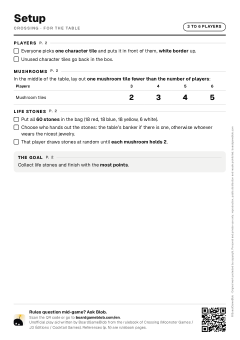 Setup
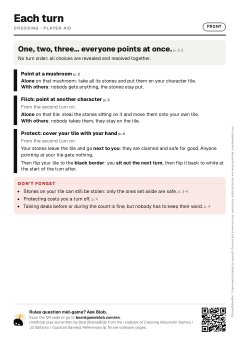 Player aid
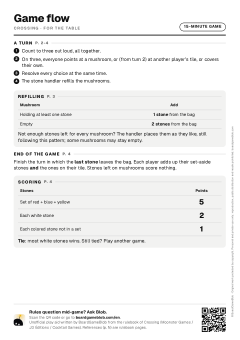 Game flow
The rules in questions
From the official rulebook by (Self-Published). In parentheses: the rulebook’s page. How Blob answers
How many mushroom tiles do you use for each player count?
Always one fewer than the number of players: 2 tiles with three players, 3 with four, 4 with five and 5 with six. The distributor then draws stones from the bag so each mushroom starts with two. (p. 2)
What happens if two players point at the same mushroom?
Nobody gets anything: the stones stay on that mushroom for a later turn. You only collect when you are the single player choosing that target. (p. 2)
Can you steal stones from another player on the first turn?
No. On the first turn every player must point at a mushroom. Stealing from another character tile, or protecting your own, only becomes possible from the second turn on. (p. 2-3)
How do you protect your stones so they can't be stolen?
Cover your own character tile with your hand instead of pointing. Those stones move off the tile and are yours for good, but you flip your tile to its black-bordered side and sit out the next turn. (p. 4)
What do you get for pointing at a tile its owner is protecting?
Nothing at all: a player who targets a character tile covered by its owner's hand comes away empty-handed that turn. (p. 4)
How are the mushrooms refilled between turns?
The distributor draws at random and adds one stone to every mushroom that still holds at least one, and two to every empty mushroom. If the bag runs short, they share out what remains as they like, following that same principle. (p. 3)
When does a game of Crossing end, and do stones left on mushrooms count?
It ends once the turn in which the final stone leaves the bag is over. Any stones still sitting on mushrooms score nothing for anyone. (p. 3-4)
How is scoring done at the end?
Each trio of three different colors scores 5 points, each white stone scores 2, and every colored stone left outside a trio scores 1. Count both the stones you set aside and those still on your tile. (p. 4)
How do you break a tie?
The tied player holding more white stones wins. If that is still equal, the rulebook simply says to play another game. (p. 4)
Are players allowed to make deals about which mushroom to point at?
Yes. The author allows talking before or during the count to three to agree on targets, but nobody is obliged to keep their promise. (p. 4)
Common mistakes
- Stealing or protecting on the first turnThe first turn is played on mushrooms only; targeting a character or protecting comes afterwards. (p. 2-3)
- Thinking stones on your tile are safeWhile they sit on your tile, an opponent who is alone in pointing at it takes them. Only stones set aside by protecting are secured. (p. 3-4)
- Playing right after protectingAfter covering your tile, flip it to the black-bordered side: you skip the following turn. (p. 4)
What’s in the rulebook
See the other part
Tap a part and Blob explains it.
The game
- Players
- 3–6
- Length
- 15 min
- Age
- 6+
- Released
- 2013
- Designer
- Yoshiteru Shinohara
- Publisher
- (Self-Published)
- Rules
- Official rulebook