Cuba rules
eggertspiele · 2007
- Players
- 2–5
- Minutes
- 75–120
- Age
- 12+
Ask your question: I answer about this game’s rules.
The game in 30 seconds
Set in pre-revolution Cuba, each player grows a village: harvest resources and products on your plantation, trade at the market, erect buildings and load ships in the harbor. In parliament, votes decide which laws reward or cost you. After 6 rounds, the most victory points wins.
A turn, in short
- Reveal one bill from the top of each of the four statute piles.
- Taking turns, each player plays a character card and performs its action until everyone has played four cards.
- In parliament, your fifth card gives your votes, you may secretly buy more, and the leader passes two bills.
- Apply the acts in force in order from I to IV.
- End of round: unstored products in the lot are lost and the ships move along the docks.
How to win
- Most victory pointsAfter round 6, each building adds 2 victory points. The highest total wins, and money breaks a tie. (p. 12)
Printable play aids
4 free A5 play aids for Cuba, from the rulebook: step-by-step setup, a player aid for everyone, the turn sequence, and a quick reference.
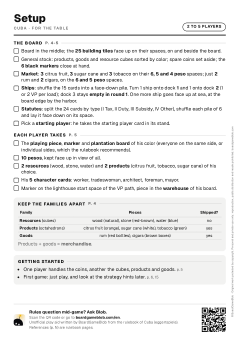 Setup
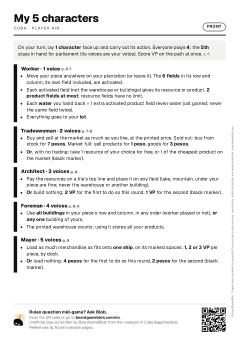 Player aid
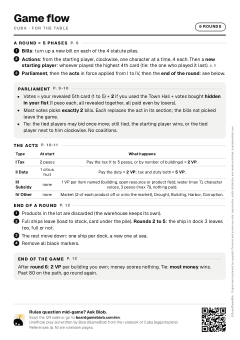 Game flow
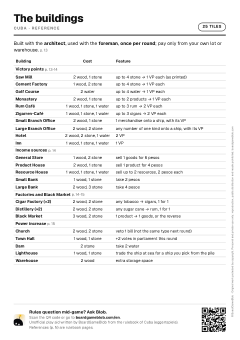 Reference
The rules in questions
From the official rulebook by eggertspiele. In parentheses: the rulebook’s page. How Blob answers
How many rounds does a game of Cuba last?
Cuba lasts 6 rounds. Each round runs through five phases: bills, actions, parliament, statutes and end of round, and the game ends after the sixth. (p. 6)
Who wins a tie in Cuba?
The tied player holding the most money wins. Before that, every player scores 2 extra victory points per building they own. (p. 12)
What does each player start with?
Each player starts with 10 pesos, 2 resources and 2 products of their choice, the five character cards, and their piece in the warehouse of their plantation. (p. 5)
What happens to products left in the lot at the end of a round?
They are lost. Only products stored in the warehouse with the foreman carry over; resources and goods stay in the lot safely. (p. 8-9, p. 12)
How many product fields can the worker use?
Only two, though resource fields in the activated row and column are unlimited. Each water piece you hand back lets you use one more activated product field, never the same field twice. (p. 7)
How does voting in parliament work in Cuba?
Your vote total is the value of your unplayed fifth character, plus 2 if you used the Town Hall, plus votes bought secretly at 1 peso each. The highest total picks 2 of the 4 bills. (p. 9-10)
Do I get my money back if I lose the vote?
No. Every peso bid for votes goes to the stock, whether or not you won the majority. Ties allow one more bidding round among the tied players. (p. 10)
What do I score for paying both the tax and the duty?
You score 5 victory points: 2 for the tax, 2 for the duty and 1 bonus for meeting both. Skipping one simply earns nothing for it. (p. 10-11)
If a ship fills up during the action phase without the Harbor Act, does it leave right away?
No. Full ships only leave at the end of the round, and from round 2 to 5 the ship in the third dock leaves then too, full or not. With the Harbor Act, a ship completed by the mayor or a branch office leaves immediately. (p. 11-12)
Can the architect's or mayor's alternative action be taken by everyone in the same round?
No. A black marker covers each alternative space once used: the first architect skipping a build gets 2 points, the second 1; the mayor's version pays 4 then 2 pesos. Markers are cleared at round end. (p. 8-9, p. 12)
Common mistakes
- Refunding losing bidsAll pesos offered for votes go to the stock, even from players who did not win the majority. (p. 10)
- Using an alternative action more than onceThe alternatives of the tradeswoman, architect and mayor are blocked by a black marker once taken, until the end of the round. (p. 8, p. 12)
- Waiting for a ship to fill before it leavesAt the end of rounds 2 to 5, the ship in the third dock sails away whatever its load. (p. 12)
- Keeping the same starting playerAfter the fourth card, the player whose last card has the highest value starts; on a tie, whoever played it last. (p. 9)
What’s in the rulebook
See the 2 other parts
Tap a part and Blob explains it.
Expansions
The game
- Players
- 2–5
- Length
- 75–120 min
- Age
- 12+
- Released
- 2007
- Designer
- Michael Rieneck
- Publisher
- eggertspiele
- Expansions
- 3
- Rules
- Official rulebook