Descent: Journeys in the Dark rules
Fantasy Flight Games · 2005
- Players
- 2–5
- Minutes
- 120–240
- Age
- 13+
Ask your question: I answer about this game’s rules.
The game in 30 seconds
Up to four heroes team up to explore a dungeon, fight monsters and collect equipment and treasure to complete a quest. One player is the overlord, who controls the monsters, springs traps and brings in reinforcements. The heroes share a pool of conquest tokens: if it ever runs out, the overlord wins.
A turn, in short
- Heroes go first, one at a time, in an order they agree on again every round.
- On your turn, refresh exhausted cards, choose your equipped items, then declare your action.
- Pick one action: run, battle (two attacks), advance (move and one attack) or ready (move or attack, plus an order).
- The overlord then gains threat, draws two cards, may play one spawn card and activates each monster once.
How to win
- HeroesComplete the quest's goal, often killing a named monster, while still holding at least one conquest token. (p. 3, 13)
- OverlordThe moment the heroes have no conquest tokens left, play stops and the overlord wins. (p. 13, 16)
Printable play aids
4 free A5 play aids for Descent: Journeys in the Dark, from the rulebook: step-by-step setup, a player aid for everyone, the turn sequence, and a quick reference.
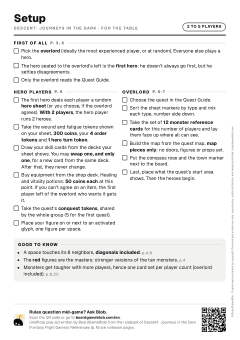 Setup
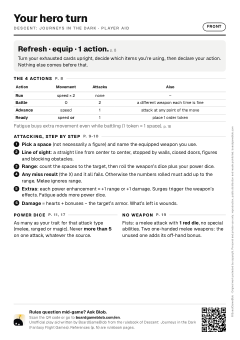 Player aid
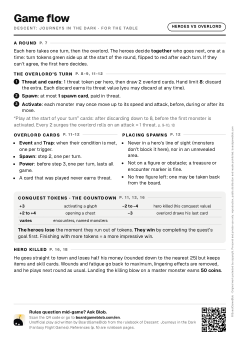 Game flow
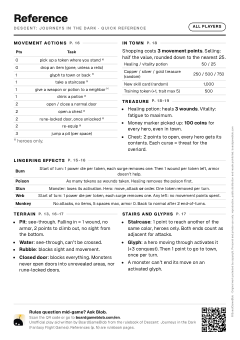 Reference
The rules in questions
From the official rulebook by Fantasy Flight Games. In parentheses: the rulebook’s page. How Blob answers
How do the heroes lose in Descent: Journeys in the Dark?
The heroes lose as soon as their shared pool of conquest tokens is empty; the overlord then wins immediately. They lose tokens whenever a hero dies (equal to that hero's conquest value) and whenever the overlord draws the final card of his deck (three tokens). (p. 11, 13, 16)
What can a hero do on his turn?
After refreshing cards and choosing equipment, a hero picks exactly one action: run (twice his speed, no attack), battle (two attacks, no movement), advance (his speed plus one attack) or ready (move or attack, plus place one order token). (p. 8)
How many power dice can be added to a single attack?
Five at most. Traits, fatigue spent after the roll and other effects all count toward this cap, whatever their source. (p. 10, 17)
What happens when a hero is killed?
He goes straight to town, the group loses conquest tokens equal to his conquest value, and he keeps his items and skills but drops half his coins, rounded down to the nearest 25. In town his wounds and fatigue are refilled. (p. 16, 18)
Can figures move diagonally, and through other figures?
Yes, every move into any adjacent space, diagonals included, costs 1 movement point. You may pass through friendly figures but must finish in an empty space and cannot attack while sharing one; enemies, closed doors and blocking obstacles stop you. (p. 9)
Does a melee attack care about the range rolled on the dice?
No. A melee attack targets an adjacent space and fails only when a miss face comes up; the range numbers are ignored. Ranged and magic attacks also fail if the total range is too short. (p. 11)
Can a hero with a guard order attack a monster before the monster's own attack resolves?
Yes. During the overlord's turn, a guarding hero may interrupt at any moment, even after a monster has declared its attack, and his attack is resolved first. The order is lost if he takes a wound or his next turn begins. (p. 14, 15)
Can the overlord spawn monsters where a hero can see them?
No. Spawned monsters must go in empty spaces of revealed areas that no hero has line of sight to; other monsters do not block that line of sight. Spaces with treasure or encounter markers are allowed, but not ones with figures or obstacles. (p. 12)
How many cards can the overlord keep in hand, and what does discarding give him?
Eight. After drawing two cards each turn he must discard down to eight, and every discarded card earns threat tokens equal to its threat value. Cards discarded after being played give nothing. (p. 9, 11, 21)
Common mistakes
- Acting before declaring an actionApart from refreshing cards and equipping items, a hero may do nothing until he has announced which of the four actions he is taking. (p. 8)
- Forgetting the cost of reshuffling the overlord deckDrawing the final overlord card costs the heroes three conquest tokens, then the discards are shuffled into a new deck. (p. 11)
- Letting monsters stop on activated glyphsMonsters may cross or attack into a space with an activated glyph, but they can never end their move there. (p. 17)
- Attacking from a space shared with an allyYou can move through friendly figures, but you cannot attack while in their space and must end your move on an empty one. (p. 9)
What’s in the rulebook
See the 3 other parts
Tap a part and Blob explains it.
Expansions
The game
- Players
- 2–5
- Length
- 120–240 min
- Age
- 13+
- Released
- 2005
- Designer
- Kevin Wilson
- Publisher
- Fantasy Flight Games
- Expansions
- 6
- Rules
- Official rulebook