Diplomacy rules
The Avalon Hill Game Co · 1959
- Players
- 2–7
- Minutes
- 360
- Age
- 12+
Ask your question: I answer about this game’s rules.
The game in 30 seconds
Seven Great Powers fight over Europe just before World War I, with no dice at all. Players negotiate freely, form alliances and break them, then everyone writes secret orders that are revealed and carried out together. The first power to hold 18 supply centers after a Fall turn takes control of Europe and wins.
A turn, in short
- Diplomacy: talk, bargain and plot with anyone, 30 minutes before the first turn and 15 before each later one.
- Orders: secretly write one order per unit, to hold, move, support or convoy.
- Resolution: reveal all orders at once; the stronger side wins, and equal strengths bounce.
- Retreats: dislodged units retreat or are disbanded, written in secret without discussion.
- After Fall only: count supply centers, then build or disband units to match.
How to win
- 18 supply centersA power controlling 18 or more supply centers after a Fall turn wins immediately. (p. 4, 6)
- Shared drawPlayers can agree to stop early; everyone still on the board then shares the draw equally. (p. 4)
Printable play aids
4 free A5 play aids for Diplomacy, from the rulebook: step-by-step setup, a player aid for everyone, the turn sequence, and a quick reference.
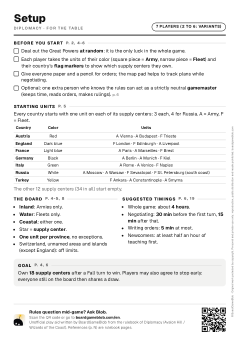 Setup
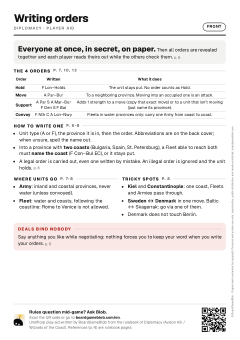 Player aid
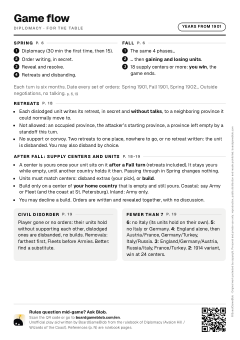 Game flow
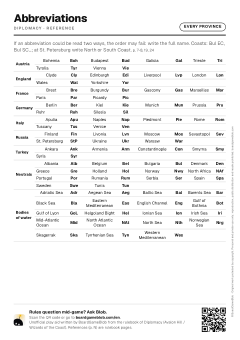 Reference
The rules in questions
From the official rulebook by The Avalon Hill Game Co. In parentheses: the rulebook’s page. How Blob answers
How many supply centers do you need to win Diplomacy?
You need 18 supply centers: the Great Power holding 18 or more after a Fall turn wins the game immediately. (p. 4, 6)
What happens if players agree to end the game early?
The game ends in a draw shared equally by every player who still has pieces on the board. Players may agree to this at any point before someone reaches 18 supply centers. (p. 4)
Are promises and written agreements binding?
No. During negotiations you may say anything, and neither spoken deals nor written documents oblige you to follow them when you write your orders. (p. 6)
Can two units swap places?
Not by moving straight into each other: both stay put. A swap works only when one or both of the units travel by convoy. Three or more units may rotate as long as no two trade directly. (p. 9, 16)
Does attacking a supporting unit always cut its support?
Almost always: any attack cuts support, even a failed one, unless it comes from the very province the support is aimed at. In that case the supporter must actually be dislodged for the support to fail. (p. 12)
Can I use my own support to dislodge my own unit?
No. A country can never dislodge one of its own units or support such a dislodgment, even by accident, so that attack simply fails. It can still be ordered to create a standoff. (p. 14, 15)
Where can I build new units after a Fall turn?
Only on unoccupied home supply centers that you still control. Conquered centers abroad count toward your total but never let you build there, and inland centers only take Armies. (p. 18, 19)
If my Army moves into a neutral supply center in Spring and leaves in Fall, do I own it?
No. Ownership is checked only at the end of each Fall turn, retreats included, so a unit passing through in Spring changes nothing. Once owned, a center stays yours while it is empty or held by you after Fall. (p. 18)
Where can a dislodged unit retreat, and what if two units retreat to the same province?
It retreats to an adjacent province it could normally enter, but not an occupied one, the attacker's origin, or a province left empty by a standoff that turn. If two units retreat to the same place, both are disbanded. (p. 18)
How do you play Diplomacy with fewer than seven players?
With six, Italy is removed and its units just hold; with five, Germany goes too. With four, three or two players, people control pairs or groups of powers, and the two-player game starts in 1914 and needs 24 centers to win. (p. 19)
Common mistakes
- Supporting a move the unit didn't makeSupport only counts if it matches the order actually given. If the supported unit moves elsewhere, the support fails and does not turn into a hold support. (p. 10)
- Building in conquered supply centersNew units appear only on empty home centers you still control, never on centers taken from others. (p. 18)
- Forgetting to name the coastWhen a Fleet could reach either coast of Bulgaria, Spain or St. Petersburg, the order must name one, or the Fleet stays put. (p. 8)
- Convoying with a coastal FleetOnly Fleets sitting in water provinces can convoy; a Fleet in Denmark, Kiel or any other coastal province cannot. (p. 13)
What’s in the rulebook
See the 7 other parts
Tap a part and Blob explains it.
Expansions
The game
- Players
- 2–7
- Length
- 360 min
- Age
- 12+
- Released
- 1959
- Designer
- Allan B. Calhamer
- Publisher
- The Avalon Hill Game Co
- Expansions
- 5
- Rules
- Official rulebook