Egizia rules
Hans im Glück · 2009
- Players
- 2–4
- Minutes
- 90
- Age
- 12+
Ask your question: I answer about this game’s rules.
The game in 30 seconds
In ancient Egypt, you send your ships along the Nile to grab Nile cards, round space actions and spots on the building sites. Then you feed your construction crews, collect stones from your quarries and build the sphinx, obelisk, graves, pyramid and temple for points. After 5 rounds, grave tiles, leftover stones and your secret sphinx cards add their final points.
A turn, in short
- Deal 10 Nile cards face-up beside the river, starting at its source.
- Take turns placing ships one at a time, always further downstream: on a Nile card, a round space or a building space.
- Feed your crews with your grain, then add the stones your quarries produce.
- Build site by site, sphinx first, then obelisk and graves, then pyramid and temple.
- Score the co-operation bonus, then the player furthest behind on the scoring track takes sequence tile 1.
How to win
- Most pointsAfter round 5, each player may sell stones, scores their grave tiles and checks their sphinx cards. Highest total wins. (p. 9)
- TieThe tied player whose stone stands in front on the shared scoring space wins. (p. 9)
Printable play aids
3 free A5 play aids for Egizia, from the rulebook: step-by-step setup, a player aid for everyone, and the turn sequence.
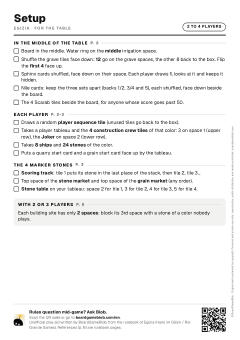 Setup
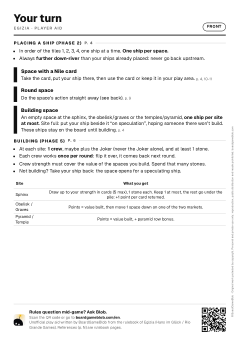 Player aid
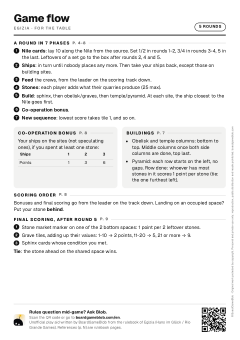 Game flow
The rules in questions
From the official rulebook by Hans im Glück. In parentheses: the rulebook’s page. How Blob answers
How many rounds does Egizia last?
Egizia is played over 5 rounds, each made of 7 phases. After the fifth round comes the final scoring, which also sets the turn order for it. (p. 4, 8)
Can I place a ship upstream of my previous ship?
No, each new ship must go further downstream than every ship you have already placed that round. Only a permanent Nile card lets you break this once per round. (p. 4, 11)
What happens if I can't feed my construction crews?
You lose points on the scoring track, and your score can drop below zero. How many points you lose for each missing grain depends on where your marker sits on the grain market, from 1 to 3. (p. 4)
Which grain fields does the water ring water?
Green fields always produce. Yellow-green fields need the ring on the middle or right irrigation space, and brown fields only count when the ring is on the right space. (p. 5, 10)
Can I use the Joker construction crew on its own?
No, the Joker crew never works alone. Once per round you may add it to another crew, and then you flip it over like any used crew. (p. 6)
If I draw sphinx cards, how many can I keep?
Normally just one, or none if you prefer. You draw up to your crew's strength, five at most, pay one stone per card drawn, and score a point for each card you put back under the pile. (p. 6)
What happens if all three spaces at a building site are taken when I want to place a ship there?
You may put your ship beside the site on speculation. In the build phase you can use a space only if another player there does not build and pulls back their ship. A speculating ship does not count for the co-operation bonus. (p. 4, 6, 8)
Who scores the bonus when a row of the pyramid is completed?
The player with the most stones in that row gets 1 point per stone they own there. On a tie, the tied player whose stone sits furthest left takes the points. (p. 7)
How is a tie broken at the end of Egizia?
Among tied players, the one whose stone is in front on the shared scoring space wins. Since a player arriving on an occupied space goes behind, being there first matters. (p. 8, 9)
What changes with 2 or 3 players?
Each building site uses only two spaces; block the third with a stone of a color nobody plays. Extra player sequence tiles and start cards go back in the box. (p. 2, 3, 9)
Common mistakes
- Skipping to a better grave tileYou must take the first face-up grave tile, then the next one. Flip a hidden tile afterwards so four stay visible. (p. 7)
- Filling the obelisk or temple from any spaceBoth are built from the bottom up: every lower number must be filled before a higher space opens. (p. 7)
- Counting speculating ships for the bonusThe co-operation bonus only counts your ships on building spaces, and only if you actually spent stones building that round. (p. 8)
- Keeping extra stones past 25Your stone table stops at 25; any production above that is lost. (p. 6)
What’s in the rulebook
See the 4 other parts
Tap a part and Blob explains it.
The game
- Players
- 2–4
- Length
- 90 min
- Age
- 12+
- Released
- 2009
- Designer
- Acchittocca
- Publisher
- Hans im Glück
- Rules
- Official rulebook