El Grande rules
Hans im Glück · 1995
- Players
- 2–5
- Minutes
- 60–120
- Age
- 12+
Ask your question: I answer about this game’s rules.
The game in 30 seconds
You compete for control of the regions of 15th-century Spain with your Caballeros. Each round, a Power card sets your turn order and your reinforcements, then you take an Action card to put Caballeros on the board and trigger its special effect. After rounds 3, 6 and 9, every region pays points to the players with the most Caballeros there. After the third scoring, the top score wins.
A turn, in short
- Flip the top card of each of the five Action card stacks.
- In clockwise order from the start player, each plays a Power card with a value nobody has played yet this round.
- From highest to lowest Power card, bring Caballeros from the Province into your Court as shown on your card.
- Pick a revealed Action card: place Caballeros next to the King or in the Castillo, and use its special action or not, in either order.
- Whoever played the lowest Power card becomes start player; every Power card played is discarded for good.
How to win
- Most pointsAfter the third general scoring, the player furthest ahead on the score track wins; a tie for the lead is a shared victory. (p. 8)
Printable play aids
3 free A5 play aids for El Grande, from the rulebook: step-by-step setup, a player aid for everyone, and the turn sequence.
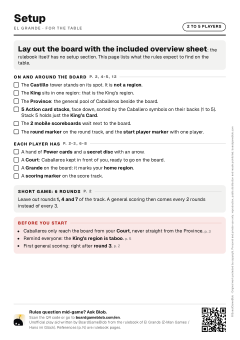 Setup
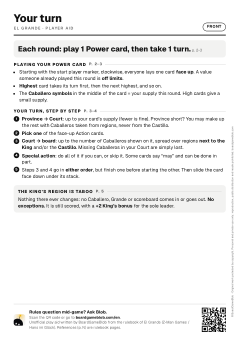 Player aid
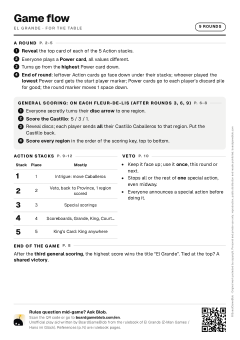 Game flow
The rules in questions
From the official rulebook by Hans im Glück. In parentheses: the rulebook’s page. How Blob answers
How does a game of El Grande end?
The game is over once the third general scoring is done, after round 9, and the highest score wins the title of El Grande. Players tied for the most points share the win. (p. 8)
When do general scorings happen?
A general scoring takes place when the round marker reaches a fleur-de-lis, which happens after rounds 3, 6 and 9. In the shorter 6-round variant, it comes every two rounds instead. (p. 2, 5)
How are ties broken when scoring a region?
Tied players each get the points of the place just below the one they tied for, so two players tied for first both score second-place points. Players with no Caballeros in a region score nothing there. (p. 6, 7)
What changes with 2 or 3 players?
With 2 players, only first place scores in each region and in the Castillo. With 3 players, first and second place score, but third-place points are never awarded. (p. 6, 7)
Can I place Caballeros in the King's region?
No, the King's region is completely off limits: nothing may be added to it or removed from it, with no exceptions. You place Caballeros in the regions bordering it, or in the Castillo. (p. 3, 5)
Does my Grande count toward the majority in its region?
No, the Grande only marks your home region and is ignored when counting who has the most Caballeros. Holding a clear majority there earns you a 2-point bonus whenever that region is scored. (p. 7, 8)
If two of us are tied for the most Caballeros in the King's region, does anyone get the 2-point King's bonus?
No, the King's bonus only goes to a player who has strictly more Caballeros than everyone else in that region. The same no-ties rule applies to the home region bonus. (p. 5, 8)
What happens to my Castillo Caballeros if I pick the King's region on my secret disc during a general scoring?
They go back into your Court instead of onto the board, since nobody may move pieces into the King's region. Everyone else moves their Castillo Caballeros to the region shown on their disc. (p. 6, 7)
Can I place some Caballeros, use the card's special action, and then place the rest?
No, you choose which comes first, but each part must be finished before starting the other. You may also skip the special action entirely. (p. 3, 4)
When can I use the Veto card, and what does it stop?
You may use it once, during the round you take it or the next one, to block all or part of another player's special action, even midway through it. Unused by the end of the following round, it goes under stack 2 with no effect. (p. 10)
Common mistakes
- Counting the Grande toward the majorityYour Grande only shows which region is your home. Only Caballeros count when deciding who is first. (p. 7, 8)
- Changing something in the King's regionNo Caballero, Grande or scoreboard may enter or leave the region with the King, by placement or by movement. It is still scored normally. (p. 5, 9)
- Placing Caballeros straight from the ProvinceCaballeros must first be brought into your Court; you can only place pieces from your Court, and missing ones are simply lost placements. (p. 3)
- Splitting the Action card into several stepsDo the placement and the special action one after the other, never interleaved. (p. 4)
What’s in the rulebook
Tap a part and Blob explains it.
Expansions
The game
- Players
- 2–5
- Length
- 60–120 min
- Age
- 12+
- Released
- 1995
- Designer
- Wolfgang Kramer
- Publisher
- Hans im Glück
- Expansions
- 2
- Rules
- Official rulebook