Ginkgopolis rules
Pearl Games · 2012
- Players
- 1–5
- Minutes
- 45
- Age
- 13+
Ask your question: I answer about this game’s rules.
The game in 30 seconds
You are urban planners in a future city. Each round, everyone secretly picks one card, either alone to operate a building or with a tile to expand the city or stack a new floor. The game stops when the tile supply runs out a second time or someone has placed all their resources.
A turn, in short
- Secretly choose 1 of your 4 cards, adding a Building tile on top if you want to build.
- Card alone: operate a building and gain resources, tiles or points based on its color and height.
- Urbanization card with a tile: your tile takes the place of the lettered token at the city edge, then its neighbors produce for you.
- Building card with a tile: stack your tile on that building and keep the card as a bonus.
- Then take the 3 leftover cards from your right-hand neighbor and draw back up to 4.
How to win
- Most pointsHighest success point total wins: tokens, endgame bonus cards, unspent New Hand tokens and district scoring. (p. 5-6)
Printable play aids
3 free A5 play aids for Ginkgopolis, from the rulebook: step-by-step setup, a player aid for everyone, and the turn sequence.
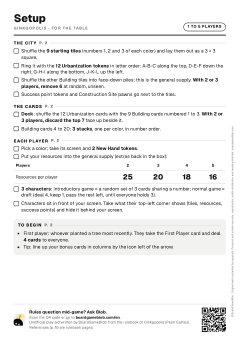 Setup
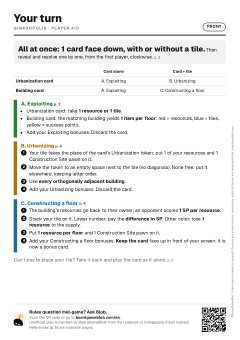 Player aid
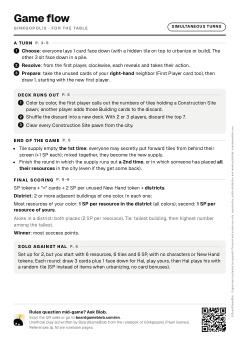 Game flow
The rules in questions
From the official rulebook by Pearl Games. In parentheses: the rulebook’s page. How Blob answers
When does a game of Ginkgopolis end?
The game ends once the tile supply runs out for the second time, or once a player has put all of her resources into the city; the current round is still finished first. (p. 5)
How many resources does each player use?
Each player uses 25 resources with 2 players, 20 with 3, 18 with 4 and 16 with 5; leftover resources go back in the box. (p. 2)
What happens when I build a floor on another player's building?
That player takes back all her resources from the building and scores 1 success point for each one returned. Building over your own building gives you no points. (p. 4)
Do I have to pay anything to build on a higher-numbered or different-colored tile?
Yes, placing a lower number costs you the difference in success points, and covering a tile of another color costs you 1 resource returned to the general supply. (p. 4)
What happens if I play a card with a tile but cannot afford to place the tile?
You keep the tile behind your screen and the action is resolved as though you had played the card alone. (p. 5)
How are districts scored at the end of the game?
In each group of at least two adjacent same-colored buildings, the player with the most resources scores the total resources there, and the runner-up scores her own count. Ties go to the tallest building, then the highest number. (p. 5-6)
What changes in a 2 or 3 player game?
With 2 or 3 players, 6 random tiles are removed during setup, and 7 cards are discarded whenever the deck is formed or rebuilt. Each player also gets more resources. (p. 2, 5)
How does the New Hand token work and what is it worth if unused?
Twice per game you can spend a New Hand token to swap your 4 cards for 4 fresh ones, and you still take your turn. Each token you never spend scores 2 success points at the end. (p. 3)
Does the game still end if a player who placed all her resources gets some back?
Yes, the game still ends even if another player's construction returns some of her resources to her afterwards. (p. 5)
How does the virtual opponent Hal work in the solo game?
Hal gets one card each round and always draws a random tile to build. When he urbanizes he scores points instead of items, and he keeps his Building cards but ignores their black-arrow bonuses. (p. 6)
Common mistakes
- Placing only one resource after building a floorYou put one of your resources per level of the new building, so its resources always equal its number of tiles. (p. 4)
- Scoring a lone building as a districtA district needs two or more touching buildings sharing one color. A building standing alone never counts as one. (p. 5)
- Discarding the card used to construct a floorThat card stays face-up in front of your screen and grants its bonus for the rest of the game. Cards played alone or to urbanize are discarded. (p. 3-4)
- Stopping the game the moment an end condition hitsWhen an end condition is met, the current round is still played out before final scoring. (p. 5)
What’s in the rulebook
See the 3 other parts
Tap a part and Blob explains it.
Expansions
The game
- Players
- 1–5
- Length
- 45 min
- Age
- 13+
- Released
- 2012
- Designer
- Xavier Georges
- Publisher
- Pearl Games
- Expansions
- 1
- Rules
- Official rulebook