Gloomhaven rules
Cephalofair Games · 2017
- Players
- 1–4
- Minutes
- 60–120
- Age
- 14+
Ask your question: I answer about this game’s rules.
The game in 30 seconds
A cooperative campaign game: your party of characters plays scenario after scenario, room by room, against monsters driven by their own ability decks. You act with a hand of cards that shrinks as the fight goes on, so manage your rests carefully. Between scenarios, your heroes earn gold, items and levels while chasing their personal quests.
A turn, in short
- Secretly pick two cards from your hand, or declare a long rest.
- Reveal your cards along with one card per monster type: lowest initiative acts first.
- On your turn, play one card for its upper action and the other for its lower action, in whichever order you like.
- End of round: elements weaken, some decks get reshuffled and you may take a short rest.
How to win
- SuccessMeet the victory condition shown on the scenario page. The current round is finished, then the scenario ends. (p. 12, 33)
- FailureIf every character becomes exhausted, the scenario is lost. You still keep the gold and experience you gathered. (p. 28, 33)
Printable play aids
4 free A5 play aids for Gloomhaven, from the rulebook: step-by-step setup, a player aid for everyone, the turn sequence, and a quick reference.
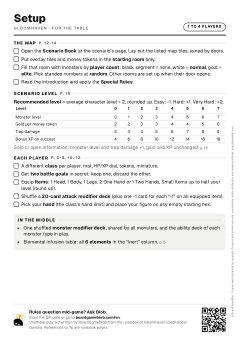 Setup
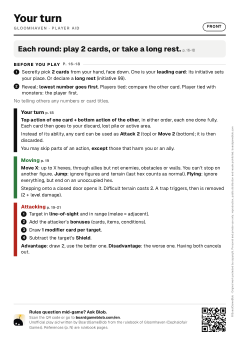 Player aid
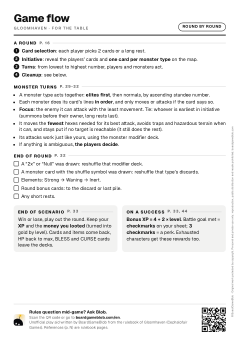 Game flow
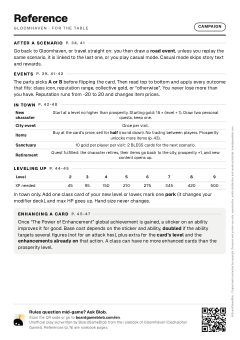 Reference
The rules in questions
From the official rulebook by Cephalofair Games. In parentheses: the rulebook’s page. How Blob answers
How does a long rest work in Gloomhaven?
A long rest takes your whole turn at initiative 99: you choose one discarded card to lose, take the other discards back into your hand, heal 2 and refresh your spent items. You need at least two discarded cards to rest at all. (p. 17)
What is the difference between a short rest and a long rest?
A short rest happens during cleanup at the end of a round and costs no turn, but the lost card is picked at random. A long rest uses your entire turn, lets you choose which card to lose, and also heals 2 and refreshes spent items. (p. 17)
When does a character become exhausted?
A character is exhausted when their hit points drop below one, or when at the start of a round they cannot play two cards and cannot rest either. An exhausted character leaves the map for the rest of the scenario, and if everyone is exhausted the scenario is lost. (p. 28)
How do monsters choose which character to attack?
Each monster focuses on the enemy it can attack using the fewest movement points; distance from its current hex breaks a tie, then the earliest initiative. Characters on a long rest are focused on last, and summons come before their summoner. (pp. 29–30)
Can I lose cards instead of taking damage?
Yes. Any time damage comes your way, you may cancel it by losing one card from your hand or two cards from your discard pile; other effects of the attack still happen. The two cards you selected for the round cannot be used this way before you act. (p. 28)
How is the recommended scenario level calculated?
Take the average level of the characters, halve it and round up: that is Normal difficulty. Subtract 1 for Easy, add 1 for Hard or 2 for Very Hard; the level ranges from 0 to 7 and is locked once play begins. (p. 15)
Do you get experience for killing monsters in Gloomhaven?
No. Killing a monster gives no experience by itself; you only earn experience by performing actions that show an experience value, plus the bonus for completing a scenario, which is four plus twice the scenario level. (pp. 27, 33)
If I play a card just for its basic Attack 2 or Move 2, is it lost?
No. Any played card can be used as Attack 2 on its top half or Move 2 on its bottom half, and a card used this way always goes to the discard pile, whatever symbols it shows. (p. 18)
What happens to the players' money and cards when a scenario fails?
Even after a failure, characters keep the experience they earned and turn their looted money tokens into gold, then recover all their cards and items. Battle goal checkmarks, the bonus experience and the scenario rewards require a success. (pp. 10, 33)
How do Advantage and Disadvantage work?
With Advantage you draw two attack modifier cards and keep the better one; with Disadvantage you keep the worse one and ignore rolling modifiers. They never stack, and having both cancels them out. A ranged attack against an adjacent enemy has Disadvantage. (pp. 20–21)
Common mistakes
- Using the top half of both cardsOne card gives its top action and the other its bottom action. You can never take two actions from the same half. (p. 18)
- Resting with a single discarded cardAny rest, short or long, needs at least two cards in your discard pile and always costs you one of them. (p. 17)
- Telling others your exact initiativeYou may talk strategy in general terms, but never show your hand or give a precise initiative, number or card title. (p. 17)
- Expecting experience for every killKilling a monster earns nothing by itself. Only actions carrying an experience icon, once performed, give you experience. (p. 27)
What’s in the rulebook
See the 22 other parts
Tap a part and Blob explains it.
Expansions
The game
- Players
- 1–4
- Length
- 60–120 min
- Age
- 14+
- Released
- 2017
- Designer
- Isaac Childres
- Publisher
- Cephalofair Games
- Expansions
- 10
- Rules
- Official rulebook