Lucky Numbers rules
Ravensburger AG · 2012
- Players
- 1–4
- Minutes
- 20
- Age
- 8+
Ask your question: I answer about this game’s rules.
The game in 30 seconds
A light placement game where each player fills a garden grid with clovers numbered 1 to 20. Every row and every column must always increase as you go. The first player to cover all their spaces wins; if the face-down clovers run out first, the player with the fewest gaps wins.
A turn, in short
- Flip a face-down clover from the middle, or take one of the face-up clovers lying there.
- Put it on an empty space or swap it with a clover already on your board, keeping every row and column ascending.
- A declined or swapped-out clover goes face-up to the middle, available to everyone.
How to win
- Full gardenFill the last empty space of your board while respecting the Placement Rules and you win. (p. 4)
- Clovers run outIf the last face-down clover is revealed, that turn finishes and the player with the fewest empty spaces wins. (p. 4)
Printable play aids
3 free A5 play aids for Lucky Numbers, from the rulebook: step-by-step setup, a player aid for everyone, and the turn sequence.
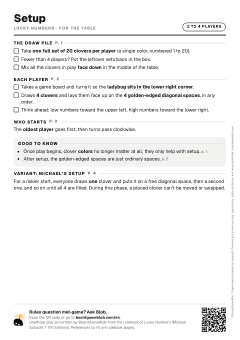 Setup
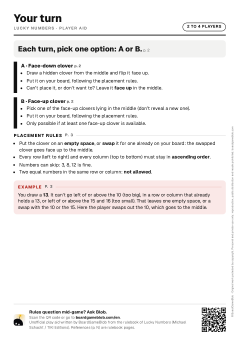 Player aid
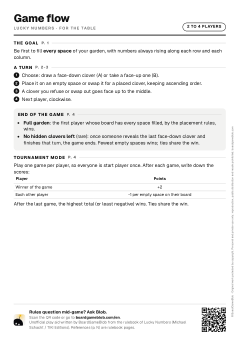 Game flow
The rules in questions
From the official rulebook by Ravensburger AG. In parentheses: the rulebook’s page. How Blob answers
How does a game of Lucky Numbers end?
The first player who fills every space on their board while following the Placement Rules wins. In rare cases the game also ends once someone reveals the last face-down clover and finishes that turn. (p. 4)
Who wins if the face-down clovers run out before anyone fills their garden?
The player who flipped the last clover completes their turn, then whoever has the fewest empty spaces on their board wins. Tied players all share the victory. (p. 4)
Can I place the same number twice in one row or column?
No. The rulebook example forbids placing a 13 in a row or column that already holds a 13, because it would be equal rather than higher. Numbers don't have to be consecutive, though. (p. 3)
Can I swap a clover that is already on my board?
Yes. Instead of filling an empty space, you may replace a placed clover with your new one, as long as the order still works. The removed clover goes face-up to the middle of the table. (p. 3)
What happens if I draw a clover I don't want to place?
You may simply decline it, even if it would fit somewhere: it stays face-up in the center, where other players can later take it. (p. 2)
How do I set up my starting clovers in Lucky Numbers?
Each player draws 4 clovers and puts them face-up on the four gold-edged diagonal spaces, ladybug in the lower right. It's wise to keep small numbers top-left and big numbers bottom-right. (p. 2)
Do the clover colors matter during play?
No. Colors only help you sort out one 1-to-20 set per player during setup; once the clovers are shuffled, only the numbers count. (p. 1)
In tournament mode, how are points scored across several games?
Play one game per player so everyone starts once. After each game, the winner gets 2 points and every other player loses 1 point per empty space. The highest total after all games wins. (p. 4)
In Michael's Setup variant, can I rearrange my diagonal clovers?
No. Players draw and place their diagonal clovers one at a time, and once a clover is placed during this setup it can't be moved or exchanged. (p. 4)
Common mistakes
- Allowing equal numbers in a row or columnA clover equal to one already in its row or column can't go there; numbers must increase left to right and top to bottom. (p. 3)
- Treating the gold diagonal as specialThe gold-edged spaces only matter at setup. Afterwards they work like any other space. (p. 2)
- Taking a face-up clover when none is outOption B is only possible if at least one face-up clover is already in the middle of the table. (p. 2)
What’s in the rulebook
Tap a part and Blob explains it.
The game
- Players
- 1–4
- Length
- 20 min
- Age
- 8+
- Released
- 2012
- Designer
- Michael Schacht
- Publisher
- Ravensburger AG
- Rules
- Official rulebook