Marrakech rules
Gigamic · 2007
- Players
- 2–4
- Minutes
- 30
- Age
- 6+
Ask your question: I answer about this game’s rules.
The game in 30 seconds
You are a rug merchant in the Marrakesh market, trying to keep as many of your rugs showing as possible while holding on to your money. A shared figure, Assam, wanders the board: where he stops decides whether you pay a rival and where you lay your next rug. Visible rug halves and dirhams each score a point.
A turn, in short
- Face Assam straight ahead or a quarter turn left or right, then roll and move him that many spaces.
- If he stops on a rival's rug, pay its owner for the linked group of that color.
- Lay one of your rugs touching a side of Assam's square.
How to win
- PointsWhen the final rug is down, each visible rug half and each dirham you hold is worth 1 point. (p. 2)
- TieAmong tied players, the one with more dirhams wins. (p. 2)
Printable play aids
3 free A5 play aids for Marrakech, from the rulebook: step-by-step setup, a player aid for everyone, and the turn sequence.
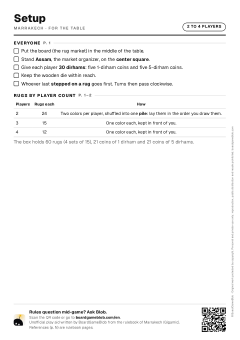 Setup
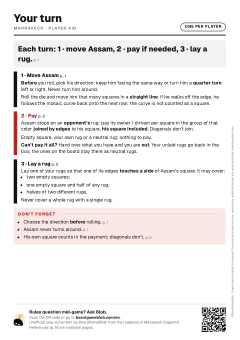 Player aid
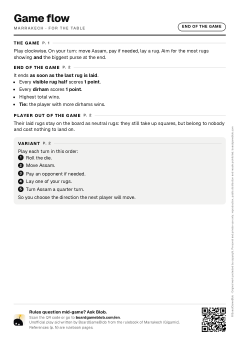 Game flow
The rules in questions
From the official rulebook by Gigamic. In parentheses: the rulebook’s page. How Blob answers
How do you win Marrakech?
The highest score wins: when the final rug has been placed, every visible rug half scores 1 point and every dirham in hand scores 1 point. (p. 2)
What happens if there is a tie in Marrakech?
The tied player holding more dirhams is the winner. (p. 2)
How many rugs and coins does each player get?
Everyone starts with 30 dirhams (five 1-coins and five 5-coins). With 3 players each takes 15 rugs of one color; with 4 players, 12 rugs of one color. (p. 1)
How do you play Marrakech with 2 players?
Each player takes 30 dirhams and 24 rugs in two colors, shuffled together into one draw pile. Otherwise the normal 3-4 player rules apply. (p. 2)
Can Assam turn around or go backwards?
No. Before rolling, you may keep his facing or rotate him a quarter turn left or right, but never a half turn. (p. 1)
What happens when Assam reaches the edge of the board?
He follows the curved mosaic at the border and comes back onto the neighboring row heading the other way. Passing through the mosaic is not counted as a space. (p. 1)
How much do I pay when Assam lands on another player's rug?
You pay its owner 1 dirham per square in the group of same-colored squares linked by edges to the square Assam stands on, counting that square too. Diagonals do not link squares. (p. 2)
Can I place my rug so it completely hides another rug in one placement?
No. A single rug may not cover another rug fully. You may cover two empty squares, an empty square plus half a rug, or halves of two different rugs. (p. 2)
What happens if a player cannot afford to pay in Marrakech?
They give what money they have and are eliminated. Their unplaced rugs go back in the box, and their rugs on the board stay as neutral rugs that never require payment. (p. 2)
Where must I place my rug after moving Assam?
Your rug must be adjacent to Assam's square: one of its edges touches one of the four sides of that square. (p. 2)
Common mistakes
- Choosing Assam's direction after the rollPick his facing before rolling. He may rotate a quarter turn but never turn around. (p. 1)
- Leaving Assam's own square out of the paymentCount every same-colored square joined by an edge, including the one he stands on. Diagonals don't count. (p. 2)
- Hiding a whole rug with one placementA single rug can never fully cover another; it takes two separate placements. (p. 2)
- Counting mosaic turns as a spaceWhen Assam loops back at the edge, the mosaic curve itself costs no movement. (p. 1)
What’s in the rulebook
Tap a part and Blob explains it.
The game
- Players
- 2–4
- Length
- 30 min
- Age
- 6+
- Released
- 2007
- Designer
- Dominique Ehrhard
- Publisher
- Gigamic
- Rules
- Official rulebook