Match of the Century rules
Deep Print Games · 2023
- Players
- 2
- Minutes
- 30–45
- Age
- 10+
Ask your question: I answer about this game’s rules.
The game in 30 seconds
A two-player duel recreating the 1972 World Chess Championship between Spassky and Fischer, each with their own 16-card deck. The match is a series of short games of up to four exchanges, where you pit one card against your rival's to tip the advantage marker your way. First to 6 points takes the title.
A turn, in short
- The player with the initiative puts a card in a free exchange section on their side, adding up to 2 pawns to strengthen it.
- The opponent answers in the same section on their side and may also add up to 2 pawns.
- Compare strengths: the weaker side may use its piece's effect, the stronger side moves the advantage marker by the section's value.
- If one player's lead beats the total of the empty sections, the game is over; otherwise play the next exchange.
How to win
- A gameThe advantage marker sits on your side at the end: your king moves one space. On the neutral space, both kings move. (p. 8)
- The matchYour king reaches the center of the match track. If both arrive together, Spassky wins. (p. 10)
Printable play aids
3 free A5 play aids for Match of the Century, from the rulebook: step-by-step setup, a player aid for everyone, and the turn sequence.
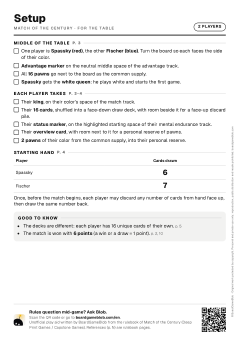 Setup
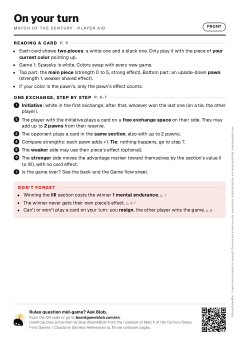 Player aid
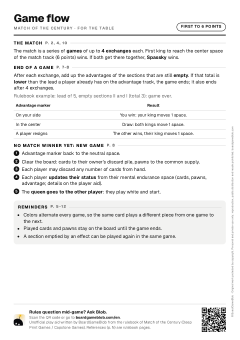 Game flow
The rules in questions
From the official rulebook by Deep Print Games. In parentheses: the rulebook’s page. How Blob answers
How many points do you need to win Match of the Century?
You need 6 points. Each game you win scores 1 point and a drawn game gives both players 1 point; the first king to reach the center of the match track takes the title. (p. 2, p. 10)
Who wins if both kings reach the center at the same time?
Spassky does. As the defending champion, he keeps the title when both players hit 6 points together. (p. 10)
Does the winner of an exchange use their card's effect?
No. Only the player with the lower total strength may trigger their piece's effect; the winner simply moves the advantage marker by the value of that exchange section. (p. 6-7)
What happens when an exchange is tied?
Nothing is triggered and no advantage moves. The cards stay on the board, and the initiative passes to whoever did not have it in that exchange. (p. 6-7)
How many pawns can I add to a card?
At most 2. Each card has two pawn spaces above it, and every pawn you put there adds 1 to its strength. Pawns come from your personal reserve. (p. 6-7)
When does a game end before all four exchanges are played?
As soon as the total value of the empty exchange sections is less than the lead one player already has on the advantage track. Then that player wins the game. (p. 7-8)
If I play a card with its pawn pointing upwards, which effect can I use?
Only the small pawn effect next to it, and only if you lose the exchange. The upright side must always match the chess color you are playing in the current game. (p. 5, p. 7)
What happens when my draw deck runs out?
Shuffle your discard pile into a new deck and keep drawing. Once you finish drawing, you lose 1 mental endurance, then discard down to your hand limit if needed. (p. 9)
When do the pawn and advantage icons on the mental endurance track apply?
Only between games, during the status update. Your hand limit is the one icon that matters at all times; extra pawns and start advantage modifiers are applied in step 4 of starting a new game. (p. 9-10)
Can I refuse to play a card during an exchange?
Yes, but that means resigning the game. Your opponent wins it and moves their king one space toward the center. (p. 8)
Common mistakes
- Using the effect of the card that wonThe winner only gains the section's advantage. It is the losing player who may apply their piece's effect, if they want to. (p. 7)
- Playing a card the wrong way upThe piece of the color you play this game must point upwards. If that is the pawn, only the pawn's effect counts. (p. 5, p. 7)
- Forgetting the cost of the IIII sectionWinning the four-bar section gives you 4 spaces of advantage, but you also lose 1 mental endurance right away. (p. 7)
- Taking track bonuses during a gameApart from your hand limit, the icons on your mental endurance track only matter when you update your status between games. (p. 9)
What’s in the rulebook
See the 2 other parts
Tap a part and Blob explains it.
The game
- Players
- 2
- Length
- 30–45 min
- Age
- 10+
- Released
- 2023
- Designer
- Paolo Mori
- Publisher
- Deep Print Games
- Rules
- Official rulebook