MicroMacro: Crime City rules
Edition Spielwiese · 2020
- Players
- 1–4
- Minutes
- 15–45
- Age
- 12+
Ask your question: I answer about this game’s rules.
The game in 30 seconds
A cooperative detective game played on one huge illustrated city map. Each case is a small deck of cards: a card asks a question, and the whole team scours the map for the scene that answers it. Once the right scene is found, the next card moves the investigation on, until the final task is solved.
A turn, in short
- The Lead Investigator reads aloud the task on the black front of the top card, without flipping it.
- Everyone searches the city map together for the exact scene that answers the task.
- When you think you have it, the Lead Investigator checks the coordinates and picture on the back.
- If you are right, they read the back aloud, show the picture and set the card aside.
- If you are wrong, they put the card back unread and you keep searching.
Printable play aids
3 free A5 play aids for MicroMacro: Crime City, from the rulebook: step-by-step setup, a player aid for everyone, and the turn sequence.
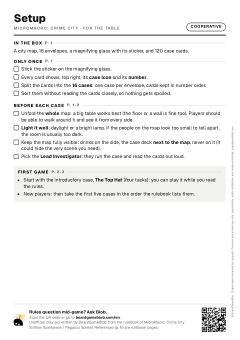 Setup
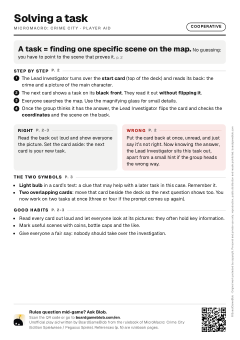 Player aid
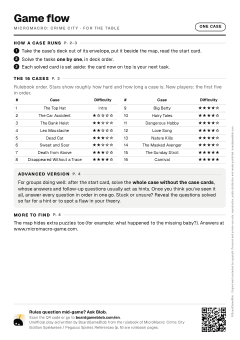 Game flow
The rules in questions
From the official rulebook by Edition Spielwiese. In parentheses: the rulebook’s page. How Blob answers
Which case should we play first in MicroMacro: Crime City?
Start with the introductory case, The Top Hat, which you can play while learning the rules. New players should then tackle the first five cases in the listed order. (p. 2-3)
What does the Lead Investigator do?
One player is picked to run the investigation and read every card aloud: the task on the black front, then the back once the group has found the right scene. (p. 2)
What happens when we give a wrong answer?
The Lead Investigator puts the card back unread and just says you are wrong. Since they now know the answer, they stop helping on that task, apart from a small hint if the group is heading the wrong way. (p. 2)
Can we guess an answer and flip the card to check?
No. You may only check once you have located a scene on the map that backs up your answer; then the Lead Investigator compares it with the coordinates and picture on the back. (p. 2)
What does the light bulb icon mean on a case card?
It marks a clue in the card text that could help you solve a later task of the same case, so it is worth remembering. (p. 3)
Can several tasks be open at the same time?
Yes. When a card front tells you to move it next to the deck, its question stays visible and you work on two tasks at once; if this repeats, three or four can be open. (p. 3)
Can we put the case cards on top of the city map while we search?
No, keep the whole map visible and place the cards beside it, or you might hide the very scene you need. Bright light and room to walk around the table also help a lot. (p. 1)
How does the advanced version of MicroMacro: Crime City work, and what if we get stuck?
After reading the start card, you try to crack the whole case without the other cards, then answer every question in order in one go. If you are stuck, you may reveal the questions solved so far for a hint. (p. 4)
Common mistakes
- Laying the cards on the mapThe full map must stay visible. Keep the cards next to it, or you may cover the scene you are looking for. (p. 1)
- Answering on a hunchAn answer only counts if you can point to a scene on the map that supports it. Guessing is not allowed. (p. 2)
- Reading the back after a wrong answerThe Lead Investigator returns the card without reading it, then stops helping on that task except for a small hint. (p. 2)
What’s in the rulebook
See the other part
Tap a part and Blob explains it.
Expansions
The game
- Players
- 1–4
- Length
- 15–45 min
- Age
- 12+
- Released
- 2020
- Designer
- Johannes Sich
- Publisher
- Edition Spielwiese
- Expansions
- 1
- Rules
- Official rulebook