Orbis rules
Space Cowboys · 2018
- Players
- 2–4
- Minutes
- 45
- Age
- 10+
Ask your question: I answer about this game’s rules.
The game in 30 seconds
Each player is a god shaping a personal universe: a pyramid of 14 Region tiles. You pick tiles from the center, pay for them with your Worshipers and stack them by color. After 15 rounds, whoever has the most Creation Points wins.
A turn, in short
- Pick one of the nine Region tiles in the center, or your God tile once per game.
- Put a Worshiper of its color on each orthogonal neighbor, then collect the Worshipers on your tile.
- Pay its cost and add it to your pyramid, or flip it to Wilderness.
- Apply its effect, cut your Worshipers down to ten and refill the central square.
How to win
- Most Creation PointsAfter 15 rounds, add up the CPs in your pyramid, your God tile and your Temple token. Ties go to the most Worshipers left. (p. 6)
Printable play aids
3 free A5 play aids for Orbis, from the rulebook: step-by-step setup, a player aid for everyone, and the turn sequence.
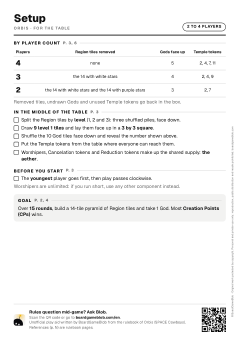 Setup
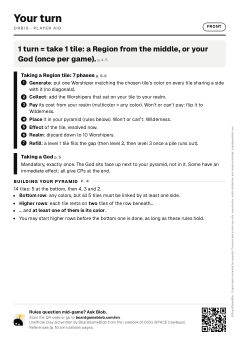 Player aid
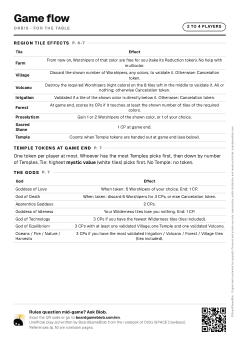 Game flow
The rules in questions
From the official rulebook by Space Cowboys. In parentheses: the rulebook’s page. How Blob answers
How many rounds does a game of Orbis last?
Fifteen rounds per player: you take 14 Region tiles to build your pyramid and, exactly once, a God tile. (p. 4)
How do you place tiles in your Orbis pyramid?
Your bottom row holds 5 tiles of any color that must all touch. Each higher tile sits on two tiles below, and one of those two has to share its color. (p. 4)
What happens if I can't pay for or place a Region tile in Orbis?
Flip it over to make it Wilderness. It costs you 1 CP at game end, ignores the same-color placement rule and counts as every color. (p. 5)
Do I still generate Worshipers if my tile becomes Wilderness?
Yes. Taking a tile always puts Worshipers of its color on the neighboring tiles, even when you end up flipping it to Wilderness. (p. 5, p. 8)
What is the Worshiper limit in Orbis?
You may keep at most 10 Worshipers at the end of your turn; discard any extra. During your turn you can also trade 3 of one color for 1 of any color. (p. 6)
Does a Farm's Reduction token lower multicolor costs?
No. A Farm only removes Worshipers of its own color from tile costs; multicolor parts of a cost must still be paid in full. (p. 6, p. 8)
Can I use the Worshipers sitting on a tile to pay for that same tile?
Yes. You collect the Worshipers on the tile you pick before paying, so they can go straight toward its cost. (p. 5, p. 8)
How are Temple tokens handed out at the end of Orbis, and what if two players have the same number of Temples?
Each player with at least one Temple gets one token; whoever has the most Temples picks first. On a tie, the owner of the white tile with the highest mystic value chooses first. (p. 7)
How is a tie broken in Orbis?
Among tied players, the one with the most Worshipers left wins. If that is still equal, the victory is shared. (p. 6)
What changes in a 2-player or 3-player game of Orbis?
You remove star-marked tiles, reveal fewer Gods (4 with three players, 3 with two) and use fewer Temple tokens: 9, 4 and 2 for three players, 7 and 2 for two. (p. 6)
Common mistakes
- Skipping Worshiper generationNeighboring tiles still get Worshipers even when the tile you take ends up flipped to Wilderness. (p. 8)
- Keeping more than ten WorshipersThe limit is checked at the end of every turn: discard whatever is over ten. (p. 6)
- Placing a tile with no matching color beneathFrom the second row up, one of the two supporting tiles must match its color, unless it is Wilderness, which counts as every color. (p. 4-5)
What’s in the rulebook
See the 6 other parts
Tap a part and Blob explains it.
The game
- Players
- 2–4
- Length
- 45 min
- Age
- 10+
- Released
- 2018
- Designer
- Tim Armstrong (II)
- Publisher
- Space Cowboys
- Rules
- Official rulebook