Pax Pamir: Second Edition rules
Wehrlegig Games · 2019
- Players
- 1–5
- Minutes
- 45–120
- Age
- 13+
Ask your question: I answer about this game’s rules.
The game in 30 seconds
You lead an Afghan faction in the nineteenth century, after the Durrani Empire falls. Buy cards from a shared market and play them into your court to place tribes, spies, armies and roads and to unlock new actions. Back the British, Russian or Afghan coalition, and score when Dominance Checks are resolved. A four-point lead or the last check ends the game.
A turn, in short
- Take up to two actions: buy a card from the market, play a card from your hand, or use an action shown on a card in your court.
- Cards matching the favored suit give free bonus actions that sit outside your two-action limit.
- Cleanup: trim your court and hand to their limits, discard events from the leftmost market column, then slide cards left and refill the market.
How to win
- Early endAfter any Dominance Check, a player ahead of everyone else by four or more victory points wins at once. (p. 9, p. 15)
- On pointsOtherwise the game stops after the last Dominance Check, whose points count double, and the highest score wins. (p. 9, p. 15)
Printable play aids
4 free A5 play aids for Pax Pamir: Second Edition, from the rulebook: step-by-step setup, a player aid for everyone, the turn sequence, and a quick reference.
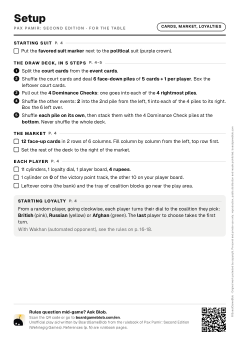 Setup
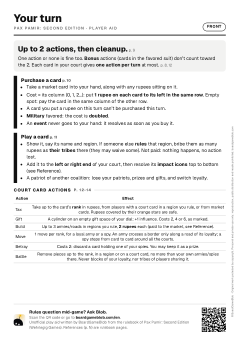 Player aid
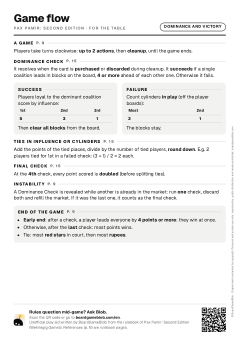 Game flow
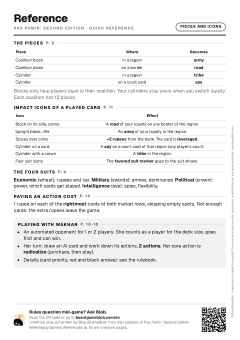 Reference
The rules in questions
From the official rulebook by Wehrlegig Games. In parentheses: the rulebook’s page. How Blob answers
How does a game of Pax Pamir end?
It ends right away if, after any Dominance Check, one player is at least four victory points ahead of everyone else. Otherwise it ends once the last Dominance Check in the deck is resolved, and the highest score wins. (p. 9)
How do you break a tie in Pax Pamir?
Among the tied players, whoever has the most red (military) stars in their court wins; if still tied, the one holding the most rupees wins. (p. 9)
How much does it cost to buy a card from the market?
The leftmost column is free and each column to the right costs one more rupee: you put one rupee on every card to its left in that row. When military is the favored suit, put two rupees on each instead. (p. 10)
What do I need to rule a region?
You need at least one tribe there and more ruling pieces than any other single player, counting your tribes and armies of your coalition. A tie means nobody rules, and enemy armies count against you. (p. 7)
Can I use two actions from the same card in one turn?
No. Each card in your court can be used for just one action per turn, even if it shows several actions and even when that action is a free bonus action. (p. 8, p. 12)
Where do rupees go when I pay for a card-based action like build or betray?
Into the market, not the bank: put one rupee on each of the rightmost cards of both rows, skipping empty slots. Rupees that find no card leave the game, and you cannot buy a card you paid this turn. (p. 12)
What happens to my gifts, prizes and patriots when I change loyalty?
You lose them all: gifts go back to your supply and your prizes and patriots are discarded before you turn your loyalty dial to the new coalition. Playing a patriot or taking a prize from another coalition triggers this. (p. 7, p. 11)
If I lose my last tribe in a region, what happens to my political cards from that region?
Under the Overthrow Rule you must immediately discard every political card of that region from your court. The reverse also applies: losing your last political card of a region removes all your tribes there. (p. 8)
How is a Dominance Check scored, and what changes on the final one?
If one coalition has at least four more blocks than each other coalition, its loyal players score 5/3/1 by influence and all blocks are cleared. Otherwise players score 3/1 by cylinders in play. On the final check, points are doubled before splitting ties. (p. 15)
Can I battle and remove the spies of a player who shares my loyalty?
Yes. You may not remove tribes of players loyal to your coalition, nor armies or roads of your own coalition, but their spies can be removed. You still cannot remove more units than you have armies or spies at that site. (p. 14)
Common mistakes
- Using one card for two actionsEach court card provides only one action per turn, whatever number of action icons it shows, bonus actions included. (p. 8, p. 12)
- Buying a card you just paidAny market card that received one of your rupees this turn, whatever the reason, is off limits for you to buy until next turn. (p. 10)
- Paying action costs to the bankCard-based action costs go onto the rightmost market cards of both rows, one rupee per card. (p. 12)
- Forgetting the Overthrow RuleLosing your last tribe in a region discards your political cards of that region, and losing the last such card removes your tribes there. (p. 8)
What’s in the rulebook
See the 3 other parts
Tap a part and Blob explains it.
The game
- Players
- 1–5
- Length
- 45–120 min
- Age
- 13+
- Released
- 2019
- Designer
- Cole Wehrle
- Publisher
- Wehrlegig Games
- Rules
- Official rulebook