Perudo rules
(Public Domain) · 1800
- Players
- 2–10
- Minutes
- 15–30
- Age
- 8+
Ask your question: I answer about this game’s rules.
The game in 30 seconds
A bluffing dice game for 2 to 6 players. Everyone hides five dice under a cup, then players take turns raising a bid on how many dice of one face sit on the whole table. When someone doubts, all dice are revealed and the loser gives up a die. The last player still holding dice wins.
A turn, in short
- At the start of a round, everyone shakes their cup, turns it over and peeks at their own dice.
- On your turn, raise the bid: a larger quantity, a higher face, or both. You may also switch to aces at half the quantity.
- Or, if you think the last bid is a bluff, call dudo: everyone reveals and the dice are counted, aces included.
- Whoever was wrong puts one die in the pouch and opens the next round.
How to win
- Last one with diceA player who loses their final die is out. The last player who still has any dice wins the game. (p. 4, p. 9-10)
Printable play aids
3 free A5 play aids for Perudo, from the rulebook: step-by-step setup, a player aid for everyone, and the turn sequence.
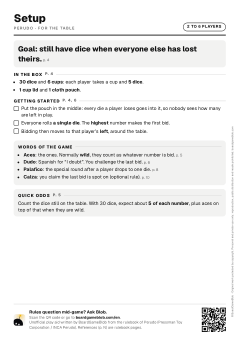 Setup
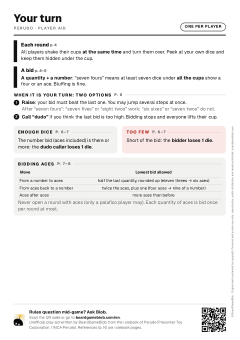 Player aid
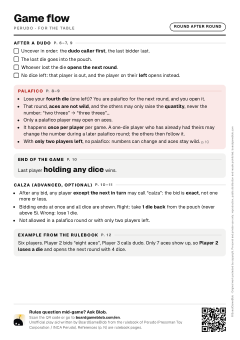 Game flow
The rules in questions
From the official rulebook by (Public Domain). In parentheses: the rulebook’s page. How Blob answers
Who starts the first round of Perudo?
Everyone rolls a single die, and whoever rolls highest makes the opening bid. After that, the player who lost a die opens each new round. (p. 4, p. 7)
Are ones wild in Perudo?
Yes. Ones are called aces and count as whatever face the current bid names, so they are added to that value when the dice are revealed. They stop being wild in a palafico round. (p. 5, p. 9)
What counts as a higher bid?
A bid must beat the previous one by raising the quantity, the face value, or both. After seven fours, seven fives or eight twos are fine, but six sixes or seven twos are not. You may also jump several steps. (p. 6)
How many aces do I need to bid after a bid on another number?
Take half the quantity of the previous bid and round up. So eight sixes can be followed by four aces, and eleven threes requires at least six aces. (p. 7)
How do I switch back from aces to a normal number?
Double the number of aces just bid and add one. After four aces you must call at least nine of a number, or else bid at least five aces, or call dudo. (p. 7-8)
Can the first bid of a round be on aces?
No, aces cannot be the opening bid of a round. The only exception is a palafico player, who is allowed to open on aces. (p. 8, p. 9)
Who loses a die when someone calls dudo?
Everyone reveals and the matching faces plus aces are counted. If there are fewer than the bid, the bidder loses a die; if there are at least as many, the doubter loses one. Lost dice go into the pouch. (p. 6-7)
What changes in a palafico round, when a player is down to one die?
In the round right after a player loses their fourth die, aces are not wild and the others may only raise the quantity, not the face. Each player gets this only once per game, and it no longer applies with two players left. (p. 8-10)
How does the optional calza rule work, and can I gain a die?
Any player except the next to bid can call calza, claiming the last bid is exact. If right, they take a die back from the bag, never exceeding five; if wrong, they lose one. It is not used in palafico rounds or with two players. (p. 10-11)
Common mistakes
- Forgetting that aces are wildOnes count as the face named in the bid when you count after a dudo, except during a palafico round. (p. 5, p. 9)
- Getting the aces conversion wrongMoving to aces halves the quantity, rounded up. Moving back from aces means doubling the aces and adding one. (p. 7-8)
- Changing the face in a palafico roundAfter a player drops to one die, the others may only raise the quantity for that round, and aces are not wild. (p. 8-9)
- Playing palafico with two players leftOnce only two players remain, palafico no longer applies: faces can change and aces stay wild. (p. 10)
What’s in the rulebook
Tap a part and Blob explains it.
Expansions
The game
- Players
- 2–10
- Length
- 15–30 min
- Age
- 8+
- Released
- 1800
- Designer
- Richard Borg
- Publisher
- (Public Domain)
- Expansions
- 1
- Rules
- Official rulebook