Pyramids rules
Hobby Japan · 2017
- Players
- 2–5
- Minutes
- 30
- Age
- 10+
Ask your question: I answer about this game’s rules.
The game in 30 seconds
In Pyramids, each player builds an Egyptian necropolis made of three edifices: a Pyramid, an Obelisk and a Tomb. Each round you pick a god that sets your turn order and what you may build, then take a pair of cards showing colored stones. After ten rounds your Pyramid is complete and points are counted.
A turn, in short
- The first player reveals one pair of cards per player to form the quarry.
- Clockwise from the first player, everyone takes one available God tile.
- In God tile number order, take a pair of cards and build right away.
- Add one card to your Pyramid, and optionally one to the Obelisk or Tomb if your god allows.
- Keep at most one card in hand, then pass the First Player token to the left.
How to win
- Most pointsAfter round ten, add up Pyramid, Obelisk, Tomb and correctly placed Glyphs; the highest total wins, and tied players share the victory. (p. 11)
Printable play aids
3 free A5 play aids for Pyramids, from the rulebook: step-by-step setup, a player aid for everyone, and the turn sequence.
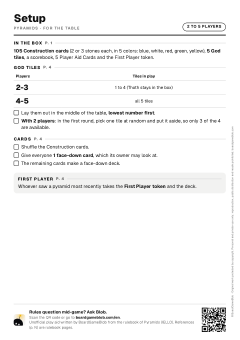 Setup
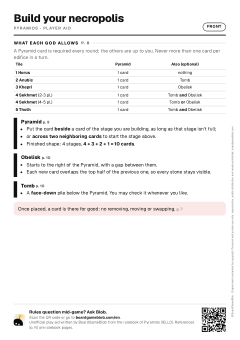 Player aid
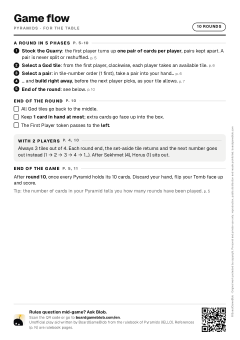 Game flow
The rules in questions
From the official rulebook by Hobby Japan. In parentheses: the rulebook’s page. How Blob answers
How many rounds are there in Pyramids?
There are 10 rounds. The game ends once every player has finished a Pyramid of 10 cards, so counting the cards in your Pyramid tells you which round it is. (p. 5, 11)
Which God tiles do you use for each player count in Pyramids?
With 2 or 3 players, use God tiles 1 to 4 and leave Thoth (5) in the box. With 4 or 5 players, all five tiles are used. (p. 4)
How does the 2-player game of Pyramids work?
Only 3 God tiles are available each round. One is set aside at random for the first round; at each round end it returns and the next number is removed instead, cycling 1, 2, 3, 4, then 1 again. (p. 4, 10)
Can I place two cards in the same edifice in one turn?
No. Each turn you play at most one card per edifice. A card in your Pyramid is mandatory; the Obelisk and Tomb depend on your God tile and are optional. (p. 7-8)
How many cards can I keep in hand between rounds?
Just one. At the end of a round, any extra cards are discarded face-up into the box. At game end, cards still in hand are discarded too. (p. 10-11)
How is the Pyramid scored, including the 10-point bonus?
For each color, your biggest group of orthogonally connected stones gives 1 point per stone. Your single biggest group gives 1 extra point per stone. If every color scores 3 or more, add 10 points. (p. 11)
If two colors tie for the most stages in my Obelisk, do both score?
No. Only one color is scored, even when several are tied; you earn points for the number of stages that color appears in (1, 3, 6, 10, then 15 for five or more). (p. 12)
Who gets the Tomb points when two players have the same number of stones in a color?
Nobody. A tie means no majority for that color, so no one earns its 5 points. Each color you hold a clear majority in is worth 5 points. (p. 12)
What does Sekhmet allow in a 4 or 5 player game compared to 2 or 3 players?
At 4-5 players, Sekhmet lets you add a Pyramid card plus one card in either your Tomb or your Obelisk. At 2-3 players it allows both, so up to 3 cards. (p. 8)
Can I look at the cards in my Tomb?
Yes. Tomb cards sit face-down below your Pyramid, but you may check them at any moment; they are revealed to everyone only during final scoring. (p. 10)
Common mistakes
- Waiting for everyone to pick before buildingYou build immediately after taking your pair, before the next player chooses theirs. (p. 6-7)
- Splitting a pair from the quarryThe pairs revealed by the first player can never be broken up or rearranged: you take a whole pair. (p. 5)
- Playing Sekhmet the same way at every player countWith 2-3 players she allows both Tomb and Obelisk on top of the Pyramid; with 4-5 players, only one of the two. (p. 8)
- Moving a card already placedOnce in your necropolis, a card stays put until the end: no removing, rearranging or swapping. (p. 7)
What’s in the rulebook
See the 5 other parts
Tap a part and Blob explains it.
The game
- Players
- 2–5
- Length
- 30 min
- Age
- 10+
- Released
- 2017
- Designer
- Matthew Dunstan
- Publisher
- Hobby Japan
- Rules
- Official rulebook