Quadropolis rules
Days of Wonder · 2016
- Players
- 2–4
- Minutes
- 30–60
- Age
- 8+
Ask your question: I answer about this game’s rules.
The game in 30 seconds
You are the mayor of a growing city. Over four rounds you send numbered Architects to pick buildings from a shared Construction Site and build them in your city. Each building type scores in its own way, but only once it is activated with Inhabitants or Energy. The highest score wins.
A turn, in short
- Place one of your Architects at the end of a row or column of the Construction Site: its number tells which square you take.
- Move the Urbanist onto the square you just emptied.
- Build the tile in your city, in the row or column matching your Architect's number.
- Take the Inhabitants and Energy Units shown on the tile.
How to win
- Most pointsAfter the fourth round only activated buildings score, and every idle Inhabitant or Energy Unit costs 1 point. Highest total wins. (p. 4)
- Tie-breakersMost Inhabitants on buildings wins a tie; if still tied, the city with fewest empty spaces wins. (p. 4)
Printable play aids
4 free A5 play aids for Quadropolis, from the rulebook: step-by-step setup, a player aid for everyone, the turn sequence, and a quick reference.
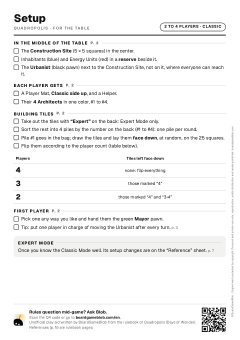 Setup
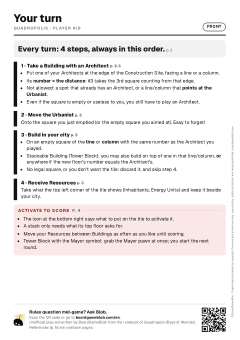 Player aid
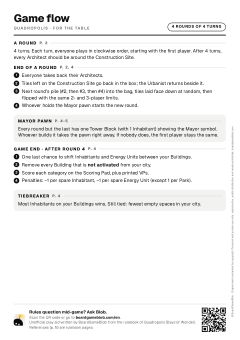 Game flow
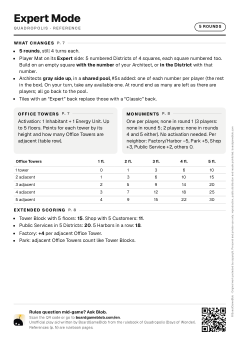 Reference
The rules in questions
From the official rulebook by Days of Wonder. In parentheses: the rulebook’s page. How Blob answers
How do you choose which building to take from the Construction Site in Quadropolis?
Put one of your Architects at the end of a row or column: its number tells you how many squares to count in from that edge. So Architect 3 gives you the third tile of that row. (p. 2)
Where are you not allowed to place an Architect?
You can never put an Architect on a spot another Architect already holds, and it can never point at the Urbanist. Even if it reaches an empty square, you still play it and move the Urbanist there. (p. 2-3)
Where can I put the building I took in my city?
On an empty square in the row or the column whose number equals your Architect's number. A stackable building like a Tower Block can also go on top of one of yours if its row, column or new floor number matches. (p. 3)
What happens if I can't or don't want to place the building I took?
You discard it. In that case you skip the resources step, so you get no Inhabitants or Energy Units from that tile. (p. 3)
Do unused Inhabitants and Energy Units cost points at the end?
Yes, each one left idle is -1 VP. Inhabitants avoid it by activating a building or sitting in a Shop as Customers; one surplus Energy Unit per Park is also safe. (p. 4)
Can I move my Inhabitants and Energy Units between buildings during the game?
Yes, freely and at any time. Their placement only becomes final at game end, after one last chance to rearrange them before scoring. (p. 4)
How does the Mayor pawn change hands, and who goes first next round?
Each round, one Tower Block shows the Mayor symbol. Whoever builds it grabs the Mayor pawn at once and starts the next round. If nobody builds it, the current first player keeps the role. (p. 4-5)
How many resources does a tall Tower Block need, and how do Harbors score if I have several rows of them?
A stacked building only needs the resources shown on its top floor, so a 3-floor Tower Block needs 1 Energy Unit. For Harbors, only your longest unbroken row and your longest unbroken column of activated Harbors count. (p. 4, 6)
Do diagonal tiles count as adjacent for Parks, Factories or Monuments?
No. Tiles touching only at a corner are never adjacent, for any building's scoring. (p. 5)
In Expert Mode, how do Architects and placement work differently?
Architects form a shared pool with one of each number (1 to 5) per player, and anyone may take any of them. You place a tile on an empty square bearing that number or in the District with that number. (p. 7)
Common mistakes
- Forgetting to move the UrbanistIt goes to the emptied square every turn, even when your Architect pointed at an empty square. Ask one player to handle it. (p. 3)
- Counting diagonal tiles as adjacentTwo tiles that only touch at a corner are never neighbors for scoring. (p. 5)
- Adding up every Harbor rowYou only score your longest line and your longest column of activated Harbors. (p. 6)
What’s in the rulebook
See the 5 other parts
Tap a part and Blob explains it.
Expansions
The game
- Players
- 2–4
- Length
- 30–60 min
- Age
- 8+
- Released
- 2016
- Designer
- François Gandon
- Publisher
- Days of Wonder
- Expansions
- 8
- Rules
- Official rulebook