Qwirkle rules
MindWare · 2006
- Players
- 2–4
- Minutes
- 45
- Age
- 6+
Ask your question: I answer about this game’s rules.
The game in 30 seconds
Holding six tiles, players take turns extending a shared grid of lines on the table. Every line is either one colour or one shape, and no tile may appear twice in it. Each line you create or extend scores points. The game ends when someone empties their hand after the bag runs out.
A turn, in short
- Play one or more tiles from your hand that share a colour or shape, all in a single line.
- Score one point per tile in every line you made or extended.
- Draw from the bag until you hold six tiles again.
- If you can't or won't place anything, trade some or all of your tiles instead.
How to win
- Most pointsThe highest score wins. Whoever plays their last tile first ends the game and takes a six-point bonus. (p. 2)
Printable play aids
3 free A5 play aids for Qwirkle, from the rulebook: step-by-step setup, a player aid for everyone, and the turn sequence.
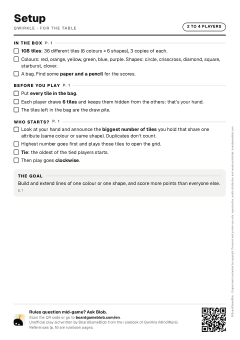 Setup
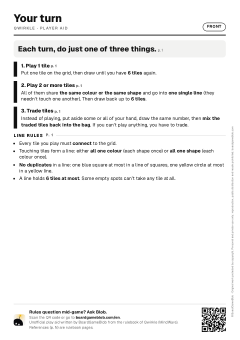 Player aid
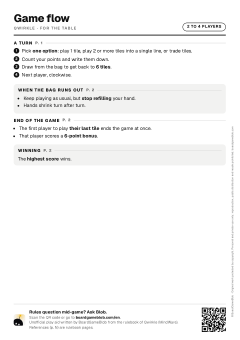 Game flow
The rules in questions
From the official rulebook by MindWare. In parentheses: the rulebook’s page. How Blob answers
Who goes first in Qwirkle?
The player who can play the most tiles sharing one colour or one shape starts, playing those tiles. Duplicate tiles don't count toward that number, and the oldest player breaks a tie. (p. 1)
What can you do on your turn in Qwirkle?
You do one thing: place one tile, place several tiles that share a colour or shape in a single line, or trade some or all of your hand. After placing, refill your hand to six. (p. 1)
Do the tiles I play in one turn have to touch each other?
No. They must all go in the same line and share one attribute, but tiles already on the grid can sit between them. (p. 1)
How do you score points in Qwirkle?
Each line you create or extend scores one point per tile in it, counting tiles that were already there. A tile belonging to two lines can score twice. (p. 1)
What is a Qwirkle and how many points is it worth?
A Qwirkle is a completed line of six tiles: one colour in six shapes, or one shape in six colours. It gives a six-point bonus on top of the six tiles, so at least twelve points. (p. 1)
Can a line in Qwirkle have more than six tiles or two identical tiles?
No. Lines longer than six are forbidden, and a line may not repeat a tile: a square line holds each colour once, a yellow line each shape once. (p. 1)
What happens if I can't place any tile on my turn?
You are required to swap part or all of your hand: set those tiles aside, draw replacements, then mix the old ones back into the bag. (p. 1)
When does a game of Qwirkle end, and who gets the end bonus?
Once the bag is empty, players stop refilling their hands. The first player to play all their tiles ends the game and earns six bonus points; the highest score wins. (p. 2)
If my tile touches a line on its side, does it score that line too?
Only lines your tile actually joins count. In the rulebook's example, an orange diamond that doesn't touch the other diamonds adds nothing to the diamond line. (p. 2)
Common mistakes
- Ignoring tiles already in the line when scoringA line is worth one point per tile in it, including the ones other players placed before you. (p. 1)
- Building a line of seven tilesSix tiles is the maximum. Completing six makes a Qwirkle, worth a six-point bonus. (p. 1)
- Thinking your tiles must be side by sideYour tiles all go in the same line, but tiles already on the grid may separate them. (p. 1)
- Leaving a line at five tilesThat gift lets the next player finish it and collect the Qwirkle bonus. (p. 2)
What’s in the rulebook
See the 5 other parts
Tap a part and Blob explains it.
Expansions
The game
- Players
- 2–4
- Length
- 45 min
- Age
- 6+
- Released
- 2006
- Designer
- Susan McKinley Ross
- Publisher
- MindWare
- Expansions
- 3
- Rules
- Official rulebook