Sagrada rules
Floodgate Games · 2017
- Players
- 1–4
- Minutes
- 30–45
- Age
- 14+
Ask your question: I answer about this game’s rules.
The game in 30 seconds
You are an artisan building a stained glass window in the Sagrada Familia out of colored dice. Over 10 rounds, players draft dice from a shared pool and place them on their Window Pattern card, respecting its color and value restrictions. At the end, public objectives and your secret private objective decide whose window scores best.
A turn, in short
- At the start of each round, the Start Player pulls two dice per player plus one from the bag and rolls them to make the Draft Pool.
- On your turn, take one die from the pool and place it on your window, use one Tool Card, do both, or pass.
- Everyone plays once clockwise, then once more counter-clockwise starting with the last player.
- Leftover dice go on the Round Track and the bag passes clockwise to the next Start Player.
How to win
- On pointsAfter round 10, total public objectives, private objective and unspent Favor Tokens, minus 1 per empty space. The highest total wins. (p. 4)
- SoloScore more than the Target Score: the sum of the dice on the Round Track, excluding dice spent on tools. (p. 4)
Printable play aids
3 free A5 play aids for Sagrada, from the rulebook: step-by-step setup, a player aid for everyone, and the turn sequence.
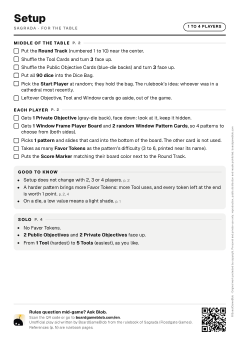 Setup
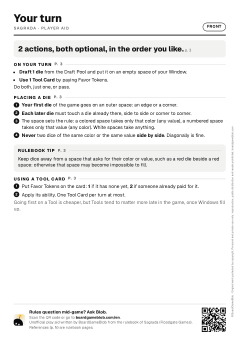 Player aid
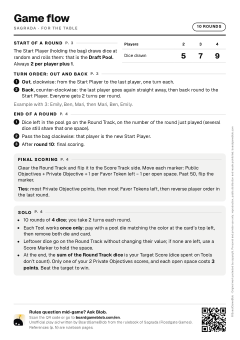 Game flow
The rules in questions
From the official rulebook by Floodgate Games. In parentheses: the rulebook’s page. How Blob answers
How many dice are drawn each round in Sagrada?
The Start Player draws two dice per player plus one: 5 dice with two players, 7 with three and 9 with four. Those rolled dice become the Draft Pool. (p. 3)
Where does your first die have to go?
On the outer ring of your window, either a corner or a space along an edge. After that, each new die has to touch one already placed, by a side or diagonally. (p. 3)
Can two dice of the same color be next to each other?
Not side by side: dice sharing a color or a value can never be orthogonally adjacent. Touching only at a corner, diagonally, is allowed. (p. 3)
What is the turn order during a round of Sagrada?
Everyone takes one turn going clockwise from the Start Player, then the last player goes again and play returns counter-clockwise. So each player gets two turns per round, and the Start Player finishes. (p. 3)
How many Favor Tokens does a Tool Card cost?
One token if the card has none on it yet, two if someone has already paid on it. You may use only one Tool Card on a turn. (p. 3)
Do I have to take a die on my turn, and what happens to leftover dice at the end of the round?
No, drafting and using a tool are both optional, so you can pass. Dice nobody took go onto the Round Track space for that round, then the bag moves clockwise to the new Start Player. (p. 3, p. 4)
How is final scoring calculated in Sagrada?
Add your Public Objective points, the total pips on dice of your Private Objective color and 1 point per unspent Favor Token, then subtract 1 point for every empty space in your window. (p. 4)
How are ties broken?
First by points from Private Objectives, then by remaining Favor Tokens, and finally by reverse player order in the last round. (p. 4)
What happens if someone notices a die placed illegally in their window?
That player must remove dice of their choice right away until the window follows every placement rule again. Removed dice leave the game and the empty spaces still cost points. (p. 4)
How do you win solo Sagrada?
Beat a Target Score equal to the sum of the dice left on the Round Track. Solo, you roll 4 dice per round, pay for each tool once with a matching-color die, and lose 3 points per empty space. (p. 4)
Common mistakes
- Thinking you must take a dieDrafting a die and using a tool are both optional. You can do one, the other, both, or nothing at all. (p. 3)
- Scoring an incomplete row or columnPublic objectives based on rows or columns give nothing for a line that still has an empty space. (p. 4)
- Scoring each public objective only onceA single Public Objective card can pay out several times, once for every set you complete. (p. 4)
- Starting in the middle of the windowYour very first die must go on the border of the window: a corner or an edge space. (p. 3)
What’s in the rulebook
See the 4 other parts
Tap a part and Blob explains it.
Expansions
The game
- Players
- 1–4
- Length
- 30–45 min
- Age
- 14+
- Released
- 2017
- Designer
- Adrian Adamescu
- Publisher
- Floodgate Games
- Expansions
- 9
- Rules
- Official rulebook