San Juan (Second Edition) rules
alea · 2014
- Players
- 2–4
- Minutes
- 45–60
- Age
- 10+
Ask your question: I answer about this game’s rules.
The game in 30 seconds
Each round, players take turns picking one of five roles: builder, producer, trader, councillor or prospector. Everyone may use the chosen role's action, but only the player who picked it gets its bonus. Cards are buildings, money and goods all at once. When someone builds a 12th building, the game ends and victory points decide the winner.
A turn, in short
- The Governor picks a role and uses its action plus its privilege; then each other player, going clockwise, may use the action.
- The next player to the left picks one of the remaining roles, and so on until every player has chosen one.
- Roles go back to the middle, the governor card moves left, chapel owners may tuck a card, and hands are cut to 7 cards.
How to win
- Most victory pointsScore your buildings, chapel cards and end-game bonuses, palace last. Highest total wins; ties go to most cards in hand plus goods. (p. 7)
Printable play aids
4 free A5 play aids for San Juan (Second Edition), from the rulebook: step-by-step setup, a player aid for everyone, the turn sequence, and what the expansions add.
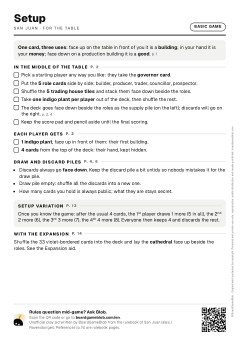 Setup
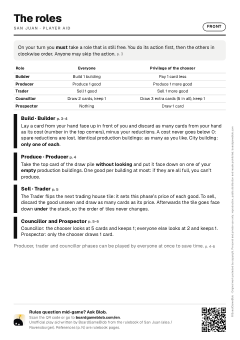 Player aid
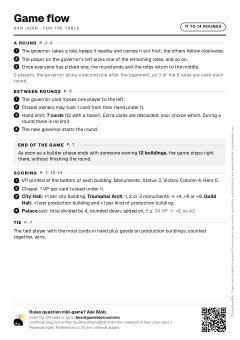 Game flow
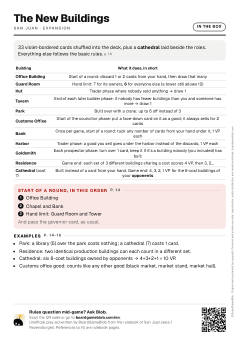 Expansion
The rules in questions
From the official rulebook by alea. In parentheses: the rulebook’s page. How Blob answers
How many cards does each player start with in San Juan?
Each player starts with an indigo plant face up in front of them plus 4 cards in hand. In the setup variation, players get 5 to 8 cards depending on seat order and then keep only 4. (p. 2, p. 13)
When does the game end?
The game stops as soon as the builder phase ends in which someone placed their 12th building; the rest of the round is not played, and everyone counts their points. (p. 7)
How are ties broken?
Among tied players, whoever has the most cards in hand plus goods cards sitting on their production buildings wins. (p. 7)
What is different in a 2-player game?
The Governor picks a second role after the other player, so three of the five roles are used each round. Each library owner may also use it just once per round. (p. 3, p. 12)
What is the hand limit?
Seven cards, but it is only checked at the start of each new round, when extra cards are discarded. During a round you may hold more. A tower owner may keep up to 12. (p. 6)
Can I build two of the same building?
Yes for production buildings, which you may duplicate freely, but no for city buildings: each player builds a given city building only once. A building previously covered with a crane may be built again. (p. 3, p. 8, p. 10)
If I am the Builder and own a smithy and a library, can my discounts make a cheap building pay me back?
No, a building's cost never drops below zero. Extra reductions are simply lost, so a 2-cost sugar mill becomes free but you get no card back. (p. 4)
When I sell a good, do I look at the goods card, and how many cards do I draw?
No, the goods card goes face down to the discard pile unseen. You then draw as many cards as the price shown for that good on the trading house tile flipped this phase. (p. 5)
If I cover my chapel with a crane, do I still score the cards under it?
Yes, the cards tucked under a covered chapel stay there and still give 1 victory point each at the end; you just get no extra point for the building placed over it. (p. 10)
How does the palace score?
The palace is counted last: add up all your other victory points, divide by 4, round down, and add that result. A subtotal of 34 becomes 42. (p. 13)
Common mistakes
- Finishing the round after the 12th buildingPlay stops right at the end of the builder phase where someone reached 12 buildings. Nothing else in that round is played. (p. 7)
- Stacking two goods on one production buildingA production building holds at most one goods card. If all of yours are full, you produce nothing this phase. (p. 4)
- Enforcing the 7-card limit mid-roundHand size is only checked when a new round begins. During the round you may go above 7 cards. (p. 6)
- Forgetting to rotate the trading house tileThe flipped tile goes face down under the stack after every trader phase, even if no one sold anything. (p. 5)
What’s in the rulebook
See the 2 other parts
Tap a part and Blob explains it.
The game
- Players
- 2–4
- Length
- 45–60 min
- Age
- 10+
- Released
- 2014
- Designer
- Andreas Seyfarth
- Publisher
- alea
- Rules
- Official rulebook