Santa Maria rules
Aporta Games · 2017
- Players
- 1–4
- Minutes
- 45–90
- Age
- 12+
Ask your question: I answer about this game’s rules.
The game in 30 seconds
You run a New World colony on a six-by-six grid: lay expansion tiles of buildings, then trigger them with dice or coins to produce goods, ship cargo, send conquistadors and climb the religion track to recruit monks. The game lasts three years, and the colony with the most happiness points wins.
A turn, in short
- On your turn take exactly one main action: add an expansion tile, activate one building with coins, activate a row or column with a die, or retire.
- Alongside it, take any number of free actions: sell resources, or buy wood or grain for 3 coins each.
- When you retire, pick a free retiring space and do its action, then collect income from your shipment tiles. You sit out the rest of the year.
How to win
- Happiness pointsAfter year three, score spare coins, colonists, monks, harbour sets and shipment tiles. Highest total wins; ties go to whoever retired nearest the 1st symbol last year. (p. 7)
Printable play aids
3 free A5 play aids for Santa Maria, from the rulebook: step-by-step setup, a player aid for everyone, and the turn sequence.
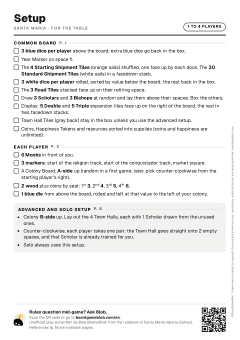 Setup
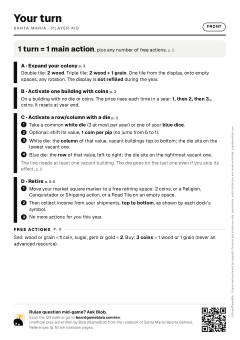 Player aid
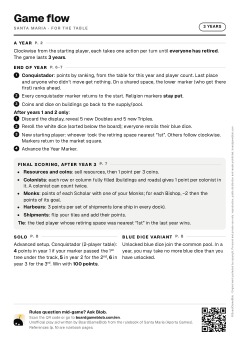 Game flow
The rules in questions
From the official rulebook by Aporta Games. In parentheses: the rulebook’s page. How Blob answers
How many white dice can I use per year in Santa Maria?
Three at most. Each player is limited to three white dice in a single year, no matter how many remain in the pool. (p. 3)
How much does it cost to activate a single building with coins?
The price climbs during the year: 1 coin for your first such activation, 2 for the second, 3 for the third and so on. The coins come off at year end and the cost resets. (p. 3)
Can I change the value of a die?
Yes, by paying 1 coin per pip up or down. Values never loop around, so turning a 1 into a 6 costs 5 coins. (p. 3)
What is the storage limit for resources?
You hold at most 3 of each resource type. Any extra you would gain is converted to its sale value: 1 coin for wood or grain, 2 coins for sugar, gems or gold. (p. 4)
Do I have to pay to place a monk where another player already has one?
Yes. You pay 2 coins to every opponent already on that space; the first monk there goes free. You can never put two of your own monks on one space. (p. 5)
When do I unlock my extra blue dice?
When your religion marker passes the first and the third monk symbol. Each one is drawn from the reserve, rolled and kept until the game ends. (p. 4, p. 5)
If I take a white die and the last building in that column is one I don't want to use, where does the die go?
It still goes on the bottommost vacant building of the column, even if you skip that building's effect. Buildings holding a die or coins are skipped, and road spaces never take a die. (p. 3, p. 5)
How are ties on the conquistador track broken at the end of a year?
The marker lower in the stack, meaning the one that reached the space first, counts as ahead. The last player and anyone who produced no conquistadors that year score nothing. (p. 6)
When I retire on the religion space and unlock a blue die, can I use it right away?
No. A blue die unlocked through that retiring space can only be used from the following year. You may still pay one grain for an extra step on the track. (p. 6)
Who wins a tie at the end of Santa Maria?
Among the tied players, the one who took the retiring space nearest the 1st symbol in the last year wins. (p. 7)
Common mistakes
- Using more than 3 white dice in a yearNobody may use more than three white dice per year, even if some are still left in the pool. (p. 3)
- Activating an occupied buildingA row or column only triggers vacant buildings, in order. Buildings with a die or coins are skipped, and the die ends on the last vacant one. (p. 5)
- Scoring purple-framed points immediatelyPoints in a purple frame only count at the end of the game, as do the points printed on shipment tiles. (p. 2, p. 4)
- Forgetting the 2-point cost of each bishopEvery monk appointed as a bishop costs you 2 points at game end, before you score that tile's requirements. (p. 5, p. 7)
What’s in the rulebook
See the 11 other parts
Tap a part and Blob explains it.
Expansions
The game
- Players
- 1–4
- Length
- 45–90 min
- Age
- 12+
- Released
- 2017
- Designer
- Kristian Amundsen Østby
- Publisher
- Aporta Games
- Expansions
- 2
- Rules
- Official rulebook