Sekigahara: The Unification of Japan rules
GMT Games · 2011
- Players
- 2
- Minutes
- 180
- Age
- 14+
Ask your question: I answer about this game’s rules.
The game in 30 seconds
A two-player block game about the 1600 campaign in Japan: Tokugawa Ieyasu against Ishida Mitsunari. Your blocks stay hidden, and your hand of cards stands for your troops' loyalty: you spend cards to move, muster and deploy blocks in battle, where betrayals can happen. The game lasts seven weeks unless a leader falls first.
A turn, in short
- Each week: discard half your hand, draw 5 cards and draw new blocks into your Recruitment Box.
- Both players bid one card; the higher bid number decides who goes first for the whole week.
- Two turns per week: each player moves by spending 0, 1 or 2 cards, then fights wherever enemies share a location.
- In battle, take turns deploying hidden blocks with cards of the same clan to build up Impact.
How to win
- Instant victoryTokugawa wins if Ishida Mitsunari dies or Toyotomi Hideyori is captured; Ishida wins if Tokugawa Ieyasu dies. (p. 2)
- On pointsAfter week 7, score 2 per castle and 1 per Resource Location. Ishida wins ties. (p. 2)
Printable play aids
3 free A5 play aids for Sekigahara: The Unification of Japan, from the rulebook: step-by-step setup, a player aid for everyone, and the turn sequence.
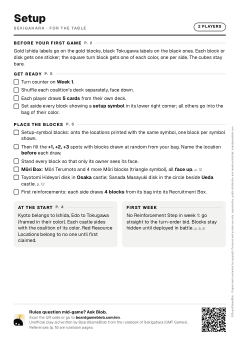 Setup
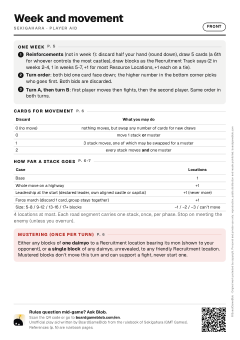 Player aid
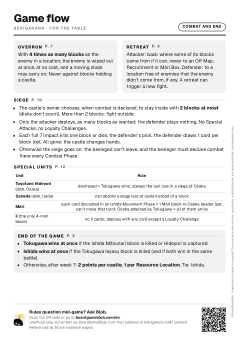 Game flow
The rules in questions
From the official rulebook by GMT Games. In parentheses: the rulebook’s page. How Blob answers
How do you win Sekigahara instantly?
Tokugawa wins at once if the Ishida Mitsunari block dies or the Toyotomi Hideyori disk is captured; Ishida wins at once if the Tokugawa Ieyasu block dies. If both happen in one battle, Ishida is the winner. (p. 2)
Who wins if nobody gets an instant victory by the end of week 7?
Each player counts 2 points per castle and 1 point per Resource Location they hold, and the bigger total wins. A tie goes to the Ishida player. (p. 2)
How many cards do you draw at the start of each week?
Five, after first discarding half your hand rounded down; whoever holds the most castles takes a sixth card. This step is skipped in week 1, since both sides start with 5 cards. (p. 5)
How many cards does it cost to move in the Movement Phase?
Zero cards lets you move one stack or muster, one card lets you move three stacks, and two cards lets every stack move plus one muster. You may also discard none and move nothing to cycle cards. (p. 6)
How far can a stack move?
One location, plus 1 each for an all-highway move, leadership at the starting point and a force march, so four at most. Stacks of 5 or more lose 1 per extra group of four blocks, and 17 blocks cannot move at all. (p. 6-7)
When does an overrun happen?
An overrun happens when you have at least four times as many blocks as the enemy in a location, whatever their strength. The enemy blocks are destroyed immediately at no cost, but units controlling a castle can never be overrun. (p. 7)
Does a cavalry or gun block always get its bonus in battle?
No, the extra 2 Impact only counts when the block is deployed with a card showing swords, and it grows by 2 for each earlier block of that type on your side. Double cards and sieges never allow it. (p. 8, 10)
What happens when my opponent plays a Loyalty Challenge on a block I just deployed and I have no matching card left?
The block defects: it joins the challenger's side for the rest of that battle and its Impact counts for them. If you can show another card able to deploy it, it stays loyal and the shown card returns to your hand. (p. 9)
How many blocks does each side lose after a battle, and who chooses them?
Each side loses one block per full 7 Impact the enemy dealt, and the loser loses one more. Players pick their own losses, starting with defected blocks, then deployed ones, then undeployed ones. (p. 9)
Can a defender hide in a castle, and what happens during a siege?
Yes, if they own the castle and have two blocks or fewer, disks not counted. The attacker alone deploys, with no special attacks or Loyalty Challenges, and every 7 Impact removes one block or disk inside. (p. 10)
Common mistakes
- Using the same road twice in one phaseEach road segment can carry only one stack, and only once, per Movement Phase. (p. 6)
- Moving blocks that just musteredFreshly mustered blocks, and Mōri blocks brought into Osaka, stay put for the rest of that turn. (p. 6, 12)
- Counting cavalry or gun bonus without a sword cardThe special attack bonus needs a card with swords. It never applies with a double card or in a siege. (p. 8, 10)
- Attacking straight from the Recruitment BoxA battle must be started by blocks already on the map; mustered blocks can only join as support. (p. 6)
What’s in the rulebook
See the 4 other parts
Tap a part and Blob explains it.
The game
- Players
- 2
- Length
- 180 min
- Age
- 14+
- Released
- 2011
- Designer
- Matt Calkins
- Publisher
- GMT Games
- Rules
- Official rulebook