Shadows: Amsterdam rules
Libellud · 2018
- Players
- 2–8
- Minutes
- 20
- Age
- 10+
Ask your question: I answer about this game’s rules.
The game in 30 seconds
Two detective teams race each other in real time across Amsterdam. In each team, one Intelligence Officer secretly sees the Map Card and guides teammates using only picture cards. The Detectives must gather three different pieces of Evidence, then reach the Client while dodging the Police. The first team to take two rounds wins.
A turn, in short
- The Intelligence Officer picks a target space on the Map Card and hands over one or two Intel Cards hinting at it.
- The Detectives discuss the pictures, then move their figure one space per card received, never across Obstacle Tiles.
- The officer checks the space: Evidence, Client or Police is announced, otherwise they stay silent.
- The used Intel Cards are set aside and the team starts again right away, without waiting for the rivals.
How to win
- Round wonYour team holds three different pieces of Evidence and reaches a Client space first. (p. 12)
- Rivals caughtIf the other team gets its third Police Token, your team takes the round. (p. 12)
- GameThe first team with two round wins takes the game. (p. 12)
Printable play aids
3 free A5 play aids for Shadows: Amsterdam, from the rulebook: step-by-step setup, a player aid for everyone, and the turn sequence.
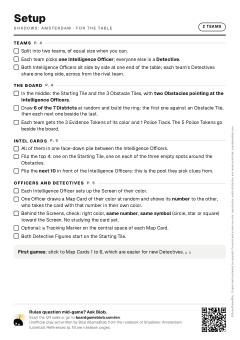 Setup
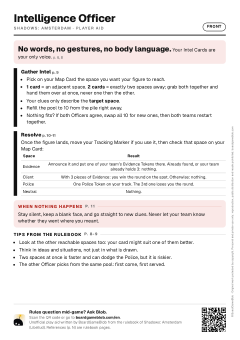 Player aid
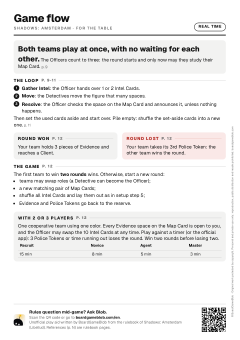 Game flow
The rules in questions
From the official rulebook by Libellud. In parentheses: the rulebook’s page. How Blob answers
How do you win a game of Shadows: Amsterdam?
You win by taking two rounds. A round goes to the team that gathers three different pieces of Evidence and then reaches a Client space, or whose opponents pick up their third Police Token. (p. 6, 12)
What happens when your team lands on a Police space?
Your team adds a Police Token to its Police Track. On the third token, your team instantly loses the round and the other team takes it. (p. 11)
Does passing over a Police space during a two-space move count?
No, only the space where the figure stops is resolved. Crossing a Police space on the way has no effect, but stopping again on one you already triggered resolves it again. (p. 11)
Can the Intelligence Officer talk or give hints to the Detectives?
No, the Intelligence Officer communicates only through Intel Cards: no speaking, gestures or postures. When a move leads to nothing, they stay silent with a poker face and never reveal whether the move matched the plan. (p. 6, 11)
If I give two Intel Cards, can my team move just one space?
No, two Intel Cards mean the figure must end exactly two spaces away, while one card means moving to an adjacent space. Obstacle Tiles can never be crossed. (p. 9, 10)
Can both teams collect the same piece of Evidence?
No. Unique Evidence exists on only one team's Map Card, and Common Evidence appears on both, but it is lost to the rival team as soon as one team finds it. (p. 7, 11)
What happens if both teams' Detectives reach the same space at nearly the same time?
The team that got there first resolves the space first. Spaces are never blocked: a figure can always enter a space holding an Evidence Token or the rival figure. (p. 10, 11)
How does the 2 or 3 player mode work, and how long do you get?
Everyone plays on one team against a timer: 15 minutes for Recruit, 8 for Novice, 5 for Agent, 3 for Master. All Evidence spaces count, the officer may refresh the 10 Intel Cards at any time, and you need two round wins before two losses. (p. 12)
Can the Intelligence Officers swap out the 10 available Intel Cards?
Yes, but only when both officers agree; then all 10 are replaced and both restart from Gather Intel. In the 2 or 3 player mode the officer can do it whenever they like. (p. 9, 12)
Common mistakes
- Moving only one space after receiving two cardsTwo Intel Cards require the figure to finish exactly two spaces away, never next door. (p. 10)
- Reacting when a move leads to nothingOn a neutral or empty result the officer says nothing and shows nothing; the team goes straight back to gathering intel. (p. 11)
- Triggering a Police space you only passed overOnly the space where the figure stops is resolved, so crossing a Police space mid-move does nothing. (p. 11)
- Taking Intel Cards one after the otherFor a two-space move the officer must grab both cards together and hand them over at once. (p. 9)
What’s in the rulebook
See the 4 other parts
Tap a part and Blob explains it.
The game
- Players
- 2–8
- Length
- 20 min
- Age
- 10+
- Released
- 2018
- Designer
- Mathieu Aubert
- Publisher
- Libellud
- Rules
- Official rulebook