Sherlock Holmes Consulting Detective: The Thames Murders & Other Cases rules
Sleuth Publications · 1981
- Players
- 1–8
- Minutes
- 60–120
- Age
- 13+
Ask your question: I answer about this game’s rules.
The game in 30 seconds
You play members of the Baker Street Irregulars working together on ten cases set in Victorian London. Using the map, the directory, the newspapers and a list of informants, you choose addresses to visit and gather clues. When you think you have cracked it, you answer the case questions and compare your score with Holmes' 100 points.
A turn, in short
- The lead investigator decides on a place or person to visit and looks up the address in the directory.
- They read that address's paragraph aloud from the case book; if there is none, they pick another lead.
- They record the lead as followed, then pass the booklet to their left, making that player the new lead investigator.
How to win
- Against HolmesYour answers earn points, then you gain or lose 5 points for each lead fewer or more than Holmes. He always scores 100. (p. 7)
Printable play aids
3 free A5 play aids for Sherlock Holmes Consulting Detective: The Thames Murders & Other Cases, from the rulebook: step-by-step setup, a player aid for everyone, and the turn sequence.
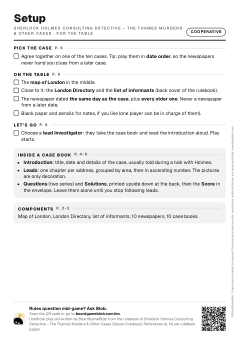 Setup
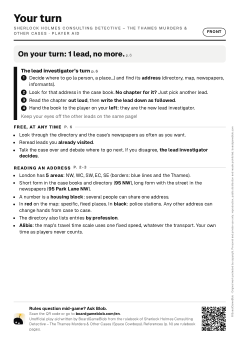 Player aid
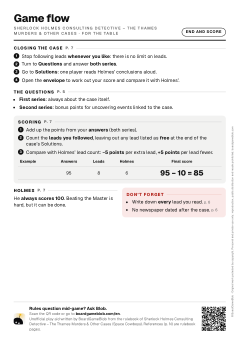 Game flow
The rules in questions
From the official rulebook by Sleuth Publications. In parentheses: the rulebook’s page. How Blob answers
How is the score calculated at the end of a case?
Add up the points earned from both sets of questions, then compare how many leads you followed with Holmes' count: lose 5 points per lead above his number, gain 5 points per lead below it. (p. 7)
What is Holmes' score?
Holmes always scores 100 points. Your goal is to get as close as possible or even beat him, which the rulebook calls hard but not impossible. (p. 7)
How many leads can a player read on their turn?
Only one. The group may follow any number of leads in total, but the lead investigator reads a single paragraph, records it, then hands the booklet to the player on their left. (p. 6)
What happens if the address we pick has no paragraph in the case book?
That lead simply does not exist in the current case, so the lead investigator just picks a different one. (p. 6)
Which newspapers can we read during a case?
The paper dated the same day as the case plus every earlier one. Later issues stay out of play, which is why playing the cases in date order is recommended. (p. 6)
Do free leads count toward the number of leads we followed?
No. Some cases list free leads at the end of their Solutions section; if you visited any of them, leave them out of your lead total before comparing with Holmes. (p. 7)
Does the travel time between two addresses matter for the players?
No, players' travel time never counts. The time scale on the map only helps check where suspects could have gone and test their alibis, using one fixed speed whatever the transport. (p. 2)
If the group disagrees about where to go next in Sherlock Holmes Consulting Detective, who decides?
The current lead investigator makes the final call. Everyone can talk freely about the case and argue for the next destination, but the person holding the booklet decides. (p. 6)
Can we look back at leads we already read, or check the directory and newspapers whenever we like?
Yes. All players have free, unlimited access to the directory and the case's newspapers, and may reread visited leads as often as they want; none of this counts as a new lead. (p. 6)
Is asking Sherlock Holmes for help at 42 NW a good idea when we are stuck?
You can visit him at 42 NW and he will give advice to get you back on track, but the rulebook warns this help may spoil the pleasure of investigating. (back cover)
Common mistakes
- Thinking a lead you have read is gone for goodVisited leads, the directory and the newspapers can be consulted again at any time, freely and without limit. (p. 6)
- Glancing at the other paragraphs on the pageThe rulebook advises not looking closely at neighbouring leads on the page you are reading, to keep the surprise intact. (p. 6)
- Searching the case book pictures for cluesThe drawings alongside the leads are only decoration and carry no information. (p. 4)
- Using newspapers dated after the caseOnly the paper from the day of the case and earlier issues are used; later ones stay aside. (p. 6)
What’s in the rulebook
See the 2 other parts
Tap a part and Blob explains it.
Expansions
The game
- Players
- 1–8
- Length
- 60–120 min
- Age
- 13+
- Released
- 1981
- Designer
- Raymond Edwards
- Publisher
- Sleuth Publications
- Expansions
- 12
- Rules
- Official rulebook