Skull rules
Lui-même · 2011
- Players
- 3–6
- Minutes
- 15–45
- Age
- 10+
Ask your question: I answer about this game’s rules.
The game in 30 seconds
A pure game of bluff and nerve. Each player holds three flowers and one skull, stacked secretly on their mat. Players then bid on how many discs they dare to reveal without hitting a skull. Win two challenges, or be the last player standing, to take the game.
A turn, in short
- Everyone puts one disc face-down on their mat.
- Going clockwise, each player either stacks one more disc or opens a challenge by naming a number of discs to reveal.
- Once a challenge is open, each player raises the number or passes, until only the highest bidder, the Challenger, remains.
- The Challenger reveals their whole own stack first, then top discs from other mats of their choice, one by one.
- Only flowers: their mat turns to its flower side. A skull: they lose a disc for good.
How to win
- Two challengesYour mat already shows its flower side and you succeed again: you win. (p. 13)
- Last one standingEvery other player has lost all four discs, so you are the only one left in the game. (p. 13)
Printable play aids
3 free A5 play aids for Skull, from the rulebook: step-by-step setup, a player aid for everyone, and the turn sequence.
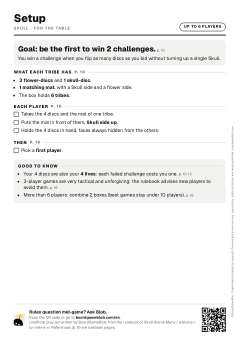 Setup
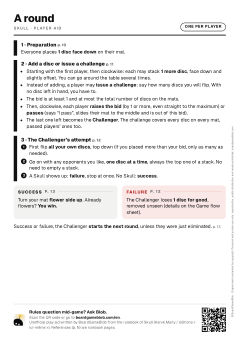 Player aid
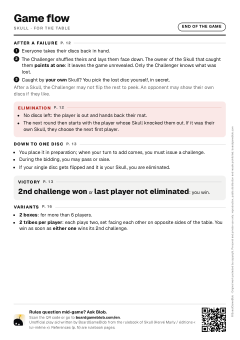 Game flow
The rules in questions
From the official rulebook by Lui-même. In parentheses: the rulebook’s page. How Blob answers
How do you win at Skull?
You win the moment you succeed at your second challenge, meaning your mat already shows its flower side and you pull off another one. You also win if every other player has been eliminated. (p. 13)
In what order does the Challenger flip discs in Skull?
Always their own stack first, every disc of it. After that they pick which opponents to reveal from, one disc at a time, always taking the top disc of a mat before any disc beneath it. (p. 12)
What happens when the Challenger reveals a skull?
The attempt ends at once and everyone takes their discs back. The Challenger then permanently loses one of their discs, which leaves the game face-down so only they know whether it was their skull or a flower. (p. 12)
Who picks the disc the Challenger loses after a failed attempt?
The owner of the skull that was revealed. The Challenger shuffles their remaining discs face-down and that player chooses one. If the Challenger hit their own skull, they choose secretly themselves. (p. 12)
Can you raise the bid by more than one in Skull?
Yes. A raise can jump several discs at once, and you may even bid straight away the total number of discs sitting on all the mats. (p. 11)
Do the discs of players who passed still count in the challenge?
Yes. Passing only takes you out of the bidding; your discs stay on your mat and the Challenger may flip them. (p. 11)
If I bid and my own stack has more discs than my bid, do I have to flip all of mine?
No. When your own stack is bigger than the number you bid, you only flip from its top as many discs as you need to complete the attempt. (p. 12)
Who goes first in the next round, especially if the Challenger was just eliminated?
Normally the Challenger, win or lose. If they were knocked out, the player whose skull they revealed starts; if they revealed their own skull, the eliminated Challenger names the next first player. (p. 12-13)
What does a player with only one disc left do on their turn?
They place that last disc during preparation, then must issue a challenge when it is their turn to add, since their hand is empty. While bidding they may still pass or raise. If that disc is revealed as a skull, they are out. (p. 13)
Can Skull be played with more than 6 players?
Yes, by putting two boxes together, though the rulebook says the best games stay below 10 players. It also suggests new players skip 3-player games, which are very tactical and unforgiving. (p. 16)
Common mistakes
- Showing the lost disc after a failureThe removed disc leaves the game face-down. Only the Challenger knows whether a skull or a flower is gone. (p. 12)
- Revealing more discs after a skullThe Challenger stops as soon as a skull turns up and may not flip the rest, so the other players' strategy stays hidden. (p. 12)
- Adding a disc with an empty handIf it is your turn to add and you have no discs left in hand, you have to open a challenge. A challenge of zero is not allowed. (p. 11)
What’s in the rulebook
See the 2 other parts
Tap a part and Blob explains it.
Expansions
The game
- Players
- 3–6
- Length
- 15–45 min
- Age
- 10+
- Released
- 2011
- Designer
- Hervé Marly
- Publisher
- Lui-même
- Expansions
- 1
- Rules
- Official rulebook