Suburbia rules
Bézier Games · 2012
- Players
- 1–4
- Minutes
- 60–90
- Age
- 8+
Ask your question: I answer about this game’s rules.
The game in 30 seconds
You grow a small town into a big city by adding hexagonal tiles to your borough. Each tile shifts your Income, Reputation or Population, often depending on its neighbors and on other players' tiles. Once the 1 More Round tile shows up, play finishes after one extra full round, and the highest Population wins.
A turn, in short
- Buy a market tile, take a basic tile, turn a market tile into a lake, or put an Investment Marker on one of your tiles.
- Collect money equal to your Income, or pay it if your Income is negative.
- Move your Population up or down by your current Reputation.
- Slide the market tiles right and reveal a new tile at the far left.
How to win
- PopulationAfter the last round, score goals, then trade every $5 for 1 Population. The biggest Population wins. (p. 3)
- SoloAlone, aim for the best title on the scoring scale, from Junior Intern to CEO of Suburbia, Inc. (p. 4)
Printable play aids
3 free A5 play aids for Suburbia, from the rulebook: step-by-step setup, a player aid for everyone, and the turn sequence.
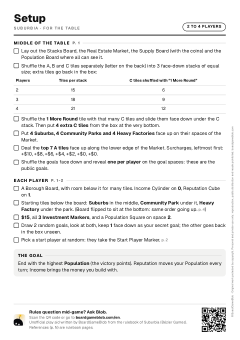 Setup
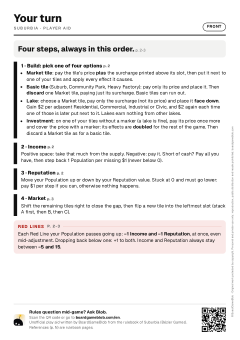 Player aid
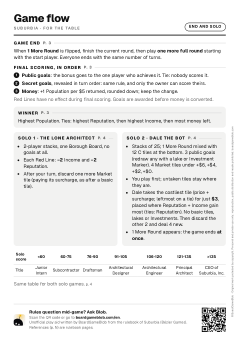 Game flow
The rules in questions
From the official rulebook by Bézier Games. In parentheses: the rulebook’s page. How Blob answers
How much money do you start with in Suburbia?
Each player begins with $15 (million), three Investment Markers and a borough of three basic tiles: Suburbs, Community Park and Heavy Factory. Income starts at 0, Reputation at 1 and Population at 2. (p. 1)
How much does a tile from the Real Estate Market cost?
You pay the price printed on the tile plus the amount shown above its slot on the market, from +$10 on the left to +$0 on the right. All of it goes to the supply. (p. 1, 2)
How does a lake work in Suburbia?
Pick any market tile, pay only the market surcharge above it, and put it face down next to your tiles. You get $2 for each neighboring non-lake tile, and $2 more whenever you later add one beside it. (p. 2)
What do Red Lines on the Population track do?
Each time your Population passes a Red Line, your Income and Reputation both drop one space, right away. Falling back below a line raises them again. Goals and money converted at the end ignore the lines. (p. 2, 3)
What happens if I can't pay my negative Income?
You hand over all your money, then move your Population back one space for each missing dollar. If you are already at 0 Population, nothing further happens. (p. 2)
What does an Investment Marker do?
It doubles every effect of the tile it sits on for the rest of the game. You pay the tile's own cost again instead of taking a new tile, then still discard one tile from the market. (p. 2)
Does placing an Investment Marker re-trigger the effects of neighboring tiles on the invested tile?
No. Only the invested tile's own effects double. For example, investing in a Community Park next to a Heavy Factory does not make the factory's Reputation penalty apply a second time. (p. 2)
When does Suburbia end and how are ties broken?
When the 1 More Round tile is revealed, finish the round, then play one full extra round. Highest Population wins; ties go to Reputation, then Income, then leftover cash. (p. 3)
If two players tie for a public goal at the end of Suburbia, does each of them score the bonus?
No. A goal's Population bonus goes only to a single player who achieves it alone; when two or more players tie, nobody gets it. Secret goals work the same way for their owner. (p. 3)
What is the difference between "each of your" and "every" on a tile?
"Each of your" counts only tiles in your own borough. "Every" counts matching tiles in all boroughs, yours included, and even the tile itself if it fits. (p. 3)
Common mistakes
- Skipping the discard after a basic tileAfter a basic tile or an Investment Marker, you must also remove one market tile, paying only the surcharge above it. (p. 2)
- Letting Income or Reputation go past the limitsBoth tracks are capped: they never go below -5 or above 15, whatever the bonuses or penalties. (p. 2, 3)
- Applying Red Line penalties after the final scoringPopulation gained from goals and from converting money at the end never lowers your Income or Reputation. (p. 3)
- Paying the tile price for a lakeA lake costs only the market amount above the chosen tile; its printed price is ignored. (p. 2)
What’s in the rulebook
See the 12 other parts
Tap a part and Blob explains it.
Expansions
The game
- Players
- 1–4
- Length
- 60–90 min
- Age
- 8+
- Released
- 2012
- Designer
- Ted Alspach
- Publisher
- Bézier Games
- Expansions
- 4
- Rules
- Official rulebook