Terra Mystica rules
Feuerland Spiele · 2012
- Players
- 2–5
- Minutes
- 60–150
- Age
- 12+
Ask your question: I answer about this game’s rules.
The game in 30 seconds
Each player leads a faction tied to one terrain type, the only kind of land it can build on. You transform nearby spaces into your home terrain, put Dwellings there, upgrade them into bigger buildings and climb four cult tracks. After six rounds, the player with the most victory points wins.
A turn, in short
- Income: take the Workers, Coins, Priests and Power shown on your Faction board, your Bonus card and your Favor tiles.
- Actions: going around the table, each player takes one action at a time until everyone has passed.
- When you pass, swap your Bonus card for one on the table. The first to pass starts the next round.
- End of round: hand out the cult bonuses on the current Scoring tile, except after round 6.
How to win
- On pointsAfter round 6, add cult track scoring, the largest connected area and 1 point for every 3 Coins. The highest total wins. (p. 16)
- TieThere is no tie-breaker: all tied players share the win. (p. 16)
Printable play aids
3 free A5 play aids for Terra Mystica, from the rulebook: step-by-step setup, a player aid for everyone, and the turn sequence.
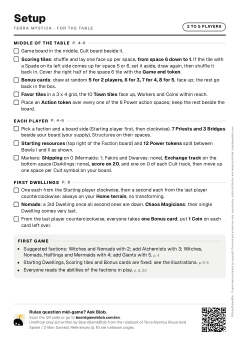 Setup
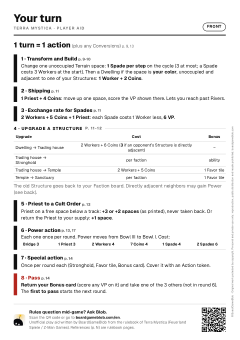 Player aid
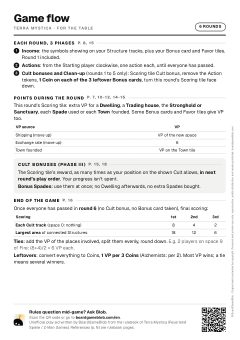 Game flow
The rules in questions
From the official rulebook by Feuerland Spiele. In parentheses: the rulebook’s page. How Blob answers
How many rounds are there in Terra Mystica?
Six rounds. Each one has an income phase, an action phase, and then cult bonuses and clean-up, which are skipped after round 6. The final scoring follows once everyone has passed in the last round. (p. 8, 15-16)
Why do you start Terra Mystica with 20 victory points?
Because taking Power when a neighbour builds next to you costs points. Starting at 20 leaves room to pay for that Power. (p. 4, 7)
How many victory points does Power from an opponent's building cost?
One less than the Power you take: 1 Power is free, 2 cost 1 point, 3 cost 2 points. You take the whole amount or nothing, unless your bowls fill up or your score would drop below zero. (p. 12)
How do the three Power bowls work?
Gained Power first shifts tokens from Bowl I to Bowl II, and only once Bowl I is empty from Bowl II to Bowl III. You can spend only tokens in Bowl III, and spent tokens go back to Bowl I. (p. 9)
Can I save spades for a later turn?
No. Spades must be used right away. You do not have to build a Dwelling on the transformed space at once, though: that can wait for a later action. (p. 10)
What exactly do I need to found a Town?
At least four of your buildings directly adjacent to each other with a combined power value of 7 or more. Three are enough if one is your Sanctuary. Bridges count, but buildings linked only by shipping do not. (p. 14-15, 17)
How is the end-of-game area scoring calculated, and does shipping count?
Count your largest group of buildings that are directly or indirectly adjacent; shipping lets a group jump river spaces up to your shipping value. The biggest group scores 18, then 12 and 6, with ties splitting the points rounded down. (p. 16)
When I pass, which Bonus card can I take and what about the coins on it?
You return your card and choose one of the three left on the table, but not the card you just put back. Coins on your new card go to your Faction board. No new card is taken in round 6. (p. 14)
Can I advance to space 10 of a cult track?
Only with a Town key, one key per track, and only one player can ever reach space 10 of each track. Without a key you stop at space 9. (p. 13, 15)
Common mistakes
- Building outside your home terrainA Dwelling goes only on a free space of your own terrain that connects to your buildings. Use spades to change the space first if needed. (p. 9-10)
- Gaining Power from your own buildingsOnly an opponent building next to your structures gives you Power, and each Power after the first costs you a victory point. (p. 12)
- Spending Power from Bowl I or IIOnly Power in Bowl III can be spent. If you are short, you can sacrifice tokens from Bowl II to move others up at once. (p. 9, 13)
- Counting shipping when founding a TownA Town needs buildings that touch directly. Bridges join them, but spaces linked only through shipping do not. (p. 15, 17)
What’s in the rulebook
See the 2 other parts
Tap a part and Blob explains it.
Expansions
The game
- Players
- 2–5
- Length
- 60–150 min
- Age
- 12+
- Released
- 2012
- Designer
- Jens Drögemüller
- Publisher
- Feuerland Spiele
- Expansions
- 4
- Rules
- Official rulebook