The Lord of the Rings: The Card Game rules
Fantasy Flight Games · 2011
- Players
- 1–2
- Minutes
- 30–60
- Age
- 13+
Ask your question: I answer about this game’s rules.
The game in 30 seconds
A cooperative card game set in Middle-earth. Each player controls one to three heroes and a personal deck of allies, attachments and events. Together you face a scenario run by the game itself: a fixed quest deck to push through stage by stage, and a shuffled encounter deck of enemies, locations and treacheries. Everyone wins or loses as a team.
A turn, in short
- Resource: each of your heroes gains one resource token, then you draw a card.
- Planning: spend resources of the matching sphere to put allies and attachments into play.
- Quest: exhaust characters to commit them, reveal one encounter card per player, then compare willpower against threat.
- Travel and encounter: the group may move to one location, then enemies engage players based on their threat.
- Combat: enemies attack with a face-down shadow card, then you strike back at the enemies engaged with you.
- Refresh: ready everything, raise your threat by 1, and pass the first player token left.
How to win
- VictoryIf at least one player is still in the game when the final quest stage is completed, the whole group wins. (p. 22)
- DefeatThe group loses once every player is eliminated, by losing all heroes or reaching 50 threat. (p. 22)
Printable play aids
3 free A5 play aids for The Lord of the Rings: The Card Game, from the rulebook: step-by-step setup, a player aid for everyone, and the turn sequence.
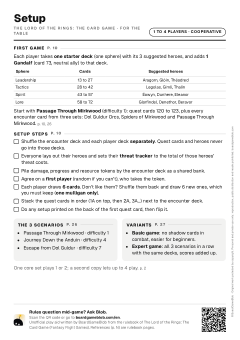 Setup
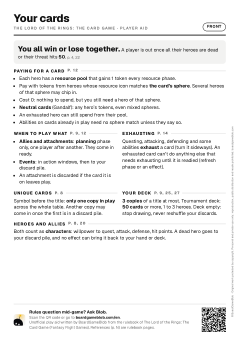 Player aid
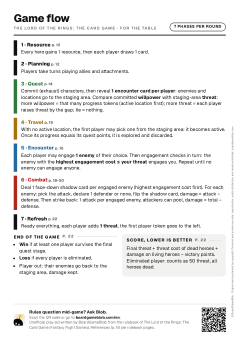 Game flow
The rules in questions
From the official rulebook by Fantasy Flight Games. In parentheses: the rulebook’s page. How Blob answers
How do you lose this cooperative game?
The whole group loses if every player is eliminated before the last quest stage is completed. A player is out when all his heroes die, when his threat hits 50, or when a card says so. (p. 22)
How many cards do you start with, and can you mulligan?
Each player begins with 6 cards. You may take one mulligan: shuffle those 6 back into your deck and draw 6 new ones, which you must then keep. (p. 10)
How does the quest phase work?
Total the willpower of your committed characters and set it against all the threat showing in the staging area. If willpower wins, the difference becomes progress tokens; if threat wins, every player raises his threat by the difference; a tie changes nothing. (p. 14)
Can you play allies or attachments outside the planning phase?
No, allies and attachments can only come into play during the planning phase, first player first, then clockwise. Events and actions are what you use in the other phases. (p. 12, p. 23)
Can I pay for a card with a hero who is exhausted?
Yes, an exhausted hero can still spend resources from his pool. What matters is that the hero's resource icon matches the sphere of the card you play. (p. 12)
If an enemy attack is undefended, who takes the damage?
All the damage goes onto one hero controlled by the attacked player, and the hero's defense does not reduce it. Allies can never take damage from an undefended attack. (p. 18)
How do engagement checks decide which enemy attacks whom?
Starting with the first player, each player is engaged by the staging-area enemy with the highest engagement cost that is not above his threat. Players keep taking turns checking until no remaining enemy can engage anyone. (p. 16)
What happens when the encounter deck runs out of cards during combat?
Enemies that have not yet received a shadow card simply get none this round. The encounter discard pile is only shuffled back into a new deck during the quest phase. (p. 18, p. 25)
Do extra progress tokens carry over to the next quest stage?
No, surplus progress is lost: you advance as soon as the quest points are reached and all progress on that card goes back to the bank. Everything else on the table stays exactly as it was. (p. 22)
How is the final score calculated, and is a low score better?
Yes, lower is better. Add each player's final threat, the threat cost of dead heroes and the damage on surviving heroes, then subtract the victory points earned. (p. 22)
Common mistakes
- Counting the threat of the active locationOnce you travel to a location, its threat no longer counts; instead it soaks up progress tokens until it is explored. (p. 15)
- Traveling while a location is already activeYou must fully explore the active location before you can travel anywhere else. (p. 15)
- Resolving a shadow card's when revealed effectA card dealt as a shadow card only uses its Shadow effect; its when revealed text does not trigger. (p. 23)
- Declaring two defenders against one attackOnly one character may defend against each attacking enemy, and it must exhaust to do so. (p. 18)
What’s in the rulebook
See the 6 other parts
Tap a part and Blob explains it.
Expansions
And 81 more.
The game
- Players
- 1–2
- Length
- 30–60 min
- Age
- 13+
- Released
- 2011
- Designer
- Nate French
- Publisher
- Fantasy Flight Games
- Expansions
- 93
- Rules
- Official rulebook