Ticket to Ride: Märklin rules
Days of Wonder · 2006
- Players
- 2–5
- Minutes
- 30–60
- Age
- 8+
Ask your question: I answer about this game’s rules.
The game in 30 seconds
A train game on a map of Germany: you collect Train Car cards to lay your trains on routes between cities and link the secret destinations you chose. Your Passengers then ride the rails to pick up Merchandise Tokens. When someone is almost out of trains, everyone plays one last turn and the best score wins.
A turn, in short
- On your turn, choose exactly one of four actions.
- Draw two Train Car cards, face-up or from the deck.
- Or claim a route by paying cards of its color, then optionally drop a Passenger in one of its cities.
- Or draw four Destination Tickets and keep at least one.
- Or send one of your placed Passengers traveling to gather Merchandise Tokens.
How to win
- On pointsRoutes, Merchandise Tokens, completed tickets minus failed ones, and 10 points for the most completed tickets: the highest total wins. (p. 6)
- TiesMost completed Destination Tickets wins, then the highest Merchandise Token total. (p. 6)
Printable play aids
3 free A5 play aids for Ticket to Ride: Märklin, from the rulebook: step-by-step setup, a player aid for everyone, and the turn sequence.
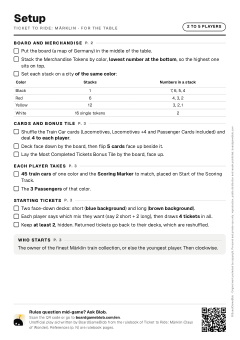 Setup
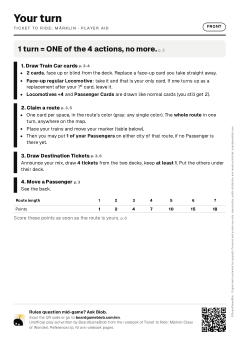 Player aid
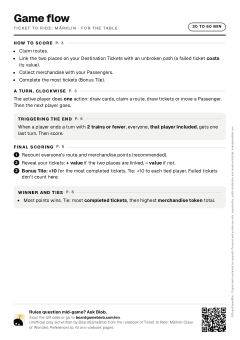 Game flow
The rules in questions
From the official rulebook by Days of Wonder. In parentheses: the rulebook’s page. How Blob answers
How do Passengers work in Ticket to Ride: Märklin?
When you claim a route, you may put one of your three Passengers in either of its cities. Later, an entire turn can be spent sending one Passenger along connected routes to collect the best token in every city it passes; then that figure leaves the game. (p. 3)
Can a Passenger travel on another player's route?
Yes, but each opponent's route used during the move costs one Passenger Card from your hand. Without such cards, the Passenger only uses your own routes. (p. 4)
Do you get a Merchandise Token in the city where the Passenger starts?
No. The starting city gives nothing; you collect the top token only in each city the Passenger travels through after leaving it. (p. 3)
What is the difference between a Locomotive and a Locomotive +4?
Both are wild, but a Locomotive +4 only helps claim routes of at least four spaces. Also, taking a face-up Locomotive +4 does not end your draw, unlike a regular face-up Locomotive. (p. 4)
Can two Passengers be in the same city?
Not when placing them: each city holds at most one Passenger. During a move, though, a Passenger may pass through or stop in a city where another one stands. (p. 3)
How many Destination Tickets do you keep at the start of Ticket to Ride: Märklin?
Draw four, mixing short and long tickets as you like after announcing the mix, and keep at least two. Later in the game you keep at least one of four drawn. (p. 3)
Can a Destination Ticket route go through a country like Österreich?
No. Routes into a country are dead ends: they cannot connect two cities, and a Passenger may never be placed in or move through a country. (p. 6)
In a 2 or 3 player game of Ticket to Ride: Märklin, can both tracks of a double route be used?
No. With two or three players, once someone claims one track of a double or triple route, the remaining parallel tracks are closed to everyone. (p. 5)
When does Ticket to Ride: Märklin end and who wins ties?
When a player ends a turn with two or fewer train cars, everyone, that player included, gets one last turn. Ties go to most completed tickets, then to the highest Merchandise Token total. (p. 6)
Common mistakes
- Taking a second card after a face-up LocomotivePicking a regular Locomotive from the face-up row ends your draw. And if one is revealed as a replacement after your first card, you may not take it. (p. 4)
- Using a Locomotive +4 on a short routeThis wild card only counts toward routes of four spaces or more; shorter routes accept regular Locomotives only. (p. 4, p. 5)
- Moving a Passenger through a countryRoutes into a country are dead ends: Passengers can neither be placed there nor pass through, and they never link two cities. (p. 6)
- Forgetting failed ticketsAt the end, every ticket you kept but did not connect costs you its value in points. (p. 3, p. 6)
What’s in the rulebook
See the 4 other parts
Tap a part and Blob explains it.
The game
- Players
- 2–5
- Length
- 30–60 min
- Age
- 8+
- Released
- 2006
- Designer
- Alan R. Moon
- Publisher
- Days of Wonder
- Rules
- Official rulebook