Tikal rules
Ravensburger AG · 1999
- Players
- 2–4
- Minutes
- 90
- Age
- 10+
Ask your question: I answer about this game’s rules.
The game in 30 seconds
An exploration game for 2 to 4 players set in a Mayan site hidden in the jungle. Each turn you lay a new terrain hexagon, then spend 10 action points to bring in your team, walk the stone paths, dig temples higher and dig up treasures. Volcanoes and the end of the stack trigger scorings; most points wins.
A turn, in short
- Draw the top terrain hexagon and lay it next to an explored one, with at least one stone giving access to it.
- Spend up to 10 action points: bring in or move members, uncover temple levels, recover or swap treasures, set up a camp, or guard a temple.
- Unspent points are lost; the next player clockwise takes a turn.
How to win
- Most pointsAfter the final scoring round, which follows placement of the last hexagon, the player furthest along the score track wins. (p. 10)
Printable play aids
4 free A5 play aids for Tikal, from the rulebook: step-by-step setup, a player aid for everyone, the turn sequence, and a quick reference.
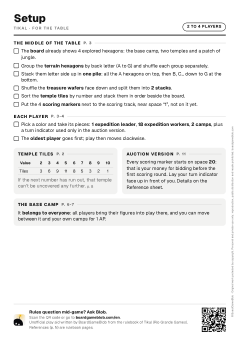 Setup
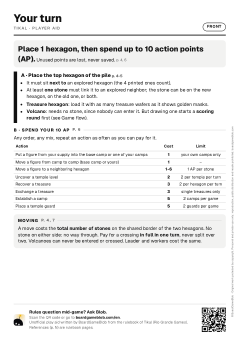 Player aid
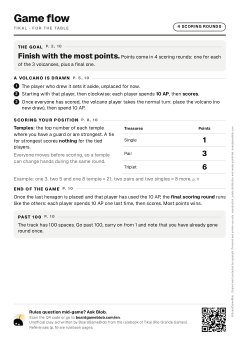 Game flow
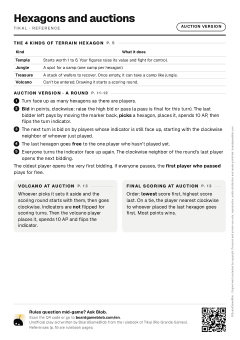 Reference
The rules in questions
From the official rulebook by Ravensburger AG. In parentheses: the rulebook’s page. How Blob answers
How many action points do you get per turn in Tikal?
You get 10 action points after placing your terrain hexagon. You may spend them in any order and combination, but any you leave unused are lost rather than carried over. (p. 6)
How much does it cost to move between hexagons?
Moving costs 1 action point for each stone on the path you cross. A three-stone path costs 3 points, paid in full in a single turn, and you can never move through a volcano. (p. 7)
How many points are treasures worth?
A lone treasure scores 1 point, a matching pair scores 3 and a set of three identical treasures scores 6, at every scoring round. (p. 8)
Does the expedition leader count more than a worker?
Yes, for majorities only. The leader counts as 3 workers when comparing strength in a hexagon, but costs the same to place and move and uncovers or recovers just like a worker. (p. 7)
What happens when someone draws a volcano?
A scoring round starts at once. The player who drew it sets it aside, spends 10 action points and scores, then everyone else does the same clockwise. Afterwards that player places the volcano and takes a normal turn. (p. 10)
Who scores a temple if two players are tied for the majority?
Nobody does. A temple only scores for a player with a guard on it or with strictly more strength there than every other player; a tie gives no points to anyone. (p. 10)
Can I uncover two temple levels or take two treasures with a single expedition member?
No. Each level uncovered and each treasure recovered needs its own member in that hexagon, and you are limited to 2 levels per temple and 2 treasures per hexagon each turn. (p. 6, 8)
What exactly happens when I place a temple guard, and what does it cost me?
For 5 points you put one of your figures on the temple, which then scores for you every remaining round. Your other figures in that hexagon leave the game, and the temple can no longer be uncovered. You may guard only 2 temples. (p. 9)
In the auction version, how do bids work and who goes last in a round?
Everyone starts with 20 points to spend. Players bid for each turn; the winner moves back on the score track and picks a displayed hexagon. The player who has not yet played takes the final turn of the round for free. (p. 11, 12)
Common mistakes
- Splitting a long path across two turnsA move between hexagons is paid in full in one turn: a path with three stones costs 3 action points at once. (p. 7)
- Sharing temple points on a tieIf the strongest expeditions in a temple hexagon are equal, none of them scores that temple. Remember the leader counts as 3. (p. 7, 10)
- Placing the volcano before scoringThe volcano is set aside first. Every player spends 10 action points and scores, and only then does the drawing player place it and take a normal turn. (p. 10)
- Skipping a temple numberTemple tiles go on in strict numeric order, even when uncovering two levels. If the next number has run out, the temple stays as it is. (p. 8)
What’s in the rulebook
See the 7 other parts
Tap a part and Blob explains it.
The game
- Players
- 2–4
- Length
- 90 min
- Age
- 10+
- Released
- 1999
- Designer
- Michael Kiesling
- Publisher
- Ravensburger AG
- Rules
- Official rulebook