Trains rules
OKAZU Brand · 2012
- Players
- 2–4
- Minutes
- 45
- Age
- 12+
Ask your question: I answer about this game’s rules.
The game in 30 seconds
You run a railway company around Tokyo or Osaka in this deck-building game. Your small starting deck earns money to buy better cards and lets you lay rails and build stations, but building often saddles you with useless Waste cards. The game stops when four Supply stacks run out, someone places all his rail tokens, or every station is on the board.
A turn, in short
- Play cards from your hand to earn money and use their effects, such as laying a rail or adding a station.
- Buy cards from the Supply with that money, in any order with playing, finishing each action before the next.
- Or pass completely to return all Waste cards in your hand to the Supply.
- Discard everything you played, bought or kept in hand, then draw five new cards.
How to win
- Most pointsAdd points from gold cards in your whole deck, points earned during play, and bonuses for rail tokens in cities with stations or remote locations. (p. 10)
- TieThe tied player with more rail tokens on the board wins; if still tied, the victory is shared. (p. 10)
Printable play aids
4 free A5 play aids for Trains, from the rulebook: step-by-step setup, a player aid for everyone, the turn sequence, and a quick reference.
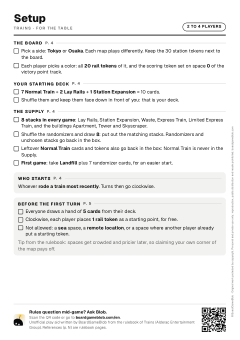 Setup
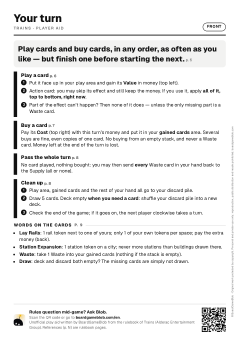 Player aid
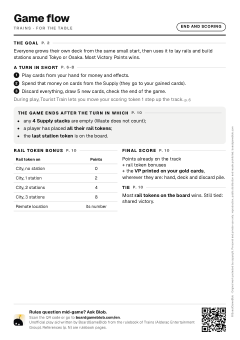 Game flow
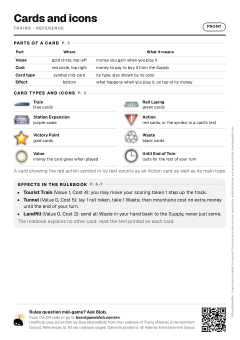 Reference
The rules in questions
From the official rulebook by OKAZU Brand. In parentheses: the rulebook’s page. How Blob answers
What cards does each player start with in Trains?
Everyone begins with a personal 10-card deck: seven Normal Train, two Lay Rails and one Station Expansion, shuffled face down. You then draw five of them as your opening hand. (p. 4)
Where can I place my first rail token?
Anywhere on the board except a sea space, a remote location, or a space where another player already put a starting token. Players choose in clockwise order after drawing their hands. (p. 5)
How much does it cost to lay rails on each type of space?
Fields are free, rivers cost 1 extra money and mountains 2. A city costs 1 plus 1 per station on it, a remote location costs its printed number, and the sea is off-limits. (p. 9)
What happens if I build in a space that already has another player's rail token?
You pay 1 extra money for each rail token already there and you also take a Waste card. These charges stack with the terrain cost, so a crowded city can get expensive. (p. 9)
How do I get rid of Waste cards?
Pass your entire turn without playing or buying anything, and you may send every Waste card in your hand back to the Supply. It is all or none: you cannot keep some. Cards like Landfill also do this. (p. 8)
Can I buy Waste cards or save money for my next turn?
No to both. Waste can never be bought, and any money you generate disappears at the end of your turn if you do not spend it. (p. 7)
If a card says to gain Waste but the Waste pile is empty, can I still use the rest of the card?
Yes. Normally an Action card works only if all its effects can happen, but running out of Waste is the one exception: you skip the Waste and still apply the other effects. (p. 6)
Does Steel Bridge also stop me from taking Waste when I lay rails on a river?
No. Steel Bridge removes the extra money for rivers, but Waste is not considered part of a cost, so you still take Waste wherever laying rails gives you one. (p. 9)
When does the game end?
The game ends after the current turn as soon as four Supply stacks other than Waste are empty, a player has placed all his rail tokens, or every station token is on the board. (p. 10)
How is a tie broken?
The tied player with more rail tokens on the board wins. If that is also equal, the tied players share the victory. (p. 10)
Common mistakes
- Keeping unspent money for the next turnMoney only lasts for the turn you generate it. Anything left over is lost when your turn ends. (p. 6)
- Playing a card bought this turnBought cards go to your gained cards area and reach your discard pile at the end of the turn, so you cannot use them right away. (p. 7)
- Treating spaces across a striped border as adjacentTwo spaces divided by the yellow and black striped border do not count as neighbours when you lay rails. (p. 9)
- Reshuffling as soon as the deck is emptyShuffle your discard pile only at the moment you must draw or reveal a card and your deck has none left. (p. 8)
What’s in the rulebook
See the 9 other parts
Tap a part and Blob explains it.
Expansions
The game
- Players
- 2–4
- Length
- 45 min
- Age
- 12+
- Released
- 2012
- Designer
- Hisashi Hayashi
- Publisher
- OKAZU Brand
- Expansions
- 7
- Rules
- Official rulebook