Unmatched: Battle of Legends, Volume One rules
Mondo Games · 2019
- Players
- 2–4
- Minutes
- 20–40
- Age
- 9+
Ask your question: I answer about this game’s rules.
The game in 30 seconds
A miniatures duel between legendary heroes, each with a unique 30-card deck and sometimes sidekicks. You move your fighters across a battlefield split into spaces and colored zones, play schemes, and attack with face-down cards your opponent may answer with a defense. The first player to bring the opposing hero down to zero health wins.
A turn, in short
- Take exactly 2 actions, the same or different: maneuver, scheme or attack.
- Maneuver: draw 1 card, then optionally move each fighter up to your move value, discarding a card to boost if you like.
- Scheme: play a lightning-bolt card face up for one of your fighters, resolve it, then discard it.
- Attack: pick a target in range, play an attack card face down, the defender may answer with a defense card, then reveal both.
- At the end of your turn, discard down to 7 cards.
How to win
- Hero defeatedAs soon as the opposing hero reaches zero health, the game stops and you win. (p. 14)
- Team gameWith 3 or 4 players, both heroes of the other team must be defeated. (p. 15)
Printable play aids
3 free A5 play aids for Unmatched: Battle of Legends, Volume One, from the rulebook: step-by-step setup, a player aid for everyone, and the turn sequence.
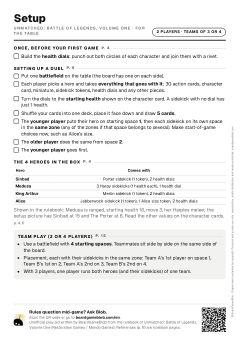 Setup
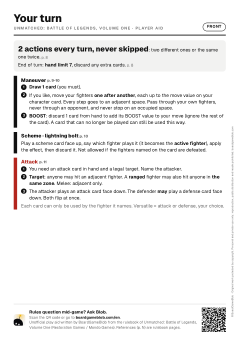 Player aid
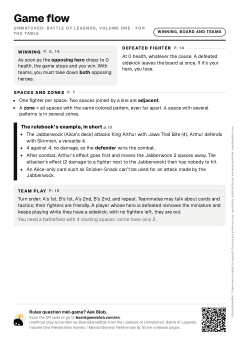 Game flow
The rules in questions
From the official rulebook by Mondo Games. In parentheses: the rulebook’s page. How Blob answers
How many actions do you take on your turn in Unmatched?
Exactly two, and you cannot skip one. Pick from maneuver, scheme and attack, and you are allowed to repeat the same action twice. (p. 8)
What happens when your deck runs out in Unmatched?
Your fighters become exhausted: you never reshuffle the discard pile, and every time you would draw, each of your fighters takes 2 damage instead. (p. 9)
What is the hand limit in Unmatched?
Seven cards, checked only at the end of your turn. You may hold more during the turn, then discard the excess to your discard pile. (p. 8, 9)
How does boosting movement work?
During a maneuver, discard one card and add its BOOST number to your move value, ignoring the card's effect. Cards whose fighters are defeated can still be discarded this way. (p. 10)
Who can a ranged fighter attack?
Any adjacent fighter, or any fighter standing in a space of the same zone, however far away. Melee fighters can only hit an adjacent space. (p. 11)
Can I move through my own fighters or my opponent's fighters?
You may pass through your own fighters but not stop on them, and you can never move through an opponent's fighter. Each space holds only one fighter. (p. 7, 9)
If both players' cards have after combat effects, which one resolves first, and does it matter who won the combat?
The defender's effect always goes first. In the rulebook example, King Arthur wins a tied combat, uses Skirmish to move the Jabberwock away, and Jaws That Bite then has nobody adjacent to hit. (p. 12, 13)
How is combat damage calculated, and who wins the combat when the attack and defense values are equal?
Damage equals the attack value minus the defense value, if a defense card was played. On a tie, no damage is dealt, so the defender wins; damage from card effects does not count toward winning. (p. 12, 13)
How do you set up and take turns in a 4-player team game of Unmatched?
Use a battlefield with four starting spaces. Heroes are placed, then turns are taken, alternating Team A first player, Team B first player, Team A second, Team B second. Beat both enemy heroes to win. (p. 15)
Common mistakes
- Taking only one actionTwo actions are required every turn, even if both are the same one. (p. 8)
- Moving through an enemy fighterYou can pass through your own fighters without stopping on them, but opposing fighters block your path. (p. 9)
- Ranged attacks outside the zoneA ranged fighter hits an adjacent fighter or one in a space sharing its zone color; melee fighters only reach adjacent spaces. (p. 11)
- Resolving the attacker's effect firstWhen two effects happen at the same moment, the defender's effect always resolves before the attacker's. (p. 12)
What’s in the rulebook
See the 8 other parts
Tap a part and Blob explains it.
The game
- Players
- 2–4
- Length
- 20–40 min
- Age
- 9+
- Released
- 2019
- Designer
- Rob Daviau
- Publisher
- Mondo Games
- Rules
- Official rulebook