Wallenstein rules
Queen Games · 2002
- Players
- 3–5
- Minutes
- 150
- Age
- 12+
Ask your question: I answer about this game’s rules.
The game in 30 seconds
A strategy game set in the Thirty Years' War where each player leads armies across five German regions. Every season you secretly assign ten actions to your counties: building, raising taxes and grain, recruiting and attacking. Battles are settled by throwing cubes into a tower that keeps some of them. After two years and two winter scorings, the most points wins.
A turn, in short
- Lay out the action cards: the first five face up, the rest hidden, and place the bonus tiles.
- Secretly cover each action box on your mat with a county card or a money card, and put a bid in your auction box.
- Draw the season's event, then reveal bids: the highest picks a bonus tile and a place in player order.
- Resolve the ten actions one at a time, each player in turn order before moving to the next action.
How to win
- On pointsCounties, buildings and regional building majorities score in each winter. After the second winter, the highest total wins, then the most Thalers. (p. 10, 12)
Printable play aids
3 free A5 play aids for Wallenstein, from the rulebook: step-by-step setup, a player aid for everyone, and the turn sequence.
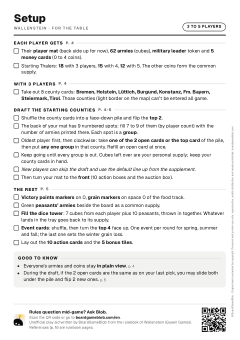 Setup
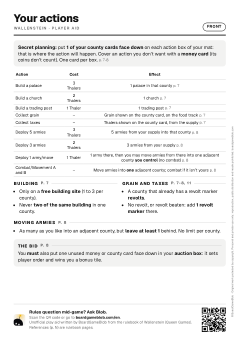 Player aid
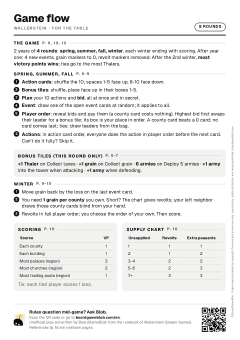 Game flow
The rules in questions
From the official rulebook by Queen Games. In parentheses: the rulebook’s page. How Blob answers
How much money does each player start with in Wallenstein?
Each player starts with 18 Thalers in a 3-player game, 15 with 4 players and 12 with 5 players. Coins that are not handed out form the common supply. (p. 4)
How many rounds does a game last?
Eight rounds over two years: spring, summer and fall, then a winter round with a scoring, played twice. The game ends after the second winter. (p. 6, 10, 12)
Which counties are removed in a 3-player game?
Eight county cards leave the game with 3 players: Holstein, Bremen, Burgund, Lüttich, Konstanz, Tirol, Steiermark and Fm. Bayern. Those counties have a light border on the map and no army may enter them. (p. 4)
How does combat with the dice tower work?
You throw every army involved, plus all cubes already sitting in the tray, into the tower. Then you count each side's cubes that came out: the side with more wins, and the winner also loses as many armies as the loser had in the tray. (p. 11-12)
What happens if a battle between two players ends in a tie?
Nobody gets the county. Both sides' armies from the tray go back to their supplies, the county is cleared of buildings, armies and revolt markers, and its card goes to the common supply. (p. 12)
When do peasants revolt?
A revolt breaks out when you collect grain or taxes in a county that already holds a revolt marker, or when you lack grain for all your counties in winter. (p. 11)
If I collect taxes in a county with no revolt marker, does anything happen?
Yes, a revolt marker is added there. A marker is also placed after you put down a revolt, so taxing or harvesting the same county again later will trigger a fight with the peasants. (p. 7-8, 11)
How are victory points scored in winter?
Each county you control and each building is worth 1 point. In every region, the most palaces earn 3 points, the most churches 2 and the most trading posts 1; tied players get one point less. (p. 10)
How is player order decided when two players bid the same amount?
Their military leader tokens go into the linen bag and are drawn one by one to set who picks first. A county card bid beats a zero money card, and players with no bid pick last. (p. 9)
Who wins if players are tied on victory points at the end?
The tied player holding more Thalers wins. Final scores are counted after the second winter round. (p. 12)
Common mistakes
- Taxing the same county twice without riskCollecting grain or taxes adds a revolt marker. If a marker is already there, the peasants rise up and you must fight them. (p. 7-8, 11)
- Doing only part of an actionIf you cannot carry out a planned action in full, you skip it entirely for that round. (p. 9)
- Keeping all your armies after winningThe winner loses as many cubes as the loser had in the tray, and only the rest move into the county. (p. 12)
- Forgetting the peasants in the trayWhen the attacked county has no revolt marker, green cubes in the tray fight on the defender's side and are removed first. (p. 12)
What’s in the rulebook
See the 8 other parts
Tap a part and Blob explains it.
Expansions
The game
- Players
- 3–5
- Length
- 150 min
- Age
- 12+
- Released
- 2002
- Designer
- Dirk Henn
- Publisher
- Queen Games
- Expansions
- 2
- Rules
- Official rulebook