Bruxelles 1893 rules
Pearl Games · 2013
- Players
- 2–5
- Minutes
- 50–125
- Age
- 13+
Ask your question: I answer about this game’s rules.
The game in 30 seconds
You are an Art Nouveau architect in Brussels. Over 5 rounds your assistants build, create and sell works of art and recruit Public Figures. Art Nouveau board actions need a coin bid that doubles as an auction for Bonus cards. Brussels board actions are free but can land an assistant in the Courthouse. Most victory points wins.
A turn, in short
- Stock Exchange: the first player flips a card and picks which part of the Art Nouveau board is open this round.
- Actions: in turn, place an assistant, with a bid on Art Nouveau or without money on Brussels, and do the action until everyone passes.
- Resolution: column auctions, new first player, Bonus cards, shield majorities, then the Brussels board majority.
- End of turn: take back free assistants, bids return to the supply, Public Figures turn upright and cards are refreshed.
How to win
- Most pointsAfter round 5, pay for kept Public Figures, then add buildings, tucked Bonus rows, noble cubes and the Manneken Pis bonus. Highest total wins. (p. 10)
Printable play aids
3 free A5 play aids for Bruxelles 1893, from the rulebook: step-by-step setup, a player aid for everyone, and the turn sequence.
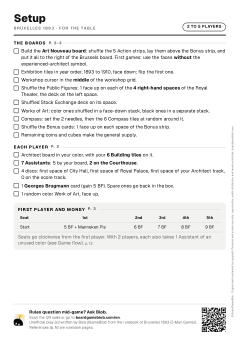 Setup
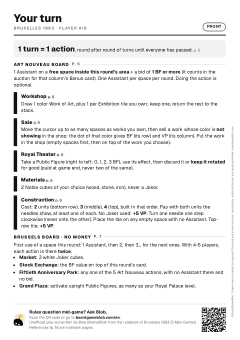 Player aid
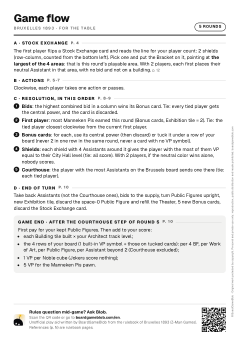 Game flow
The rules in questions
From the official rulebook by Pearl Games. In parentheses: the rulebook’s page. How Blob answers
How many rounds are there in Bruxelles 1893?
Five rounds, one per Exhibition tile. In the last round, play stops right after the Brussels board majority and you go straight to final scoring, skipping the End of Turn phase. (p. 10)
How is the available area of the Art Nouveau board chosen?
The first player flips a Stock Exchange card, reads the line for your player count and picks one of its two shields. He sets the Bracket tile there, pointing at the biggest of the four zones it creates. (p. 4)
What happens when two players tie for a column's Bonus card?
Every tied player gets the card's central power, but nobody keeps the card: it is discarded. (p. 8)
Can I pay for a building with white Joker cubes?
Yes, each Joker cube stands in for any single construction unit. Using even one, though, means you lose the 5 VP bonus for a build paid without Jokers. (p. 6)
How many assistants does a Brussels board action cost?
The first use of an action in a round takes one assistant, the next use two, then three, and so on. With 4 or 5 players each action is available twice, so the second user also needs only one. (p. 7)
Who sends an assistant to the Courthouse?
At the end of each round, whoever placed the most assistants across the four Brussels actions moves one of them to the Courthouse. If several players tie, each of them sends one. (p. 9)
What happens at the end if I can't pay for my kept Public Figure cards?
You pay the amount printed on each card you kept. For every card left unpaid, you lose that card and 5 VP on the scoring track. (p. 10)
If an opponent places an assistant on an Art Nouveau space where I built, what do I get?
You get that action's secondary effect, right after the active player finishes. For example, Sale gives you 1 VP per work of art you own, and Construction gives 1 VP per building you have on the board. (p. 11)
With the compass, how do I split a construction cost of three units?
You must pay at least one unit of each type shown by the two needles, then divide the rest freely. If one needle points at the empty space, the whole cost uses the other needle's unit. (p. 6-7)
How does the neutral assistant work in a 2-player game?
At the start of the Action phase, each player places a neutral-colored assistant, with no bid, on an empty space in the available area. It counts for shield majorities: if neutral wins one outright, no one scores it. (p. 12)
Common mistakes
- Repeating a Brussels action with one assistantThe first use in a round costs one assistant; using the same action again costs two, then three, and so on. (p. 7)
- Building a top tile too earlyYou must build the two bottom tiles of your board first, then the middle ones, and only then the top ones. (p. 6)
- Scoring a shield with fewer than 4 assistantsA shield is only scored when all four spaces around it hold an assistant. Bids do not count for this majority. (p. 9)
- Tucking two Bonus cards under one rowIn a single round you cannot put two cards in the same row, and a card without VP symbols cannot be tucked at all. (p. 9)
What’s in the rulebook
See the 6 other parts
Tap a part and Blob explains it.
The game
- Players
- 2–5
- Length
- 50–125 min
- Age
- 13+
- Released
- 2013
- Designer
- Etienne Espreman
- Publisher
- Pearl Games
- Rules
- Official rulebook