Cyclades rules
Matagot · 2009
- Players
- 2–5
- Minutes
- 60–90
- Age
- 13+
Ask your question: I answer about this game’s rules.
The game in 30 seconds
Each player leads a Greek city in the Cyclades archipelago. Every cycle you collect income, then bid gold for the favor of one God, who lets you recruit, build, sail or fight. You can also pay for Mythological Creatures. The game ends after a cycle in which someone owns 2 Metropolises.
A turn, in short
- Refresh the Creature track, then shuffle the God tiles onto the track to set this cycle's order.
- Collect 1 GP per prosperity marker you control, on your isles and on commerce spaces.
- In turn, bid on one God. If someone outbids you, bid on another God at once. Apollo is free.
- Pay your offering, then when your God comes up, take its actions in any order you like.
How to win
- Two MetropolisesOwn 2 Metropolises at the end of a cycle. If several players do, the richest in GP wins. (p. 6)
- 2 playersYou need 3 Metropolises when a cycle ends, rather than 2. (p. 6)
Printable play aids
3 free A5 play aids for Cyclades, from the rulebook: step-by-step setup, a player aid for everyone, and the turn sequence.
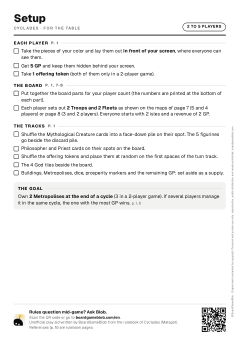 Setup
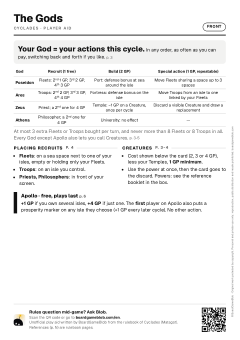 Player aid
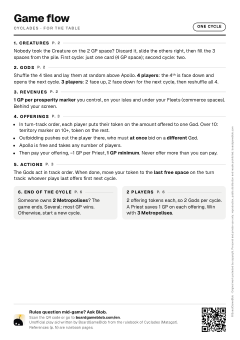 Game flow
The rules in questions
From the official rulebook by Matagot. In parentheses: the rulebook’s page. How Blob answers
How do you win Cyclades?
You win by owning two Metropolises when a cycle ends. If several players manage it in the same cycle, the one with the most gold pieces left behind their screen takes the game. (p. 6)
How much gold does each player start with?
Everyone begins with 5 GP hidden behind their screen. With the starting layout of 2 Troops and 2 Fleets, each player then holds 2 isles and earns 2 GP of revenue. (p. 1, 7)
What happens when someone outbids my offering to a God?
You remove your marker and have to switch straight away to another God. That new bid may itself oust another player, and every such chain is settled before the next player bids. (p. 3)
Can I bid more than 10 gold on a God?
Yes. Put one of your territory markers on the 10+ space and use your offering marker to show the amount above 10, so a bid of 13 is territory marker on 10+ and offering marker on 3. (p. 3)
Can several players choose Apollo in the same cycle?
Yes, Apollo is free and can be shared. Each of them gets 1 GP, or 4 GP with a single isle, but only the first one to pick Apollo receives the prosperity marker. (p. 3, 6)
Do Priests make my offering free?
No. Each Priest cuts 1 GP from the offering you pay, but you always pay at least 1 GP; only Apollo costs nothing. In a 2-player game a Priest saves 1 GP on each of your two offerings. (p. 4, 6)
Can I keep a Mythological Creature card to use on a later turn?
No. A Creature you buy must be used right away, and the card then goes face-up onto the discard pile. New Creatures only arrive at the start of each cycle. (p. 3)
If my Troops move onto an isle with a Fortress but no enemy Troops, is there a battle?
No. Landing on an isle without Troops takes it with no fight, even when a Fortress stands there. Fortresses only add 1 per building to the defender's die when a battle actually happens. (p. 5)
What happens if both armies are wiped out at the same time in a land battle?
The defender keeps the isle and marks it with a territory marker. They still collect its revenue and building effects, but it stays undefended until they recruit new Troops through Ares. (p. 5)
What changes in a 2-player game?
Each player uses both offering markers and must bid on two Gods every cycle, and may even outbid themselves. To win, a player needs 3 Metropolises when a cycle ends, not 2. (p. 6)
Common mistakes
- Buying several Priests or Philosophers in one turnZeus and Athena each give one for free, and you may buy just one more for 4 GP. (p. 4)
- Letting an emptied isle become neutralWhen your Troops leave an isle empty, you put a territory marker on it, and it stays yours until an opponent lands there. (p. 5)
- Attacking an opponent's last isleThat is forbidden unless taking it would make you win the game, for example capturing a Metropolis when you already own one. (p. 5)
- Using a Temple's discount twice in a cycleEach Temple lowers a Creature's price by 1 GP only once per cycle, and a Creature always costs you at least 1 GP. (p. 4)
What’s in the rulebook
See the 5 other parts
Tap a part and Blob explains it.
The game
- Players
- 2–5
- Length
- 60–90 min
- Age
- 13+
- Released
- 2009
- Designer
- Bruno Cathala
- Publisher
- Matagot
- Rules
- Official rulebook