Five Tribes: The Djinns of Naqala rules
Days of Wonder · 2014
- Players
- 2–4
- Minutes
- 40–80
- Age
- 13+
Ask your question: I answer about this game’s rules.
The game in 30 seconds
You compete to become Great Sultan of Naqala. The Sultanate is a grid of 30 Tiles covered with meeples from five tribes. You scoop up one Tile's meeples and sow them one by one to end on a useful Tile, use that tribe's power, then the Tile's action, and claim the Tile with a Camel if you emptied it.
A turn, in short
- At the start of each turn, players bid in Bid Order track order for a spot on the Turn Order Track; higher spots play first.
- On your turn, move your Turn marker to the Bid Order track, then pick up a Tile's meeples and sow them across neighboring Tiles.
- Take back the last meeple and all of its color on that Tile. If the Tile is now empty, place a Camel on it.
- Use the action of that tribe, then the Tile's action, and optionally sell sets of different Merchandise.
- Once everyone has played, refill the rows to 9 Resource cards and 3 Djinns.
How to win
- Most Victory PointsScore gold, Viziers, Elders, Djinns, owned Tiles with their Palm Trees and Palaces, and Merchandise sets; the highest total wins. (p. 3, 8)
- TiesThere is no tiebreaker: tied players share the title of Sultan, or play again. (p. 8)
Printable play aids
4 free A5 play aids for Five Tribes: The Djinns of Naqala, from the rulebook: step-by-step setup, a player aid for everyone, the turn sequence, and a quick reference.
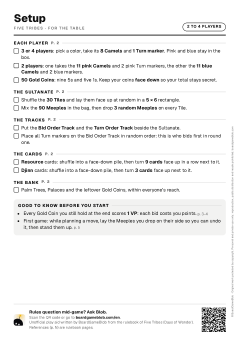 Setup
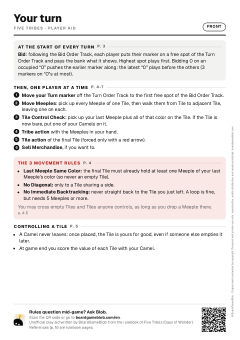 Player aid
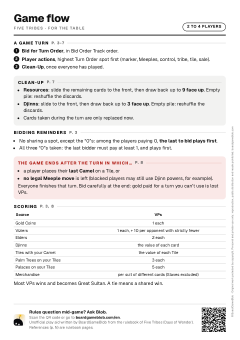 Game flow
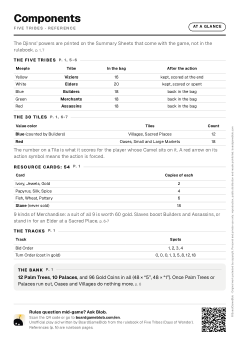 Reference
The rules in questions
From the official rulebook by Days of Wonder. In parentheses: the rulebook’s page. How Blob answers
How does bidding for turn order work in Five Tribes?
In Bid Order track order, each player picks a free spot on the Turn Order Track and pays its Gold Coin cost to the bank. Higher spots play earlier, so the biggest bid goes first. (p. 3)
What happens if several players bid 0?
Up to three players can bid 0. Each new 0 bid pushes the markers already there along, so the last player to bid 0 plays first among them and the first one plays last. (p. 3)
How do you move meeples?
Pick up every meeple on one Tile, then drop one per Tile as you travel orthogonally, never diagonally and never stepping straight back. The final meeple must land where a meeple of its color already stands. (p. 4)
Can my last meeple land on an empty Tile?
No. You may cross empty Tiles while dropping meeples, but the final one must join at least one meeple of the same color already on that Tile. (p. 4)
Can I take over a Tile that another player already controls?
No. A Camel never leaves its Tile. You may move through or empty an owned Tile, but ownership stays with the original player. (p. 5)
How many Gold Coins do Builders earn?
Count the Blue valued Tiles around your final Tile, including it, then multiply by the number of Builders you returned to the bag. Each Slave you discard adds 1 to that multiplier. (p. 6)
If my Assassins empty a second Tile, do I get two Camels and two Tile actions?
You place a Camel on both Tiles, the one you ended on first, but you only perform the action of the Tile where your move ended. If you lack Camels, the assassinated Tile goes unclaimed. (p. 6)
Are Oasis and Village actions optional, and what happens when Palm Trees or Palaces run out?
They are mandatory: an Oasis gets a Palm Tree and a Village a Palace. If the supply is empty, the action is simply skipped. Market and Sacred Place actions are optional. (p. 6-7)
How does selling Merchandise work, and can I sell Slaves?
At the end of your turn you may discard sets of all-different Merchandise for Gold Coins, from 1 for a single card up to 60 for a set of nine. Slaves can never be sold. (p. 7)
When does the game end?
The turn is finished and then the game ends, either when someone places their last Camel or when no legal meeple move remains. Scores are then totalled; ties are shared. (p. 8)
Common mistakes
- Using the action of the Tile your Assassins emptiedOnly the Tile where your last meeple landed gives you its action, even if your Assassins claimed a second Tile for you. (p. 6)
- Skipping an Oasis or Village actionThese two actions are compulsory: a Palm Tree or Palace must be placed. Markets and Sacred Places are optional. (p. 6-7)
- Refilling cards right awayResource cards and Djinns taken are only replaced during Clean-Up, after all players have taken their turn. (p. 7)
- Stealing an opponent's TileEmptying a Tile someone already owns changes nothing: a Camel never moves once placed. (p. 5)
What’s in the rulebook
Tap a part and Blob explains it.
Expansions
The game
- Players
- 2–4
- Length
- 40–80 min
- Age
- 13+
- Released
- 2014
- Designer
- Bruno Cathala
- Publisher
- Days of Wonder
- Expansions
- 3
- Rules
- Official rulebook