Deus rules
Pearl Games · 2014
- Players
- 2–4
- Minutes
- 60–90
- Age
- 14+
Ask your question: I answer about this game’s rules.
The game in 30 seconds
You grow an ancient civilization on a board made of Continent tiles. Each turn you either construct a building, whose card goes into a column of your player board and triggers every card in that column, or make an offering to a god to refresh your hand. The game nears its end when all temples are built or all barbarian villages are attacked. Most victory points wins.
A turn, in short
- Pick one action: construct a building or make an offering to the gods.
- To construct, put the card on top of its color column, pay its cost, place the matching piece on the board, then trigger the column from bottom to top.
- To make an offering, discard one or more cards, use the god of the top discarded card, then refill your hand to 5.
How to win
- Most pointsAdd your VP from play, your temples (12 each at most) and 2 VP per resource or gold majority. Highest total wins. (p. 6)
Printable play aids
3 free A5 play aids for Deus, from the rulebook: step-by-step setup, a player aid for everyone, and the turn sequence.
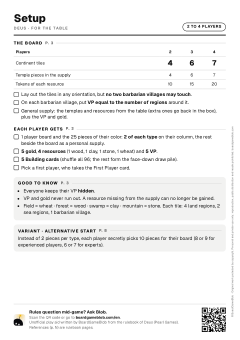 Setup
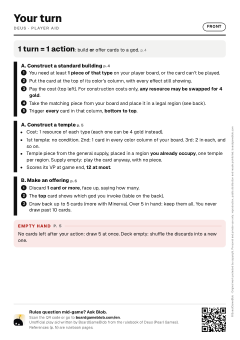 Player aid
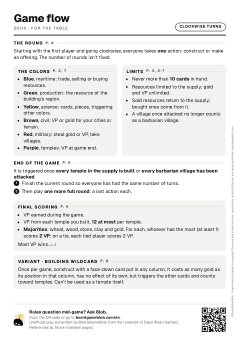 Game flow
The rules in questions
From the official rulebook by Pearl Games. In parentheses: the rulebook’s page. How Blob answers
When does a game of Deus end?
The end is triggered once every temple in the general supply is built or every barbarian village has been attacked. Players complete the current round so everyone has had the same number of turns, then play one more round with one last action each. (p. 6)
How is final scoring done in Deus?
Add the VP earned while playing, the VP from your temples (capped at 12 per temple), and 2 VP for each majority of wheat, wood, stone, clay and gold. You need at least 1 of a type to claim it, and tied players all get the 2 VP. (p. 6)
Can I pay for a building with gold instead of resources?
Yes, any resource in a construction cost can be swapped for 4 Gold, even if you own that resource. This swap only applies when paying a construction cost, temples included. (p. 4-5)
When is a barbarian village attacked?
Right after a building is placed, if every region next to the village is occupied and at least one of them holds an army. The player with the most armies there takes the village's VP; ties go to whoever has more buildings around it, otherwise the VP are split, rounded down. (p. 5)
How many cards do I draw after an offering?
You refill your hand to 5 cards, plus one extra per discarded card if you invoked Minerva. If you already hold more than 5 you keep them all, and you can never go above 10 cards. (p. 6)
Where can I place my first building?
In a region on the edge of the gameboard. If possible, each player's first region must be at least two empty regions away from the others. (p. 4)
Can two of my buildings share a region?
Yes, in a region you already control, as long as every building there is a different type, so never two civil buildings together. Temples follow the same rule: only one per city. (p. 4-5)
What can I do if I am blocked in and have nowhere to build?
You may spend 3 VP to place your building in any empty region on the edge of the gameboard. (p. 4)
What do I need on my player board to build a second or third temple in Deus?
Your first temple has no requirement. A second one requires every color column of your player board to hold at least 1 card, a third requires 2 per column, and so on. Each temple costs one resource of every type. (p. 5)
Can I still play a Temple card when no wooden temples are left, and does it count?
Yes. Unlike other cards, a Temple card can be played with an empty temple supply; you simply place no wooden temple, but the card still scores at game end. (p. 5)
Common mistakes
- Triggering the column in the wrong orderAfter constructing, every card in that column activates, starting with the lowest and finishing with the card you just added. (p. 4)
- Playing a card with no matching pieceIf your player board has no wooden piece of that type, you cannot play the card. Only Temple cards may be played when their supply runs out. (p. 4-5)
- Using the 4 Gold swap outside constructionReplacing a resource with 4 Gold is only allowed when paying a construction cost, including temples. (p. 4)
- Stopping the game as soon as it triggersFinish the current round first, then everyone gets one last full round with a final action. (p. 6)
What’s in the rulebook
See the 3 other parts
Tap a part and Blob explains it.
Expansions
The game
- Players
- 2–4
- Length
- 60–90 min
- Age
- 14+
- Released
- 2014
- Designer
- Sébastien Dujardin
- Publisher
- Pearl Games
- Expansions
- 1
- Rules
- Official rulebook