Troyes rules
Pearl Games · 2010
- Players
- 1–4
- Minutes
- 90
- Age
- 12+
Ask your question: I answer about this game’s rules.
The game in 30 seconds
You lead a wealthy family in medieval Troyes. Your citizens in the Palace, Bishopric and City Hall give you red, white and yellow dice. You use groups of dice to activate Activity cards, build the cathedral or fight events, buying opponents' dice when needed. Hidden characters score for everyone, and the most victory points wins after the last round.
A turn, in short
- In the first three rounds, reveal one new Activity card of each color.
- Take 10 deniers, then pay salaries: 1 per Bishopric citizen, 2 per Palace citizen, nothing for City Hall.
- Roll your dice and keep them on your district; the start player also rolls the neutral dice.
- Add two new events, resolve the queue from left to right, then counter the black dice with your own dice.
- In turn, spend a group of 1 to 3 same-colored dice on one action, or pass and collect deniers.
How to win
- Most victory pointsAdd event presence, tradesman spaces and all Character cards to your tokens, minus 2 for each cathedral level without your cube. (p. 8)
Printable play aids
3 free A5 play aids for Troyes, from the rulebook: step-by-step setup, a player aid for everyone, and the turn sequence.
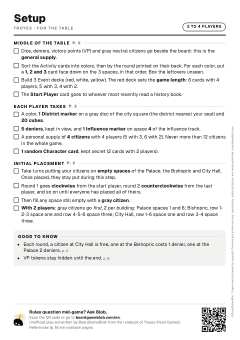 Setup
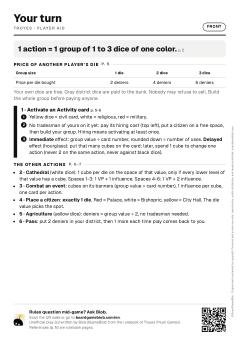 Player aid
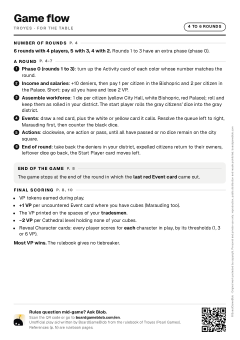 Game flow
The rules in questions
From the official rulebook by Pearl Games. In parentheses: the rulebook’s page. How Blob answers
How many rounds does a game of Troyes last?
Six rounds with 4 players, five with 3 and four with 2, set by how many red Event cards go into the deck. The game stops at the end of the round in which the last red card appears. (p. 2, 4, 8)
How much does it cost to buy another player's die in Troyes?
It depends on the size of your group: 2 deniers for a single die, 4 per bought die in a group of two, 6 per bought die in a group of three. Your own dice are free and neutral dice are paid to the bank. (p. 5)
What happens if I can't pay my citizens' salaries?
You pay whatever you can and then lose 2 VP, unless you have no VP at all. Bishopric citizens cost 1 denier each, Palace citizens 2, and City Hall citizens nothing. (p. 4)
How do you counter black dice in Troyes?
Use one or more dice from your own district whose total equals or beats the black die; red dice count double. Each black die you counter gives 1 Influence point, and failing costs 2 VP. (p. 4)
What can you spend Influence on, and is there a maximum?
One point rerolls one of your dice, two points add a citizen to your personal supply, and four points flip 1 to 3 of your dice to the opposite face. You can never hold more than 20 points. (p. 8)
If I hire a tradesman on an Activity card, do I have to use the card right away?
Yes. Hiring a tradesman obliges you to activate that card at least once in the same action. You also can never have two of your tradesmen on one card. (p. 5, 6)
How does placing a citizen on the Palace, Bishopric or City Hall work?
You spend exactly one die: red for the Palace, white for the Bishopric, yellow for City Hall. Its value picks the space or row, and someone may be pushed out and laid on the building. (p. 7)
Can I use two cubes from delayed-effect cards on the same action, or use one against black dice?
No to both. Only one cube can modify a given action, and cubes from delayed-effect Activity cards are never usable when countering black dice in the Event phase. (p. 6)
How do the Character cards score at the end of the game?
Every Character card in play scores for all players, at thresholds worth 1, 3 or 6 VP. That is why guessing which characters your opponents hold matters so much. (p. 8, 10)
Do you lose points for not building the cathedral?
Yes. At the end you lose 2 VP for each of the three cathedral levels where you have no cube, while each cube placed during play earns VP and Influence. (p. 6, 8)
Common mistakes
- Pricing a bought die before building the groupThe price of each purchased die depends on how many dice the action uses. Assemble the whole group first, then pay. (p. 5)
- Buying dice to fight black diceAgainst enemies you may only use dice from your own district, although your red dice are worth double there. (p. 4)
- Placing a citizen with several diceEntering a principal building always takes a single die of that building's color; its value chooses the space or row. (p. 7)
- Stacking two cubes on one actionA cube from a delayed-effect card modifies one action, and never more than one cube per action. They do not help against black dice. (p. 6)
What’s in the rulebook
See the 5 other parts
Tap a part and Blob explains it.
Expansions
The game
- Players
- 1–4
- Length
- 90 min
- Age
- 12+
- Released
- 2010
- Designer
- Sébastien Dujardin
- Publisher
- Pearl Games
- Expansions
- 1
- Rules
- Official rulebook