Dominant Species rules
GMT Games · 2010
- Players
- 2–6
- Minutes
- 120–240
- Age
- 14+
Ask your question: I answer about this game’s rules.
The game in 30 seconds
An ice age is coming and you play one animal class, from mammals to insects. With action pawns you adapt your animal to the elements, spread your species across the earth tiles and fight for dominance on them. Tiles earn points when they are scored. The game stops at the end of the turn in which someone takes the Ice Age card, and a last scoring of every tile crowns the winner.
A turn, in short
- Planning: in Initiative order, each player places one action pawn at a time on a free eyeball space until everyone is out of pawns.
- Execution: pawns come off the action display from top to bottom and left to right, and each owner may carry out that action.
- Reset: endangered species go extinct, the Survival Card holder scores, then the action display, cards and tile stacks are refilled.
How to win
- Most pointsAfter the Ice Age turn, every tile is scored once more with no Dominance Cards, and the highest VP total wins. (p. 20)
- TiebreakAmong tied animals, the one highest on the food chain takes the victory. (p. 20)
Printable play aids
3 free A5 play aids for Dominant Species, from the rulebook: step-by-step setup, a player aid for everyone, and the turn sequence.
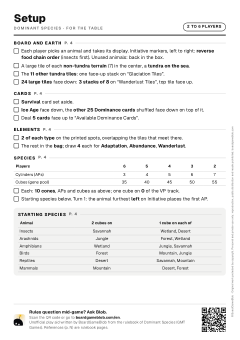 Setup
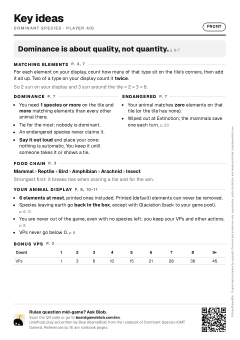 Player aid
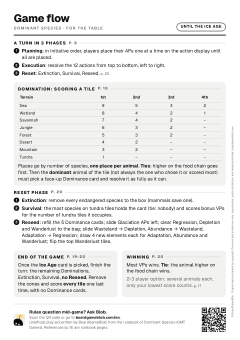 Game flow
The rules in questions
From the official rulebook by GMT Games. In parentheses: the rulebook’s page. How Blob answers
How does Dominant Species end?
The game ends after the turn in which someone takes the Ice Age Dominance Card. Players finish Domination, resolve Extinction and Survival, skip Reseed, then score every tile one final time without awarding any cards. (p. 19, 20)
Who wins a tie in Dominant Species?
The tied animal highest on the food chain wins: mammal first, then reptile, bird, amphibian, arachnid and insect. (p. 3, 20)
How do you get dominance on a tile?
You need at least one species on the tile and strictly more matching elements there than every other animal present. A tie means nobody is dominant, and endangered species can never be dominant. (p. 7)
How do you count matching elements?
For each element on your animal display, count how many of that element sit on the corners of the tile, then add the results together. Two sun on your display and three sun on a tile gives you 6. (p. 3, 6, 7)
What happens to species that are eliminated?
They go back in the box for good, not into your gene pool. The only exception is Glaciation: the extra species removed from a tile that turns to tundra return to their owners' gene pools. (p. 6, 8, 13)
How many action pawns and cubes does each player get?
It depends on the player count: 3 pawns and 35 cubes with six players, then one more pawn and five more cubes for each player fewer, up to 7 pawns and 55 cubes with two players. (p. 4)
Does the player who scores a tile with Domination always take the Dominance Card?
No. After the tile is scored, the card goes to whichever animal is dominant there, even if another player chose the tile or scored more points on it. If no animal is dominant, nobody takes a card. (p. 16)
How do the optional rules for 2 or 3 players work?
All six animals are used, so each player runs two or three of them, each with 3 pawns and 35 cubes and its own score. At the end, only each player's lowest-scoring animal counts. (p. 17)
Can birds migrate two tiles in one move, and over empty hexes?
Each bird can move up to two tiles away, passing through an adjacent tile. Birds may not cross blank hexes that have no terrain tile yet. (p. 15)
Which animals have special abilities in Dominant Species?
Reptiles have a free pawn in Regression, insects place one free species after Speciation, arachnids get a free Competition on one tile, birds migrate two tiles, and mammals save one endangered species during Extinction. (p. 11, 14, 15, 20)
Common mistakes
- Putting eliminated cubes back in the gene poolA species that leaves the earth is out of the game. Only Glaciation sends the surplus species back to the gene pools. (p. 6, 8)
- Skipping empty sections of the action displayRegression, Wasteland, Speciation and Competition still happen without pawns, because of their automatic effects or the free insect and arachnid abilities. (p. 9)
- Resolving every Glaciation pawn in the same turnOnly the leftmost pawn acts each turn. The others move one space left during Reset and wait their turn. (p. 13, 20)
- Assuming dominance updates by itselfPlayers must announce and mark any gain or loss of dominance; otherwise the existing cone stays in place. (p. 7)
What’s in the rulebook
See the 22 other parts
Tap a part and Blob explains it.
The game
- Players
- 2–6
- Length
- 120–240 min
- Age
- 14+
- Released
- 2010
- Designer
- Chad Jensen
- Publisher
- GMT Games
- Rules
- Official rulebook